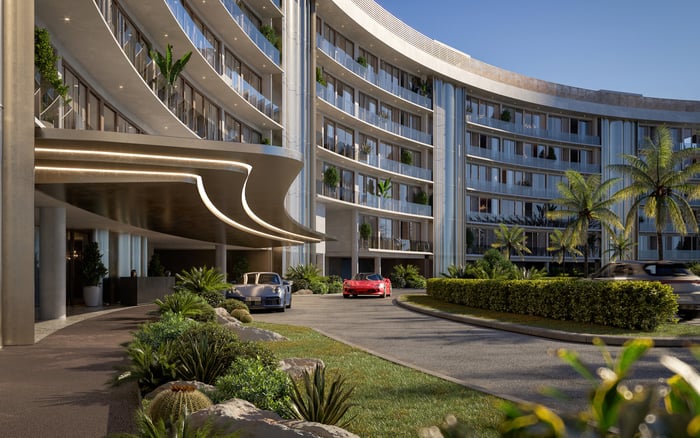
Five Miami-Dade residential candidates offer distinct starting points for private-aviation households, from full-floor privacy potential to a northern rental alternative. The decisive questions concern individual layouts, caregiver access, school-day logistics and the household’s actual private terminal.

For a family flying privately, the most valuable residential amenity may be an uneventful Tuesday: children reach school, a caregiver arrives without friction, guests retain their privacy, and the car leaves for the correct terminal without disrupting the household. A prestigious address should support that sequence, not complicate it.
The five choices below form a provisional shortlist-not a definitive ranking of aviation access or a list of five confirmed active construction sites. Their documented distinctions range from financing milestones to residence formats and rental tenure. Current construction status, availability and household suitability require project-specific confirmation.
A buyer beginning with Four Seasons Residences Coconut Grove should separate the appeal of the address from the practical question: can a particular residence accommodate the family’s daily movements comfortably and discreetly?
1. Four Seasons Private Residences Coconut Grove - Coconut Grove, Miami
Four Seasons retains first position for its documented development milestone: a reported $323.8 million in construction financing. That milestone matters when assessing project progress, but it does not establish a delivery date, move-in readiness or suitability for a particular school calendar.
For a private-aviation household, the next step is a residence-level review, not an assumption about branded service. Separate caregiver accommodation, practical school travel times and project-operated private-airport transfers are not established. Request a current floor plan and written access procedures before deciding whether the residence can comfortably accommodate children, overnight visitors and household assistance.
2. St. Regis Residences Brickell - Brickell, Miami
St. Regis is the strongest documented layout candidate here for evaluating privacy. Its documented features include full-floor and half-floor residences, private elevators, and wellness and dining offerings. The residence formats and elevator arrangements provide concrete starting points for examining how family and visitors might move through the home.
They do not establish separate staff bedrooms, secondary entrances or independent guest accommodation. Inspect where the elevator opens, how bedrooms relate to entertaining spaces, and whether a caregiver can arrive without crossing the family’s private rooms. A full-floor residence is a format, not a guarantee of household separation.
3. JEM Private Residences - Miami Worldcenter, Downtown Miami
Naftali Group obtained $465 million in financing for JEM, planned as a 67-story tower with 259 condominiums on its top 25 floors. The development program also includes 29 floors of apartments-an important distinction for buyers who might otherwise assume an exclusively condominium building.
That mix warrants precise questions about entrances, elevator access, visitor handling and the relationship between resident groups. It is not, by itself, evidence of compromised privacy. Nor do upper-floor positioning and financing establish family amenities, staff accommodation or a workable school run. Evaluate the building’s proposed operating arrangements alongside the selected residence.
4. Vista Harbor Residences & Yacht Club - Miami riverfront, central Miami
Vista Harbor provides the shortlist’s lower-rise condominium alternative, with 12 stories and 242 planned residences. Sales have reportedly launched, and the offering emphasizes a private marina lifestyle. For a household balancing time on the water with aviation, that combination warrants consideration, but the practical requirements of each still need review.
Road access to Miami International Airport and PortMiami comes without verified journey times here. Commercial-airport connectivity does not establish convenient access to a preferred private terminal or aviation operator. Review marina terms separately from airport logistics, and assess guest separation through the actual floor plan rather than the building’s height.
5. Aventana - Aventura/Ojus, Miami-Dade County
Aventana is a different proposition: a planned 16-story, 334-unit Class A rental development by Pinnacle and Ram Realty Advisors, near the Aventura Brightline station. Its rental tenure distinguishes it from the condominium candidates and may make it relevant to families considering leasing rather than purchasing.
The previously scheduled summer 2025 construction start does not confirm current construction or delivery status. Before treating Aventana as a relocation option, establish availability, lease conditions and occupancy timing. Station proximity is no substitute for testing the family’s school route or private-terminal journey, neither of which is established here.
At St. Regis® Residences Brickell, full-floor and half-floor formats make the circulation review especially relevant. Ask for a plan marked with family, guest and caregiver routes. Identify where an arriving visitor first encounters the household and whether an overnight guest must cross children’s spaces to reach shared rooms.
For buyers also considering The Residences at 1428 Brickell, apply the same questions without assuming equivalent layouts or access arrangements. The objective is not simply more square footage, but a plan that allows several routines to coexist.
Distinguish a visiting caregiver from live-in assistance. Request written policies covering credentials, permitted access hours, service-elevator procedures and overnight occupancy. A spare bedroom is not necessarily suitable caregiver accommodation, and a private elevator does not explain how household staff enter the building.
Choose the school and the private terminal before comparing routes. No standardized school travel times, assigned schools or comparative drives to Opa-locka Executive Airport are established for this shortlist. Nor should Miami International Airport serve as shorthand for a household’s preferred aviation operator.
Test the complete sequence: residence departure, vehicle collection, school drop-off and terminal arrival. Repeat it during the weekday periods that matter to the family, allowing for children at different campuses and the possibility that a caregiver travels separately. Record the return journey as well.
Ask building management how drivers wait, where passengers board and how luggage is handled. These are questions to resolve, not services to presume. Compare a school-only morning with a school-and-flight morning; the residence needs to support both if private flying is integral to family life.
Keep three decisions separate: whether the project’s timing works, whether the individual layout protects household privacy, and whether the daily travel pattern is acceptable. A financing announcement answers none of those questions completely. Neither does a marina offering, a private elevator or proximity to rail.
Before committing, assemble current plans, occupancy expectations, caregiver and guest policies, driver arrangements, and weekday travel estimates tied to the actual school and terminal. The right choice is the residence whose documented arrangements fit the family-not merely the project with the most persuasive presentation.
For a discreet discussion of your family’s Miami-Dade residential priorities, connect with MILLION.
If branded residences are on your mind — as a home or as an allocation — we would be glad to share what we are seeing, privately.
Begin a quiet conversationThey form a provisional shortlist, not a verified ranking of aviation access or household suitability. Current status, residence layouts and actual travel patterns need individual confirmation.
Its reported $323.8 million in construction financing provides a documented development milestone. That milestone does not establish delivery timing or family suitability.
St. Regis Residences Brickell is described as offering full-floor and half-floor residences and private elevators. Actual guest and caregiver separation still depends on the individual plan.
No. Buyers should review entry arrangements, access credentials and service-elevator procedures rather than assuming an independent caregiver route.
No. JEM is planned with 259 condominiums on its top 25 floors and an additional 29 floors of apartments within a 67-story tower.
Vista Harbor is planned as a lower-rise, 12-story development with 242 residences and a marina-oriented offering. Its airport connectivity does not establish verified private-terminal travel times.
No. Aventana is planned as a 334-unit Class A rental development across 16 stories in Aventura/Ojus.
No. The historical summer 2025 start forecast does not confirm current construction, delivery or leasing availability.
No comparative school-to-airport travel times are established. Test the complete weekday route using the household’s actual school and preferred private terminal.
Request current floor plans, occupancy expectations, caregiver and guest policies, service-elevator procedures and driver staging arrangements. Pair those documents with weekday school and private-terminal travel estimates.