Five Brickell and Downtown Miami inventory leads offer a starting point for a more exacting luxury search. The decisive questions concern advertised impact protection, practical post-storm access, and association records that demonstrate completed maintenance and future funding.
In Brickell and Downtown Miami, the most consequential luxury amenity may be confidence in the building itself. For buyers prioritizing strong wind protection, post-storm access, and documented coastal maintenance, the conversation should move beyond finishes and views to the records supporting the residence.
These are three distinct tests. Advertised impact glass addresses part of the wind-protection question; it does not establish whether elevators, entrances, or essential services will operate after a storm. Likewise, a maintenance charge that includes the exterior does not demonstrate that coastal repairs have been completed. Each question requires its own documentary review.
The following five entries form an ordered buyer shortlist, not a hurricane-performance ranking. Availability requires reconfirmation, and inclusion does not certify storm resilience. For a buyer considering Aston Martin Residences Downtown Miami, that distinction preserves the address's appeal while anchoring the purchase decision in evidence.
1. Aston Martin Residences: 300 Biscayne Boulevard Way
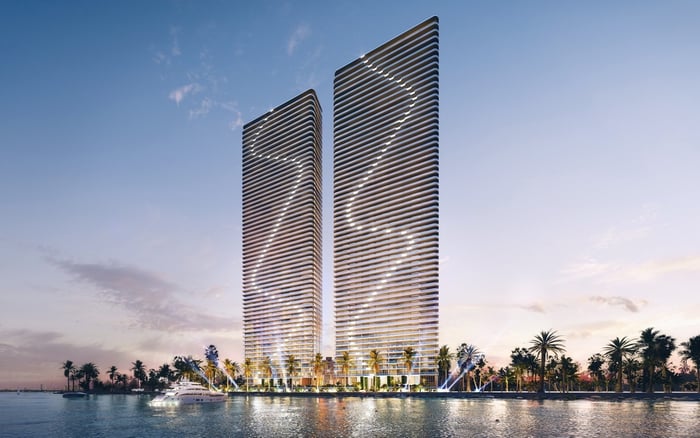
Near the Miami River in Downtown Miami, Aston Martin Residences is listed with 391 residences and 70 stories. Its recorded 2023 “Built/Estd.” year is a descriptive field, not independently verified documentation of completion or occupancy. The address is a starting point for buyers considering newer luxury inventory.
The priority is to move from building identity to building records: window and door specifications, applicable inspection documents, maintenance history, and emergency operating procedures. Neither its scale nor its recorded year establishes post-storm access or completed coastal-maintenance work.
2. 1300 S Miami Avenue, Unit 3402: advertised impact protection
This Brickell listing expressly advertises high-impact windows and impact glass-the clearest directly stated wind-protection feature among these leads. Treat that language as a feature to verify, not an engineering finding or a promise of uninterrupted occupancy.
The maintenance description includes the building exterior, security, trash removal, and all amenities. That defines stated coverage, not condition. Request the relevant glazing documentation and exterior-work records, then evaluate emergency operations separately from the unit's advertised protection.
3. 1331 Brickell Bay Drive, Apartment 606: East Brickell inventory lead
This apartment provides a concrete starting point for an East Brickell search. Its presence in luxury-condominium inventory identifies a property to investigate, not evidence of building-level storm resilience.
Before treating it as a strong match, request wind-protection specifications, association maintenance records, and the building's post-storm access procedures. Keep the residence's appeal and the association's operational condition as separate lines of inquiry until the documentation connects them.
4. 1010 Brickell Avenue: additional Brickell sale-directory lead
Properties at 1010 Brickell Avenue appear in sale-directory inventory, making the address another candidate for a document-led search. That presence does not establish wind protection, backup-power coverage, or maintenance history.
Its place on the shortlist is an invitation to compare records, not a resilience endorsement. Ask the association which documents apply to the property under consideration, and have the relevant technical material reviewed before assigning a premium for presumed storm readiness.
5. 2200 Brickell Avenue: another address for comparison
Sale-directory inventory also includes properties at 2200 Brickell Avenue. The address provides a fifth concrete search lead; confirm current availability and the specific residence before advancing.
Apply the same standard here: documentary support for wind protection, an explanation of emergency access and services, and evidence of completed maintenance. The available property details do not establish those outcomes. The decision should turn on the records obtained during diligence.
High-impact windows are useful search language, but the purchase file should be more precise. Ask which windows and doors serve the residence, what approvals and installation records are available, and whether subsequent alterations affect the original specifications. A qualified professional can assess what those documents establish.
Do not substitute neighborhood-level references to stringent hurricane codes for a building-specific assessment. A newer address is not, by itself, proof of a particular operating outcome. The same questions belong in a comparison involving 2200 Brickell: identify the claimed protection, obtain its documentation, and distinguish design specifications from current condition.
For waterfront buyers, salt-air corrosion deserves separate attention. Request inspection findings and completed repair records rather than assuming that attractive exterior surfaces establish the condition of underlying components.
Wind protection and practical access are different questions. Ask management for written storm procedures, re-entry criteria, a resident communication plan, and arrangements for assessing damage before normal operations resume. These requests clarify expectations without implying that a particular building has already demonstrated those capabilities.
Backup power warrants specificity. Request a description of any generator coverage, supported equipment, testing, and operating arrangements. Ask how elevators, entry systems, and essential services are addressed. The available property details establish neither generator coverage nor flood-barrier performance or restoration times for any of these shortlist entries.
Buyers extending their Downtown comparison to One Thousand Museum Downtown Miami should carry the same questions forward. A project name belongs in the search; an operational assurance belongs in the supporting documents.
Documented maintenance is more persuasive than a broad statement about what monthly charges include. Request dated inspections, scopes of work, completion evidence, and any professional sign-offs. For coastal structures, salt-air corrosion and post-hurricane damage assessment are relevant concerns-not findings about a residence without property-specific evidence.
Milestone inspections and Structural Integrity Reserve Studies, or SIRS, are important considerations for qualifying Florida condominium buildings of three or more stories. Confirm applicability and timing for the specific building rather than relying on a generalized coastal deadline.
Structural reserve studies address future funding for major components. Read the applicable study alongside the association's financial records and planned work. The question is not simply whether a document exists, but what it identifies and how the association intends to fund the obligations it describes.
A disciplined buyer can use this shortlist to organize requests before becoming committed to a particular view or floor plan. Confirm availability first. Then distinguish advertised features from professional findings, completed work from proposed work, and emergency procedures from guaranteed outcomes.
The strongest purchase case combines an appealing residence with clear technical and financial documentation. Where an answer remains unresolved, seek professional review before treating confidence as a feature included in the price.
For a discreet, document-led approach to your next Miami residence, explore MILLION.
If branded residences are on your mind — as a home or as an allocation — we would be glad to share what we are seeing, privately.
Begin a quiet conversationNo. It orders five inventory leads for buyer consideration, without certifying storm resilience or uninterrupted occupancy.
1300 S Miami Avenue, Unit 3402, advertises high-impact windows and impact glass. Buyers should verify the relevant specifications and installation records.
It is listed at 300 Biscayne Boulevard Way in Downtown Miami, near the Miami River.
The listed figures are 391 residences and 70 stories. Those figures do not establish storm performance.
No. Its 2023 Built/Estd. field should not be treated as independently verified completion or occupancy documentation.
No. A maintenance description identifies stated coverage, while dated work records and completion evidence help establish what was actually done.
Request written re-entry procedures, resident communication plans, and explanations of elevator and essential-service arrangements. Ask for specifics about any backup-power coverage.
It is a specific East Brickell luxury-inventory lead. Its wind specifications, post-storm access performance, and association maintenance condition are not established here.
They address future funding for major building components. They are relevant to evaluating deferred maintenance and potential assessment exposure.
No. Inventory and listing status are snapshots, so current availability and the precise residence offered should be reconfirmed.