Bentley Residences brings the private garage into the oceanfront condominium, pairing vehicle access with a more discreet arrival. Here is what the Dezervator promises, how collector-focused living shapes the design, and what buyers should confirm before committing.

The most compelling feature of a luxury residence is not always its view. Sometimes it is the transition from the outside world to home. At Bentley Residences Sunny Isles, that transition is central to the proposition: a car-elevator system designed to carry residents inside their vehicles from street level to private in-residence garages.
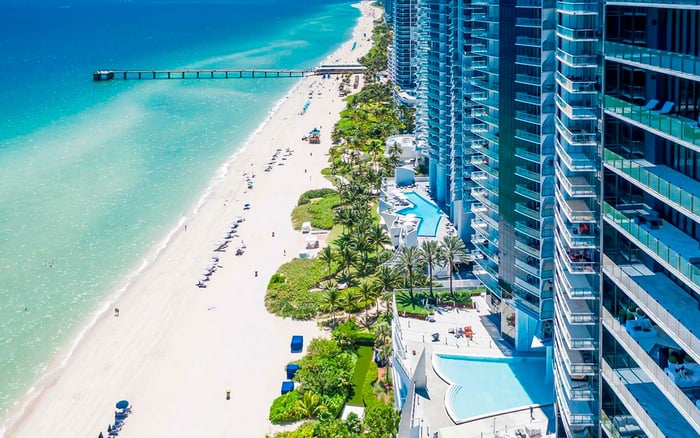
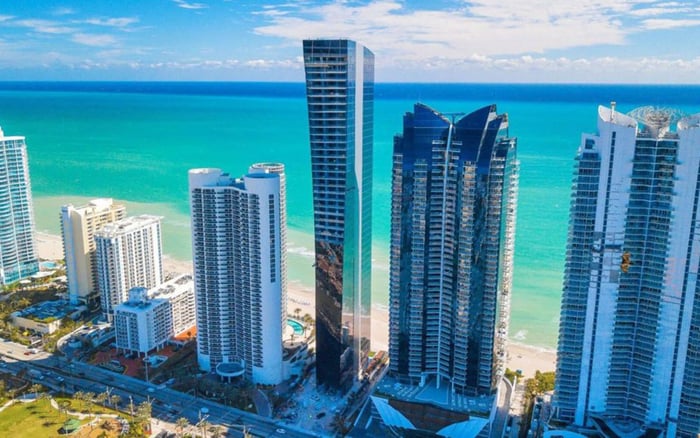
Planned for 18401 Collins Avenue in Sunny Isles Beach, the oceanfront condominium is a collaboration between Dezer Development and Bentley Motors, with architecture by Sieger Suarez Architects. Its official groundbreaking was announced on February 27, 2024, as the first Bentley-branded residential tower. Plans call for 216 private residences. Yet the project's distinction lies less in its scale than in how it brings the automobile into domestic life.
For an owner who values discretion, convenient vehicle access or a collection's visual presence, the garage becomes more than a place to park. It becomes part of the home's arrival sequence.
The signature feature is the Dezervator, a patented car-elevator system connecting street-level arrival with private garages within the residences. The planned configuration includes four hydraulic car elevators. Vehicles and passengers travel together, allowing residents to remain in their cars on the journey to their floor.
That distinction matters. Rather than parking in a conventional communal garage and continuing through shared circulation, an owner can arrive with the vehicle at the residence's private garage. The appeal is continuity: fewer transitions between driving and being home.
The standard residence concept includes multi-car garages with up to four spaces. Buyers should confirm that specification for the particular residence rather than read it as a promise for every layout. Nor should private garage access be confused with an individually dedicated elevator. The described system comprises four car elevators serving the residences.
The concept has a local precedent at the nearby Porsche Design Tower, where Dezer Development previously introduced the Dezervator. At Bentley, vehicle access is again positioned as an organizing feature of residential life rather than a conventional parking amenity.
A private car elevator is easy to understand as automotive theater. Its more enduring appeal may be practical: remaining inside a vehicle until reaching a private garage reduces the need to pass through a communal parking area.
For buyers who prefer a discreet arrival, that can be meaningful without implying absolute seclusion. Access controls, service arrangements and operational procedures still deserve scrutiny. The distinction is between an architectural promise of privacy and the details that make it work in daily use.
Convenience also warrants careful evaluation. Direct vehicle access does not establish a particular elevator wait time or guarantee uninterrupted operation. The strongest reason to consider the system is the arrival it enables, not an unverified claim that every journey will be faster.
That is a useful lens for a broader Sunny Isles search. When considering St. Regis® Residences Sunny Isles alongside Bentley, buyers should decide which aspects of arrival, privacy and daily use carry the greatest weight. Those priorities should guide the comparison before individual amenities do.
For collectors, proximity can be as important as convenience. A garage integrated into a residence changes the relationship between an automobile and its owner: the collection need not remain a separate destination below the home.
A $37.5 million penthouse presented in June 2025 illustrates the more expressive version of this idea. Its design included a glass-enclosed garage in the living room, making the cars part of the interior display. The same penthouse was presented with EV-charging capacity for up to seven vehicles.
Those details must remain distinct from the standard residence concept. Seven-vehicle charging capacity is a penthouse-specific specification, not evidence that every home offers seven parking spaces. Likewise, a glass-enclosed living-room garage should not be assumed across the building.
The design question is personal: does the owner want the collection on view or simply close at hand? The answer helps establish whether the garage is principally a convenience or an essential part of the interior composition.
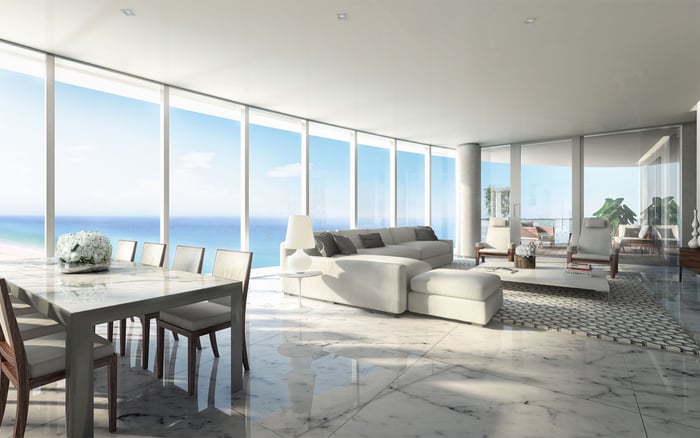
The automotive feature is only one part of the planned residential experience. Homes are marketed with private pools, expansive terraces, floor-to-ceiling glazing, and ocean or Intracoastal views. Outdoor showers and summer kitchens are also part of the marketed offering.
These elements matter because an exceptional arrival should lead to an equally considered home. Buyers should examine how the garage, living spaces and terrace relate within a specific plan rather than assess each feature in isolation. The most persuasive layout will reflect the owner's habits, including how often vehicles are used and how much outdoor space is desired.
More than 20,000 square feet of shared amenities are marketed, spanning wellness, dining and entertainment. Announced indoor facilities include a cinema, restaurant, bar, fitness center, spa and cigar lounge. A pool, cabanas and landscaped gardens are also planned. These remain planned or marketed features, not completed facilities that buyers should assume are operating.
A considered shortlist might also include Armani Casa Sunny Isles Beach, with the evaluation kept firmly on the buyer's priorities. A recognizable name is a starting point for inquiry, not a substitute for understanding a residence's layout, access and ownership obligations.
Bentley's proposition is specific: the automobile becomes part of the home's functional design. For someone who values that connection, the car elevator may carry more weight than another shared amenity. For someone who rarely drives, its importance may be secondary. Neither preference requires an investment argument to be valid.
Begin with the vehicles themselves. Confirm garage dimensions, permitted vehicle weight and length, and the applicable EV-charging specifications. A stated number of spaces does not establish compatibility with a particular collection.
Then examine operations: access controls, backup procedures and alternative arrangements during maintenance. Ask how insurance treats vehicles within the residence and how elevator maintenance costs are allocated. These are ownership questions, not incidental technicalities.
No independently verified elevator wait times, operating costs, maintenance charges or resale premiums attributable to the car elevators are established here. The decision is therefore best grounded in documented specifications and personal utility. Private arrival, immediate vehicle access and collector-focused design can be persuasive benefits without promising a financial return.
For a considered view of South Florida residences shaped around the way you live, explore MILLION.
If branded residences are on your mind — as a home or as an allocation — we would be glad to share what we are seeing, privately.
Begin a quiet conversationThe oceanfront condominium project is planned for 18401 Collins Avenue in Sunny Isles Beach, Florida.
The project is a collaboration between Dezer Development and Bentley Motors, with architecture by Sieger Suarez Architects.
The Dezervator is a patented car-elevator system designed to connect street-level arrival with private in-residence garages.
Yes. The system is designed to carry vehicles and their passengers together, allowing residents to remain inside their cars.
The planned system includes four hydraulic car elevators serving the residences. Private garage access does not mean each home has its own dedicated elevator.
The standard residence concept includes in-unit garages with up to four spaces. Buyers should confirm the capacity and dimensions of their specific residence.
No such building-wide specification is established. EV-charging capacity for up to seven vehicles was presented for a particular $37.5 million penthouse in June 2025.
Marketed features include private pools, expansive terraces, floor-to-ceiling glazing, outdoor showers and summer kitchens, with ocean or Intracoastal views.
Confirm vehicle dimensions and weight limits, charging specifications, access controls and backup procedures. Insurance treatment and maintenance-cost allocation also warrant review.
No independently verified resale premium attributable to the elevators is established here. Their value should be assessed through personal utility and documented ownership obligations.