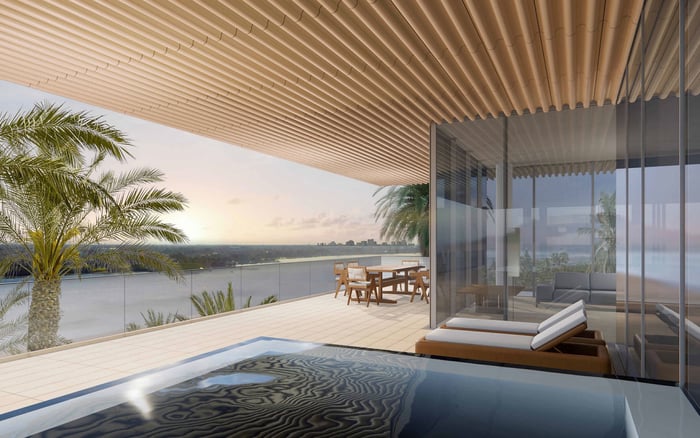
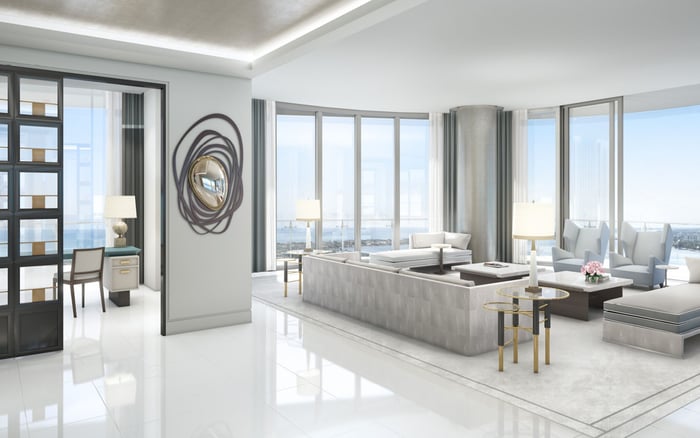
At Mandarin Oriental Residences, West Palm Beach, resale optionality may depend less on bedroom count alone than on the relationship among usable interior area, terrace scale, elevation, view width, and total ownership cost. Buyers should evaluate the exact residence rather than relying on a plan-family label.

At Mandarin Oriental Residences, West Palm Beach, a buyer evaluating future resale optionality should look beyond whether a residence is described as having two, three, or four bedrooms. The more useful question is whether its combination of interior scale, room utility, outdoor space, exposure, and ownership cost could appeal to several plausible buyer profiles.
Buyer-pool depth is not the same as broad popularity. It reflects how many qualified purchasers may find the complete proposition persuasive at the same time. A residence can be rare and impressive while still serving a narrow audience. Another may be less specialized but easier for seasonal residents, full-time households, couples, families, or owners who need flexible work and guest space to understand.
The most resilient residence may be the one that balances distinction with adaptability.
That balance should be assessed at the individual-home level. Plan names and bedroom counts are useful starting points, but they cannot reveal whether circulation is efficient, furniture placement is intuitive, the terrace functions as an outdoor room, or the view remains compelling from seated positions.
Headline square footage should be tested against how the home actually works. Buyers can begin by studying room dimensions, circulation paths, storage, furniture walls, door swings, and the relationship between living areas and outdoor space. An expansive foyer or corridor may create a sense of arrival, but it may not provide the same practical value as a well-proportioned living room, flexible den, or additional storage.
The primary living area deserves particular attention. Consider whether it can support separate seating and dining zones without interrupting movement to the terrace. Review where televisions, artwork, and larger furniture pieces could be placed in relation to glazing and doors. A visually dramatic room can still present practical limitations if the usable walls are too fragmented.
Bedroom placement also matters. Privacy between the primary suite and guest rooms can broaden the range of households that find a plan workable. Buyers should consider bathroom access, closet capacity, acoustic separation, and whether guests can move through the residence without crossing private areas.
When comparing the project with Forté on Flagler West Palm Beach, use the same measurement framework for every candidate. Separate interior and exterior area, identify spaces with genuine daily utility, and note any design feature that limits furniture placement or flexible use. This produces a more meaningful comparison than relying on a single area figure.
Bedroom count can broaden demand, but only when the rooms and surrounding layout perform convincingly. A secondary bedroom that can function as a guest room, office, media space, or private retreat may help a residence serve changing needs. That flexibility should be confirmed through dimensions, privacy, storage, natural light, and access to a suitable bathroom.
A buyer should also distinguish between theoretical capacity and comfortable occupancy. More bedrooms do not automatically create a deeper future audience if common areas feel undersized or if the added ownership cost becomes difficult to justify. Conversely, fewer bedrooms may not be limiting when the plan offers generous shared space and an adaptable room arrangement.
Test each layout against several owner profiles. Consider a couple using the home seasonally, a household living there full time, and an owner who regularly hosts guests while maintaining a dedicated workspace. The plan does not need to suit everyone, but a convincing response to more than one profile may strengthen resale optionality.
The Ritz-Carlton Residences® West Palm Beach can provide another branded-residence comparison. The objective is not to assume that two projects are interchangeable. It is to observe how buyers may weigh brand experience, room configuration, outdoor space, waterfront orientation, and the complete ownership proposition.
A water view should never be treated as a uniform feature. Its practical and emotional value can depend on orientation, elevation, width, depth, privacy, natural light, and potential obstruction. Buyers should inspect what the principal living spaces, primary bedroom, and terrace actually frame rather than relying on a broad view description.
The seated sightline is especially important. A panorama that appears open while standing may feel different from a sofa, dining chair, bed, or terrace lounge. Railings, structural elements, neighboring buildings, landscaping, and balcony geometry can affect the everyday experience without appearing prominently in a general project description.
Light conditions also deserve review. Morning and afternoon exposure can influence glare, heat, ambiance, and how frequently outdoor space feels comfortable to use. Buyers should consider their own routines rather than assuming one orientation is universally superior.
Potential development should be part of the diligence process. No purchaser should assume a view is permanently protected without reviewing the available materials and obtaining appropriate professional guidance. The relevant question is not simply whether a residence faces the water today, but how clearly its outlook and privacy can be understood before closing.
Terrace area can influence future appeal when it creates a usable extension of the interior. Shape and depth may matter as much as total area. A buyer should determine whether the outdoor space supports dining, conversation seating, circulation, and access from the rooms where those functions make sense.
Review how doors open, where furniture could be placed, and whether structural features divide the terrace into practical or awkward zones. Consider exposure to wind, sun, neighboring terraces, and mechanical or maintenance elements. An outdoor area that photographs well but is difficult to furnish may contribute less to everyday utility than a smaller, more coherent space.
The relationship between terrace and view is equally important. A well-positioned outdoor area can strengthen the experience of the living room and primary suite. If the most compelling outlook is visible only from a narrow portion of the terrace, buyers should account for that limitation when comparing alternatives.
Alba West Palm Beach is another relevant reference for buyers considering waterfront condominium living in West Palm Beach. Project comparisons can clarify priorities, but the final analysis should return to the exact residence. A change in stack, floor, orientation, room allocation, or terrace geometry can materially change how a home functions and whom it may attract later.
Create a consistent comparison sheet for every candidate. Record interior and exterior area separately, then note bedroom utility, storage, privacy, terrace function, view direction, visible obstructions, and the rooms from which the principal outlook can be enjoyed. Add the complete acquisition and recurring ownership costs only after confirming them in current documentation.
Avoid treating price per square foot as a complete conclusion. That metric does not independently account for outdoor space, plan efficiency, view quality, condition, services, or recurring costs. It can be one comparison point, but it should sit within a broader residence-specific analysis.
Obtain the current buyer materials and confirm the exact stack, floor, exposure, dimensions, interior area, exterior area, bedroom configuration, specifications, fees, pricing, and availability. Marketing labels should not replace dimensioned plans, written disclosures, governing documents, contracts, or advice from appropriate professionals.
Model carrying costs for the specific home rather than relying on a building-wide assumption. Added scale, outdoor space, or elevation may strengthen appeal, but the benefit should remain coherent with the complete cost of ownership. A future purchaser is likely to compare the total proposition rather than one design feature in isolation.
Finally, identify the residence’s strongest source of distinction and its most meaningful limitation. A clear view corridor, efficient layout, useful terrace, or adaptable room can support demand, while awkward circulation, compromised privacy, or a difficult cost-to-utility relationship can narrow it. The strongest choice is not automatically the largest home or the one with the highest bedroom count; it is the residence whose qualities work together convincingly.
For private guidance on comparing residences, layouts, and view lines, connect with MILLION.
If branded residences are on your mind — as a home or as an allocation — we would be glad to share what we are seeing, privately.
Begin a quiet conversationBedroom count does not reveal layout efficiency, privacy, terrace utility, view quality, or total ownership cost. Those factors can shape how many future buyers find a residence suitable.
Review room dimensions, circulation, storage, furniture walls, and the relationship between indoor and outdoor spaces. Usable proportions can matter more than a headline area figure.
It may broaden the range of potential uses when its dimensions, privacy, light, storage, and bathroom access are practical.
No. Greater scale can increase distinction while the associated acquisition and ownership costs may narrow the future audience.
No. Orientation, elevation, view width, privacy, natural light, and potential obstructions can distinguish one residence from another.
Railings, structural elements, and neighboring features may affect the view from sofas, beds, dining chairs, or terrace seating.
Useful depth, coherent shape, convenient access, furniture capacity, privacy, and a strong relationship with interior rooms all contribute to terrace utility.
Use a consistent framework covering interior and exterior area, layout efficiency, terrace function, view quality, and complete ownership costs.
Confirm the exact stack, floor, exposure, dimensions, specifications, fees, pricing, availability, and potential obstructions in current materials.
No. Resale performance cannot be guaranteed, and buyers should assess the complete residence with appropriate professional guidance.