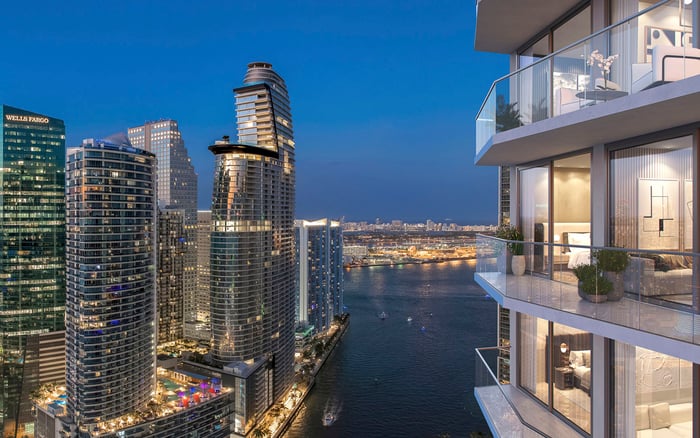
A precise buyer’s guide to distinguishing baseline residential amenities, club privileges and individually billed services at Faena Residences Miami.

For buyers evaluating Faena Residences Miami Downtown Miami, the central amenity question is not simply what may be available. It is which privileges are funded through recurring ownership costs, which require reservations or usage fees and which may depend on a separate membership.
That distinction is especially important when hospitality language blurs the line between access and payment. A concierge may be able to arrange a service without the underlying service being complimentary. Likewise, access to a wellness setting does not by itself establish that treatments, classes or other offerings are covered by common charges.
Buyers should treat renderings, amenity menus and sales presentations as descriptions of an intended lifestyle rather than final evidence of what an assessment covers. The controlling documents and written fee schedules should resolve the cost treatment.
Access is a privilege to use or book something, not proof that its cost is included.
Before contract execution, request a written matrix assigning every promoted feature to one of four categories: HOA-included, usage-capped, pay-per-use or membership-only. This framework turns an expansive amenity narrative into a practical ownership model.
HOA-included amenities are facilities or staffing supported by common charges. Usage-capped benefits cover only a defined number of visits, hours or reservations. Pay-per-use services generate a charge when ordered. Membership-only offerings may require initiation fees, annual dues or a separate agreement.
Apply the same method when comparing other Downtown Miami properties, including Aston Martin Residences Downtown Miami and Waldorf Astoria Residences Downtown Miami. Compare governing documents, proposed budgets and written schedules rather than amenity counts alone.
A useful rule is to divide every amenity into three layers: the physical space, routine staffing and the transaction taking place within it. Pool access, for example, could have a different cost treatment from food, beverages, reserved seating or private-event use. A cabana or daybed could also be governed by reservation rules, rental charges, minimum spends or cancellation terms.
Use the same analysis for spa and fitness offerings. Ask whether access to physical facilities is included and whether treatments, classes, appointments or specialized services carry separate prices. Request a line-by-line schedule identifying complimentary access, resident pricing and outside-vendor charges.
Private-chef services, in-home dining, catering and grocery provisioning should be treated as optional unless the controlling documents state otherwise. Request rates, service charges, gratuity practices, minimum spends and cancellation terms. “Fully serviced” may describe the availability and coordination of assistance without promising unlimited housekeeping or dining within common charges.
If any club privileges are presented during the sales process, establish whether participation is permanently bundled with ownership, introductory, optional or subject to initiation fees and annual dues. Ask whether the applicable agreement can be changed separately from the condominium documents.
Request precise definitions for “access,” “preferred access,” “resident pricing” and “priority booking.” These phrases may describe eligibility to reserve, a scheduling advantage or a discount rather than complimentary use. Do not import the fee structure of another property into the analysis of Faena Residences Miami.
Any discussion of Faena House Miami Beach may help frame questions about brand-related hospitality language, but another South Florida property’s costs and privileges do not determine the structure in Downtown Miami.
For every concierge-arranged offering, clarify whether coordination is covered while vendors, tickets, merchandise, transportation or other underlying costs remain separately billed. Request written guidance rather than assuming that availability means inclusion.
Ask whether booking fees, administrative surcharges, gratuities or cancellation penalties apply. For transportation, determine whether any service is included, limited by time or geography, or priced by trip. For housekeeping, request rates by residence size and service level. For culinary arrangements, ask about labor, ingredients, staffing, rentals and minimum spends.
Valet and parking deserve their own schedule. Confirm the treatment of resident vehicles, guest parking, overnight parking, detailing and storage, along with any customary gratuities. Separate any common staffing expense from optional vehicle services charged directly to an owner or guest.
A common space can be accessible to residents while still carrying charges under particular conditions. Ask whether ordinary use is included, how far in advance reservations open, whether hourly limits apply and whether guests affect eligibility or price.
Then test the private-event scenario. Exclusive room use may trigger cleaning, catering, security, technical-support or staffing fees even when casual access is included. Request rules for deposits, cancellations, guest limits and outside vendors. For buyers comparing amenity-rich pre-construction properties such as Casa Bella by B&B Italia Downtown Miami, this operational detail can be more useful than the number of spaces shown in a presentation.
The final allocation among HOA-funded amenities, metered use, optional services and membership-only privileges should be confirmed in the purchase agreement, condominium declaration, operating budget and any separate club, spa or service agreements. If a sales representation matters to the purchase, request written confirmation that it aligns with the controlling documents.
Review whether the budget accounts for the staffing and operations associated with promoted amenities. Identify assumptions concerning vendor contracts and any food-and-beverage operations. Ask how fees may change, who controls pricing, whether memberships transfer upon resale and whether owners can opt out of optional programs.
Prepare a final pre-signing schedule with columns for provider, included access, usage limit, reservation rule, current fee, gratuity, cancellation charge and governing document. The goal is not to diminish the amenity proposition but to understand its recurring and per-use costs with precision.
For a private review of Faena Residences Miami and other South Florida opportunities, connect with MILLION.
If branded residences are on your mind — as a home or as an allocation — we would be glad to share what we are seeing, privately.
Begin a quiet conversationNot necessarily. Confirm each amenity’s cost treatment in the governing documents, budget and written fee schedules.
Ask for a written matrix classifying each feature as HOA-included, usage-capped, pay-per-use or membership-only.
That should be confirmed in writing. Determine whether participation is permanent, introductory, optional or subject to separate fees and dues.
Not necessarily. Distinguish access to physical facilities from separately priced treatments, classes and appointments.
Do not assume they are included. Request rates, service charges, gratuity practices, minimum spends and cancellation terms.
No. Coordination may have a different cost treatment from transportation, dining, shopping and third-party services.
Yes. Ask whether reservations, rentals, minimum spends, time limits or cancellation charges apply.
Confirm the treatment of resident vehicles, guests, overnight parking, gratuities, detailing and storage.
Yes. Exclusive use may involve cleaning, catering, staffing, security or technical-support charges even when ordinary access is included.
Review the purchase agreement, condominium declaration, operating budget and any separate club, spa or service agreements.