A buyer-focused comparison of two branded residential models, examining how arrivals, public access and hotel traffic may shape privacy in daily ownership.
For buyers considering South Florida’s branded residences, privacy is no longer measured solely by elevator access or the distance between neighboring homes. It begins at the curb, continues through the lobby and parking arrival, and extends to amenity floors, service passages, and guest policies. The central question is not simply whether a property carries a hospitality name, but how many groups use the building, where their paths intersect, and who controls those intersections.
Banyan Tree Residences West Palm Beach and Delano Residences & Hotel Miami present a particularly useful contrast. Banyan Tree is conceived as residential-only, offering hotel-level amenities without a transient hotel population. Delano is planned as a hotel-integrated development, with distinct entrances designed to organize residents, hotel guests, and the general public.
The decisive luxury is not merely a private entrance, but a circulation system that preserves privacy throughout the day.
Neither model is inherently superior. Each speaks to a different lifestyle preference. One prioritizes a quieter residential ecosystem; the other introduces the energy and service environment of a hotel while seeking to protect the owner experience through separation.
Planned for 400 Hibiscus Street in downtown West Palm Beach, Banyan Tree is an 88-residence, 25-story condominium with one- to four-bedroom homes and penthouses. It also represents Banyan Group’s first residential project in the United States. Its most consequential privacy feature is structural rather than decorative: no on-site hotel operation will generate daily check-ins, departures, and guest-room traffic.
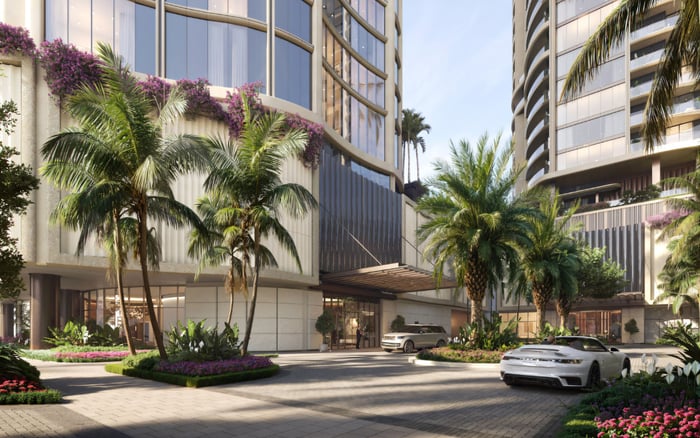
The arrival program includes a private porte cochère and 24-hour concierge. The principal groups moving through the property will therefore be residents, their invited guests, staff, and controlled visitors associated with the restaurant or club. Ground-floor retail, a restaurant, and a 5,700-square-foot rooftop private club mean the building is not sealed off from outside activity. Still, these uses differ from the continuous turnover created by hotel rooms.
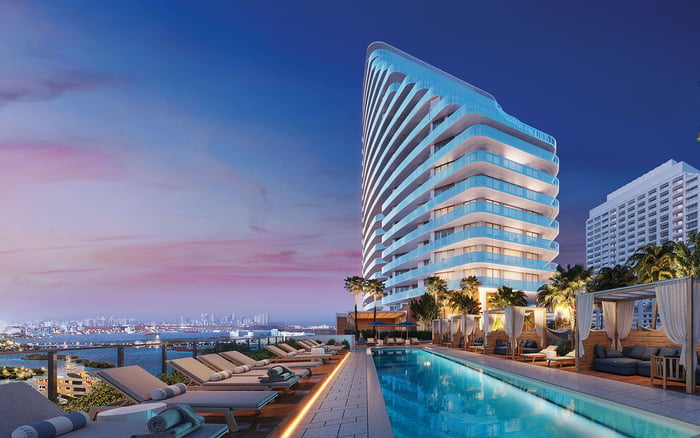
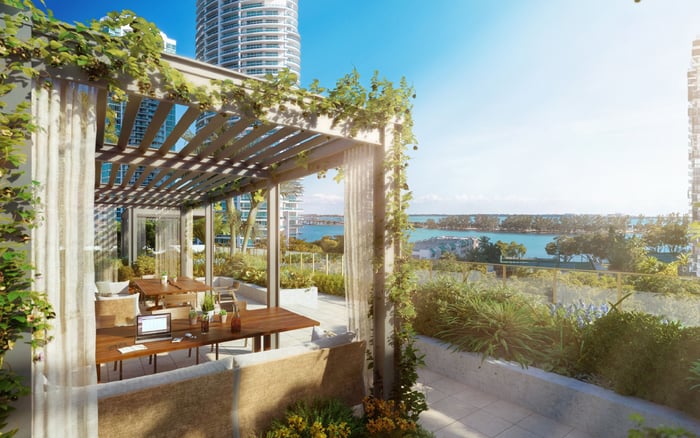
An entire amenity floor is dedicated to wellbeing, with a full-service spa, reflection garden, meditation spaces, hammam, steam room, sauna, cold plunge, and treatment facilities. Indoor and outdoor fitness areas, a resort-style pool, cabanas, lounges, an open-air cinema, children’s spaces, and recreation rooms further support the hotel-caliber proposition. The appeal lies in receiving this breadth without routinely sharing residential circulation with transient guests.
The Sanctuary Club extends owner benefits beyond the building, connecting residents with more than 100 Banyan Group hotels and resorts and over 140 spas and galleries worldwide. Conceptually, it separates global hospitality access from the privacy of everyday life at home. Among new-construction options in West Palm Beach, that distinction may be especially persuasive to buyers who want service without living above a working hotel.
At 400 Biscayne Boulevard in Downtown Miami, Delano adopts the more complex condo-hotel proposition. Hotel guests and public visitors are part of the development’s operating reality, making privacy dependent on how effectively their paths are separated from those of residence owners.
The disclosed plan calls for three access points: one for residents, one for hotel guests, and one for the general public. Owners are promised a dedicated residential entrance reserved exclusively for them and separated from the hotel portion. This is an important first filter, helping preserve the character of coming home even when another part of the property is animated by arrivals and public activity.
Delano’s residential sky homes will not permit daily rentals. That limitation should reduce short-stay turnover within the residential component, even though the broader development includes a hotel. It does not remove hotel traffic from the site, but it establishes a meaningful distinction between a stable owner population and transient hotel occupancy.
The unresolved issue is how far that separation continues beyond the entrance. Available details do not establish a complete amenity-access matrix or confirm whether every elevator bank, parking route, loading area, service corridor, and back-of-house connection is divided. Buyers should therefore regard the three-entry plan as a strong organizing principle, not proof that every operational path is independent.
Public access can enrich a branded property when restaurants, lounges, or retail create atmosphere and convenience. It can also generate friction if visitors cross residential arrival zones or compete for elevators, parking, and staff attention. The important distinction is not simply public versus private, but whether public uses have their own intuitive entry, vertical circulation, and service support.
At Banyan Tree, the principal public-facing interfaces are the ground-floor restaurant and retail-not a hotel lobby and guest-room operation. The property’s rooftop club is private. At Delano, a dedicated public entrance is intended to prevent general visitors from using the residential arrival point. The precise venues accessible from that entrance, and their internal connections, should be verified in the governing plans and condominium documents.
Buyers comparing a broader hospitality set, including Four Seasons Hotel & Private Residences Fort Lauderdale and Waldorf Astoria Residences Downtown Miami, should apply the same discipline. A celebrated brand may shape service and design, but it does not determine who may enter each space, which route they take, or whether access rules can later change.
Marketing language such as “private residential entrance” is valuable, but buyers need the operating details behind it. The condominium declaration, exhibits, easements, and management agreements should identify resident-only areas, hotel or club access rights, public pathways, and the authority responsible for security.
Particular attention should be paid to elevator banks, garage entry and valet procedures, loading zones, staff circulation, and delivery protocols. Buyers should also ask whether residential guests may use hotel facilities, whether hotel guests may enter residential amenities, and how access is monitored. If an amenity is shared, the documents should explain reservation priority, capacity controls, hours, and cost allocation.
Future flexibility matters as much as opening-day plans. Public easements, commercial leases, and rights granted to a hotel operator can affect noise, staffing, and circulation over time. The essential inquiry is whether resident protections are embedded in binding documents or left to operating custom.
Banyan Tree offers the simpler privacy proposition. By omitting a hotel, it reduces the number of recurring user groups and removes routine hotel check-in traffic from the equation. It is suited to an owner who values sanctuary, predictable circulation, and extensive wellness amenities within a residential setting.
Delano offers a more socially active hospitality environment. Its three-entry concept and prohibition on daily rentals within the sky homes are meaningful safeguards, but the quality of privacy will depend on execution across elevators, amenities, parking, and service routes. It may appeal to an owner who welcomes hotel energy yet expects a clearly defended residential domain.
The refined choice is therefore not between service and privacy. It is between privacy created by limiting outside populations and privacy created by carefully managing them. For discreet guidance comparing South Florida’s branded residential opportunities, connect with MILLION.
If branded residences are on your mind — as a home or as an allocation — we would be glad to share what we are seeing, privately.
Begin a quiet conversationBanyan Tree omits an on-site hotel, while Delano manages hotel and public traffic through separate planned entrances.
Yes. It is conceived as a residential-only property with hotel-level amenities and no transient hotel guests.
Banyan Tree Residences West Palm Beach is planned with 88 residences in a 25-story tower.
Yes. Its identified public-facing spaces include ground-floor retail and a restaurant, while its rooftop club is private.
Delano is planned with three separate access points for residents, hotel guests and the general public.
Yes. The plan promises an exclusively residential entrance separated from the hotel portion of the development.
No. Daily rentals are not planned to be permitted within the residential sky homes.
No. Buyers should also verify elevator banks, parking routes, service corridors, amenity access and security procedures.
No complete amenity-access matrix is established, so buyers should confirm which spaces are residential-only, hotel-only or shared.
Review the condominium declaration, exhibits, easements and management agreements for access rights, public pathways, security rules and authority over future changes.