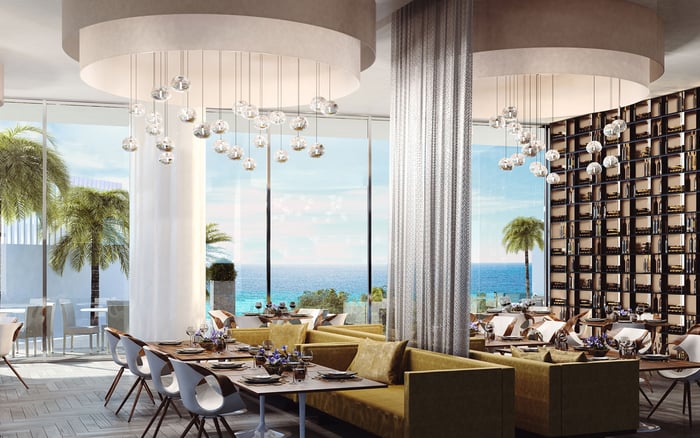
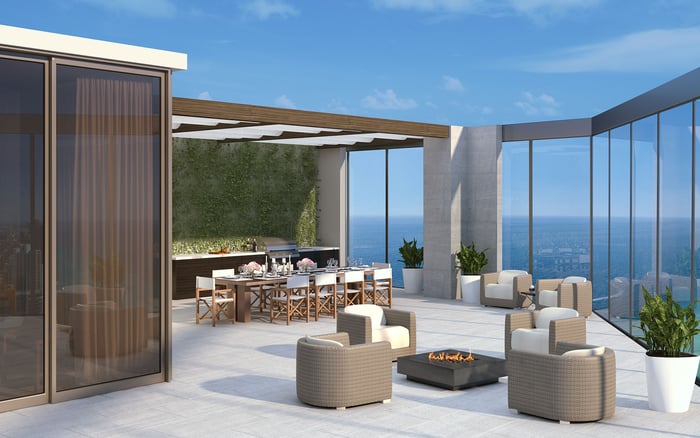
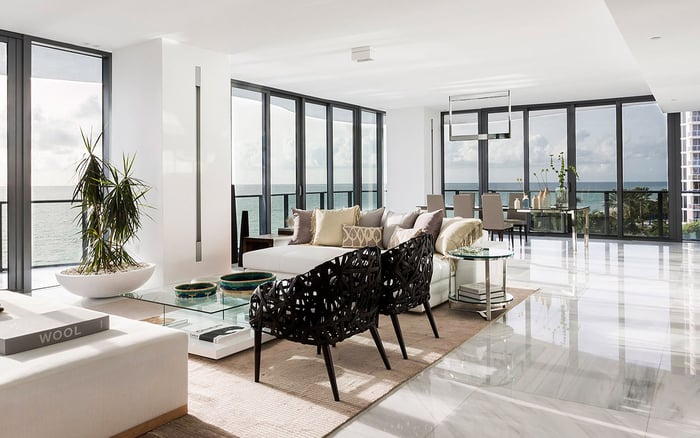
A collector-focused guide to evaluating light, display walls, art handling, security, and environmental control at St. Regis Residences Sunny Isles.
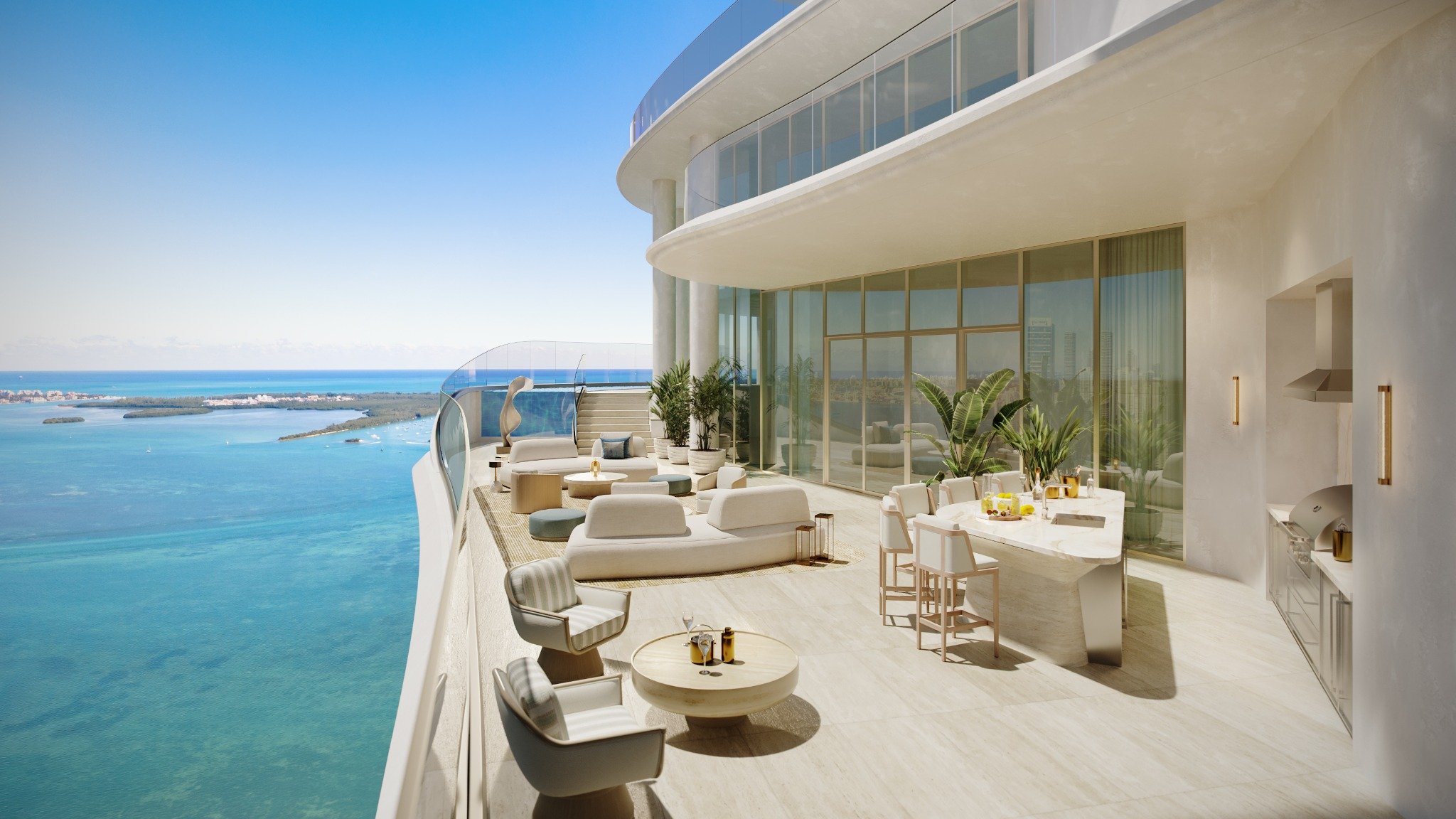
At 18801 Collins Avenue, St. Regis® Residences Sunny Isles presents an unusually compelling proposition: an oceanfront home defined by expansive glass, panoramic water and city views, and the service language of branded residences. Developed by Fortune International Group and Château Group, the project offers residences spanning approximately 1,785 square feet to more than 10,000 square feet, depending on unit type.
For an art collector, however, square footage is only the opening metric. More consequential questions concern usable wall length, daylight exposure, circulation, installation access, security procedures, and environmental stability. This buyer's guide applies a design-and-architecture standard to new-construction due diligence, separating visual appeal from the technical conditions a collection may require.
Floor-to-ceiling impact glass frames panoramic outlooks across the ocean, city, and Intracoastal. It also reduces the number of uninterrupted walls available for paintings, photography, textiles, and wall-mounted sculpture. A generous great room may therefore offer less exhibition capacity than its area suggests.
Plans include two-bedroom-plus-den configurations of 2,078 and 2,888 square feet, alongside layouts of roughly 1,950 to 2,200 square feet and larger plans of about 3,500 to 4,680 square feet. Yet precise wall dimensions are not available for every room. Buyers should commission a scaled art-placement study for the specific stack under consideration, mapping glazing, doors, millwork, controls, switches, mechanical grilles, and circulation clearances.
Standard residences have 10-foot ceilings, while penthouses have 12-foot ceilings. That distinction can be meaningful for vertically scaled works, but ceiling height alone does not establish usable hanging height. Reflected ceiling plans and interior elevations can reveal soffits, shade pockets, lighting positions, and other constraints.
Abundant daylight is integral to the appeal, but impact resistance should not be mistaken for conservation-grade ultraviolet protection. Artwork-specific ultraviolet and visible-light transmission values for the glazing are not established. Collectors should request the exact glass specification and have a conservation professional interpret it for the collection's media and sensitivity.
Orientation and daily sun patterns should guide placement. Works on paper, photographs, textiles, and certain pigments may warrant positions away from direct exposure, while less sensitive objects may be suitable nearer the glass. Buyers should also confirm whether motorized shades are standard, optional, or owner-installed-and whether power, controls, and recessed pockets are incorporated.
The objective is not to darken an oceanfront residence. It is to create layers of control that allow views and art to coexist. Dimmable artificial lighting, carefully selected beam angles, and shade scenes can help maintain that balance without assuming one treatment suits every work.
Private elevator access and a dedicated service elevator create a promising framework for discreet art movement. Before acquiring a home, request the service elevator's clear door opening, cab dimensions, weight limit, turning radii, loading access, delivery hours, and protection requirements. Oversized works must be tested against the complete route, not merely the elevator interior.
The service program includes 24/7 concierge access, doorman service, valet parking, St. Regis butler service, and 24/7 property access control. These services provide a valuable baseline, but collectors should separately establish procedures for advance crew registration, certificates of insurance, supervised receiving, camera coverage, temporary holding, crate disposal, and after-hours installation.
A “Workshop & art room” is the clearest identified art-related amenity. Its presence should not be interpreted as confirmation of secure art storage, conservation facilities, or private installation support. Its intended use, access rules, equipment, and environmental conditions require direct verification.
Museum-grade climate-control performance is not established. A collector should ask how the HVAC system is zoned, where thermostats and sensors are located, and what humidity stability can be achieved in principal display areas throughout the year. Average comfort is not equivalent to a narrow, consistently maintained environment.
An independent HVAC consultant can evaluate whether supplemental dehumidification, revised air distribution, or discreet monitoring would be appropriate. Battery-backed data loggers can also document temperature and relative-humidity patterns before moisture-sensitive paintings, wood objects, textiles, or works on paper are installed. Any intervention should be coordinated with building requirements and the residence's mechanical design.
Sunny Isles Beach offers several luxury towers that collectors may evaluate through the same technical lens. At Bentley Residences Sunny Isles, Jade Signature Sunny Isles Beach, and Muse Residences Sunny Isles Beach, the useful exercise is not to assume equivalence, but to ask the same questions about wall geometry, glazing, elevator access, receiving procedures, security, and HVAC control.
A disciplined comparison should use the same inventory of works and scaled templates for every candidate residence. That approach turns an emotional viewing into a practical test: Which plan accommodates the collection with the fewest compromises while preserving the light and outlook that made the home attractive?
Request dimensioned plans, interior elevations, reflected ceiling plans, glazing data, shade specifications, and mechanical zoning information. Ask management for written delivery and installation protocols, then have an art handler validate the route for the collection's largest crate.
Finally, distinguish among what is included, what can be customized, and what requires approval. The best residence may not be the largest. It may be the stack with the most coherent display sequence, manageable daylight, discreet service access, and sufficient environmental control to support the collection responsibly.
Does the impact glass provide conservation-grade UV protection? Artwork-focused ultraviolet performance is not specified. Request visible-light and UV-transmission values for professional review.
Are wall dimensions available for every room? Complete room-by-room wall dimensions are not available. Commission a stack-specific measured study before planning installations.
Do penthouses offer more display height? Penthouses have 12-foot ceilings, compared with 10-foot ceilings in standard residences. Soffits and other interruptions still require review.
Can large artworks use the service elevator? A dedicated service elevator is specified, but cab size, door clearance, weight limits, and route geometry should be confirmed.
Is there an art amenity in the building? A Workshop & art room is listed. Buyers should verify its intended use rather than assume it supports storage or conservation.
Does 24/7 access control cover artwork receiving? Not necessarily. Confirm crew registration, camera coverage, supervised receiving, temporary holding, and delivery procedures separately.
Are motorized shades included? Their status is not clearly established. Ask whether shades, pockets, wiring, and controls are standard or optional.
Is the HVAC system museum-grade? Museum-grade performance is not established. Verify zoning and achievable humidity stability with an independent specialist.
Which works need the most daylight caution? Works on paper, photographs, textiles, and light-sensitive pigments commonly merit conservative placement and professional guidance.
What should a collector review before signing? Review scaled plans, glazing data, shade provisions, HVAC capabilities, elevator dimensions, and written security and installation protocols.
If you'd like a private walkthrough and a curated shortlist, connect with MILLION.
If branded residences are on your mind — as a home or as an allocation — we would be glad to share what we are seeing, privately.
Begin a quiet conversation