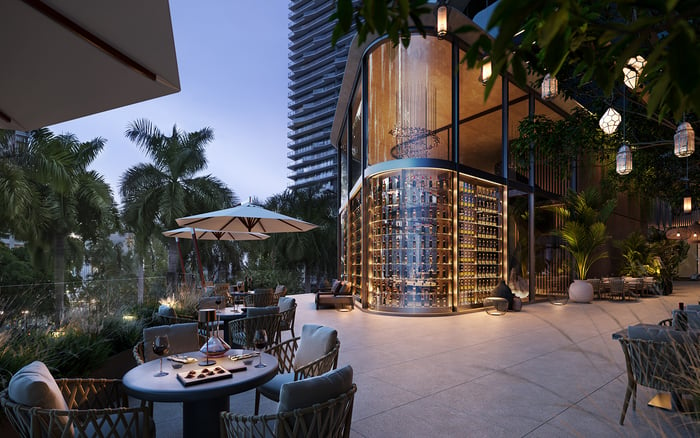
A due-diligence guide for art collectors considering ORA by Casa Tua Brickell, focused on residence-specific questions about daylight, usable walls, installation access, security, climate control, and backup power.

Evaluating ORA by Casa Tua Brickell through an art collector’s lens requires residence-specific review. Buyers should examine the exact floor plan, orientation, glazing configuration, wall dimensions, building systems, delivery route, and operating procedures before deciding whether a home suits a particular collection.
The central issue is compatibility. Paintings, photography, works on paper, textiles, and sculpture can have different display, lighting, handling, security, and environmental needs. A qualified conservator, collection manager, lighting adviser, engineer, security consultant, or interior designer can translate those needs into questions for the project team.
Daylight should be evaluated for the precise home under consideration rather than inferred from general plans or visual materials. Ask for the available orientation, glazing, and floor-specific documentation, then map how direct and ambient light may reach proposed display positions.
Review priority works individually. The analysis should consider their sensitivity, intended placement, artificial lighting, window treatments, and any conservation measures recommended by a specialist. Buyers should also confirm which glazing details are documented and whether relevant specifications may vary by residence.
Total interior area does not establish how much practical display space a residence offers. Collectors should identify uninterrupted walls and account for doors, circulation paths, built-ins, switches, vents, sight lines, ceiling conditions, and furniture placement.
Place scaled representations of priority works on the exact plan and prepare wall elevations where possible. For sculpture, review dimensions, weight, clearances, floor conditions, and safe circulation. Any proposed structural support or specialized hanging system should be assessed by qualified professionals and reviewed against applicable building requirements.
For a focused Brickell comparison, buyers may also review The Residences at 1428 Brickell, Cipriani Residences Brickell, and Una Residences Brickell. Each option should be assessed independently using current, residence-specific documentation.
An acquisition plan should include the path from the approved arrival point to the final display location. Request exact service-elevator dimensions, corridor and doorway clearances, turning constraints, loading procedures, scheduling rules, insurance requirements, and policies for outside installers.
Large or fragile works may require specialist handling. Before purchase, confirm whether priority pieces can move through every stage of the route and whether any proposed rigging, temporary protection, or special access would be permitted.
Security due diligence should address the residence, shared areas, deliveries, vendors, staff, guests, and private events. Ask how access is authorized, monitored, and documented, particularly when art handlers or other outside specialists are present.
Collectors should avoid assuming that general residential security answers every collection-specific concern. A security adviser can help identify appropriate questions about alarms, access controls, surveillance, storage, event procedures, and coordination with building management without relying on unverified assumptions.
Request written information about HVAC zoning, humidity management, system operation, monitoring options, glazing performance, and backup power. The goal is to distinguish documented building or residence capabilities from features that would require separate equipment, approvals, or interior work.
No single environmental setting is appropriate for every collection. A conservator can prepare a collection-specific brief, while engineering and project representatives can address whether the contemplated systems and modifications can support it. Buyers should also confirm which specifications are final and which remain subject to change.
A coordinated review should bring together the exact residence plan, scaled wall elevations, a daylight study, lighting concepts, proposed hanging methods, sculpture requirements, the delivery route, security procedures, and environmental needs. Written responses are preferable when a point could affect purchasing, installation, insurance, or long-term care.
The final decision should reflect both daily enjoyment and stewardship. Where documents are incomplete, buyers can identify unresolved questions, responsible parties, and required approvals before treating a proposed solution as available.
Is ORA by Casa Tua Brickell suitable for an art collection? Suitability depends on the exact residence, the collection’s needs, and verified details concerning light, walls, access, security, and environmental systems.
Why does residence orientation matter? Orientation can affect daylight conditions, so it should be reviewed alongside proposed artwork locations and specialist conservation advice.
Should a buyer rely on general plans or visual materials? No. Request the most specific available plan and documentation for the residence being considered.
How should usable wall space be evaluated? Measure uninterrupted surfaces and account for doors, built-ins, controls, vents, circulation, furniture, and sight lines.
What should be checked for sculpture? Review dimensions, weight, floor conditions, structural requirements, clearances, circulation, and the full delivery path with qualified advisers.
Which installation details should be requested? Ask about elevator dimensions, doorway and corridor clearances, turning constraints, loading procedures, scheduling, insurance, and installer rules.
What security topics deserve attention? Review access for residents, guests, staff, vendors, and art handlers, together with delivery and private-event procedures.
Does standard residential HVAC automatically meet conservation needs? It should not be assumed. Obtain system details and ask a conservator or qualified technical adviser to assess them against the collection’s requirements.
Why should backup power be investigated? Buyers need to know which relevant systems, if any, remain supported during an interruption and for what operating conditions.
Who should participate in pre-purchase review? Depending on the collection, the team may include conservation, art-handling, lighting, engineering, security, insurance, and interior-design specialists.
If you'd like a private walkthrough and a curated shortlist, connect with MILLION.
If branded residences are on your mind — as a home or as an allocation — we would be glad to share what we are seeing, privately.
Begin a quiet conversation