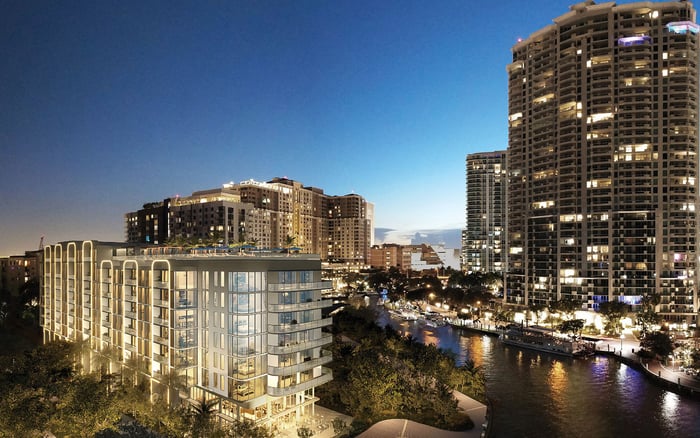
Shell Bay advertises EV charging, but ownership readiness depends on the details behind the amenity. A buyer-focused audit examines usable capacity, electricity billing, parking access, and the rules that would govern future demand.

For an electric-vehicle owner, residential luxury includes a quiet certainty: the car should be ready when the day begins. At Shell Bay by Auberge Hallandale, electric-vehicle charging stations are an advertised parking amenity. That is a useful starting point, but it does not establish private equipment, guaranteed availability, or electricity included in ownership costs.
Plans call for a residential and hotel experience within a private-club setting, with a debut in 2027 and 108 residences across 20 stories at 501 Diplomat Parkway, Hallandale Beach. Secured enclosed parking, valet, and self-parking are advertised. None of those details establishes how charging will operate for an individual household.
The ownership-readiness question is specific: what charging service will this residence receive, at what cost, and under whose rules? A useful audit separates advertised amenities from documented commitments and unresolved operating decisions.
Begin with a written equipment and parking schedule. Request the number of charging ports intended to be operational at residential occupancy, their locations, connector types, and rated output. Distinguish equipment installed at delivery from spaces merely prepared for later installation.
Then ask for the planned simultaneous operating capacity. A charger count alone does not tell an owner what to expect when several vehicles need energy at once. Request an explanation of any load-management arrangement, including how available power would be divided and whether any minimum service level is promised.
Test the proposal against the household's routine, not an abstract amenity count. Specify the intended vehicles, usual arrival and departure windows, and whether both cars may need charging overnight. Ask the project team to explain how the proposed system would accommodate that pattern, without treating an illustrative response as a guarantee.
Buyers also considering 2000 Ocean Hallandale Beach should use the same written questions. This is a comparison framework, not a claim that the properties have equivalent charging capacity or access terms.
Because both valet and self-parking are advertised at Shell Bay, establish how each would interact with charging. Would an owner plug in directly, request valet service, or use a reservation system? Would charging require moving the vehicle from its usual space?
Ask whether resident charging would be physically or operationally separated from hotel and club demand. The private-club setting establishes neither shared equipment nor resident exclusivity. The documents should resolve the question rather than leave the buyer to infer the answer.
Clarify overnight access, maximum session duration, late arrivals, vehicle movement after charging, and procedures during equipment outages. For a household with two EVs, request an explicit answer on whether access would attach to the residence, the parking space, a registered vehicle, or an individual account.
The essential distinction is simple: a parking entitlement is not a charging entitlement unless the relevant documents say so.
The advertised amenity does not establish free electricity or a particular billing model. Request a written schedule separating energy charges from any session, subscription, parking, valet, administrative, or idle-time charges. These are categories to investigate, not confirmed Shell Bay fees.
Ask how consumption would be measured, who would issue the bill, and how owners could review or dispute a charge. If pricing could change, identify who would have authority to change it, what notice would be provided, and whether any contractual limits would apply.
A sample statement can be more revealing than a broad assurance of convenience. Request an illustration using a clearly stated amount of energy, with each applicable charge shown separately. Also ask who would bear the costs of maintenance, networking, equipment replacement, and any shared electrical infrastructure.
Buyers comparing branded residences, including Auberge Beach Residences & Spa Fort Lauderdale, should request a property-specific cost schedule each time. A shared brand is not evidence of shared billing terms.
A charging policy should address more than initial occupancy. Ask how a purchaser who acquires an EV later would obtain access and how a household adding a second vehicle would be treated. Request any proposed waitlist, priority, reservation, or reassignment rules in writing.
Determine whether an initial allocation would continue indefinitely, be reviewed periodically, or transfer with a residence upon resale. Ask separately about tenants and guests. A verbal promise of charging availability does not explain whose request would take precedence when demand increases.
Expansion deserves its own inquiry. Request documentation identifying any planned additional electrical capacity, space for future equipment, and responsibility for approving and funding upgrades. Do not mistake an expansion concept for a funded commitment or a guaranteed installation date.
Finally, identify the proposed decision-maker for future changes: the association, a property operator, a charging provider, or another party. The audit should establish both the initial rules and the authority to revise them. These are separate ownership risks.
With a planned 2027 debut, buyers should distinguish the overall project timetable from any commitment to deliver operational charging. Ask when equipment would be installed, tested, and available to residents, and what arrangements would apply if that schedule slipped.
For each answer, record the document, its date, the responsible party, and whether it describes a proposal or a binding obligation. Request the applicable parking agreement, charging policy, equipment specification, fee schedule, and governing provisions as available. Have counsel assess which representations would form part of the purchase and ownership framework.
An unresolved question need not end a purchase discussion. It should, however, remain an explicit condition in the buyer's decision rather than quietly becoming an assumption. For a charging-dependent household, certainty of access may matter more than the presence of equipment alone.
For a Broward buyer, the final file should answer four practical questions: whether the household can charge when needed, what the service would cost, how competing demand would be allocated, and who would fund future capacity. Tie each answer to written, project-specific terms.
Shell Bay's advertised charging amenity invites that review; it does not replace it. The strongest ownership decision aligns the residence's appeal with the practical requirements of daily life, including what happens in the garage long after the initial purchase.
For a considered approach to South Florida ownership, explore MILLION.
If branded residences are on your mind — as a home or as an allocation — we would be glad to share what we are seeing, privately.
Begin a quiet conversationYes. Electric-vehicle charging stations are expressly included among the advertised parking amenities, but that description does not establish capacity or individual access rights.
Shell Bay has a planned debut in 2027. That timetable does not independently establish when charging equipment will be operational for residents.
Published project information lists 108 residences in a 20-story building. These figures do not establish the number of charging spaces.
A private charger or one charging space per residence is not established by the advertised amenity. Buyers should request written terms defining their specific entitlement.
Request operational port counts, connector types, rated output, and simultaneous operating capacity. Ask how any load-management system would affect service when multiple vehicles charge.
Included electricity is not established. Request a fee schedule separating energy costs from any service, valet, subscription, or idle-time charges.
Both valet and self-parking are advertised, alongside secured enclosed parking. Their relationship to charging access requires project-specific clarification.
Shared use and resident exclusivity are not established. Buyers should request written rules identifying eligible users and any resident priority.
Ask about waitlists, second vehicles, later EV purchases, and whether access transfers on resale. Also identify who can revise allocation rules and approve expansion.
Request the applicable parking agreement, charging policy, equipment specification, fee schedule, and governing provisions as available. Counsel should assess which terms create enforceable commitments.