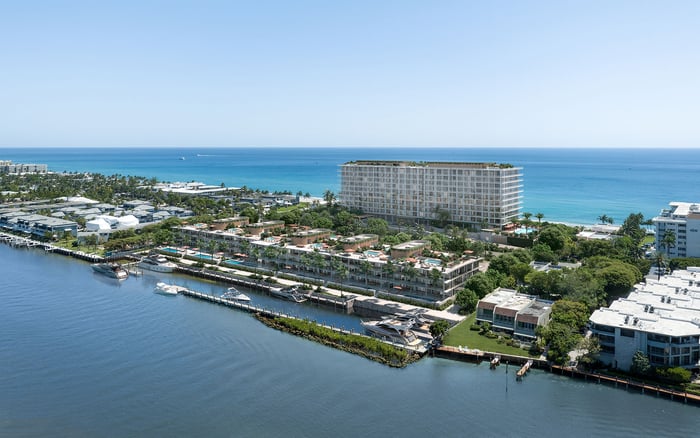
For buyers moving from Jackson Hole to Hillsboro Beach, ownership planning deserves the same attention as the residence itself. Trust structure, Broward public records, and the contested FinCEN rule require separate decisions coordinated before closing.

Leaving Jackson Hole for Hillsboro Beach is a personal transition. Purchasing the next residence also calls for a precise ownership decision. The questions extend beyond which home feels right: who will hold title, what the public record will reveal, and which federal reporting obligations will apply at closing.
For a buyer considering Rosewood Residences Hillsboro Beach, those questions belong alongside the residential brief-not among the final administrative details. A trust may serve an estate-planning purpose, but it does not, by itself, make the acquisition confidential. Nor does uncertainty surrounding a federal reporting rule change the visibility of county records.
Treat ownership structure, public-record exposure, and federal reporting as three separate workstreams. This distinction allows the buyer’s advisers to address each issue without suggesting that one solution resolves all three. Jackson Hole provides the relocation context, not a basis for assuming that familiar arrangements will produce the intended result in Florida.
Hillsboro Beach ownership research runs through Broward County’s official records. Searchable recorded documents include deeds, mortgages, liens, lien releases, court judgments, and condominium declarations. Plan the purchase with the expectation that its recorded documents will be accessible, rather than presumed private.
Trust-related deeds must still be recorded. Changing the ownership structure neither eliminates that requirement nor removes the resulting document from county records. Arranging ownership and managing expectations about public visibility are distinct tasks.
The property-appraiser ownership display warrants a separate review. For trust-owned property without a homestead exemption, the ownership line lists the trust name and trustee, with “TRSTEE” appended. This rule applies to a specific circumstance; it does not describe every trust-owned residence.
Before approving the deed, ask counsel to explain both the recorded document and the anticipated ownership display. The useful question is not simply whether a trust provides privacy, but which names and information will appear in each record relevant to the purchase.
Establish the trust before deeding property into it. This makes trust planning a pre-closing priority, not an item to revisit after acquiring the residence. It is practical sequencing, not a newly imposed statutory deadline.
Estate counsel, title counsel, and the closing agent should coordinate before the ownership structure is finalized. Ask them to agree on the proposed title language, the trust’s intended role, and the documents needed to complete the transaction. An informal preference for “buying in trust” is not a substitute for a reviewed plan.
A broader search in Pompano Beach, including The Ritz-Carlton Residences® Pompano Beach, should not interrupt that work. Property selection and ownership planning can proceed together. The objective is to have the structure ready for the chosen residence, rather than let the closing timetable dictate an unexamined arrangement.
Trust ownership may support continued homestead treatment while helping avoid probate. Neither outcome is automatic. Trusts are complex to establish correctly, and the intended result must be assessed against the buyer’s circumstances and proposed structure.
For a household deciding whether Hillsboro Beach will be its principal residence or another home, begin with a clear description of intended use. Counsel can then evaluate the trust and homestead questions together without confusing them with confidentiality.
Ask for a separate answer on each objective: the estate-planning purpose, potential homestead treatment, and public-record visibility. A structure that serves one objective should not be assumed to satisfy the others.
In particular, do not turn the non-homestead ownership-display rule into a promise about how a homesteaded trust property will appear. Precision matters more than reassurance when the concern is what others may discover through a public search.
The federal residential real-estate reporting timeline requires careful reading. On September 30, 2025, the reporting requirements were postponed until March 1, 2026. March 1 subsequently served as the closing-date threshold for reportable transfers, but that date must be read alongside the later court action.
On March 19, 2026, the U.S. District Court for the Eastern District of Texas vacated the Residential Real Estate Rule. FinCEN and the Department of Justice appealed the decision. Conflicting federal district-court decisions also form part of the litigation landscape, so the Texas ruling should not be described as settling every challenge.
The operative condition is essential: while the order vacating the rule remains in force, designated reporting persons are not required to file Real Estate Reports and are not liable for failing to file them. This does not mean the reporting framework has been permanently abolished.
The vacated rule assigned obligations to designated reporting persons involved in covered non-financed residential transfers. Buyers should ask the title and closing team to confirm the rule’s status and any applicable reporting responsibility for the actual closing, rather than rely on a remembered implementation date.
A suspension of federal reporting does not remove Broward’s public records. The two systems address different questions: one concerns reporting obligations for covered transactions; the other concerns recorded property documents. A change in one does not erase the other.
This distinction also belongs in a wider Fort Lauderdale search, including consideration of Four Seasons Hotel & Private Residences Fort Lauderdale. Neither the residential brand nor the property choice substitutes for a review of the proposed deed and ownership structure.
Ask the closing team to keep its federal-status assessment distinct from its explanation of public-record exposure. A conditional statement about filing obligations should not become an unintended assurance of anonymity.
A clear plan should leave the buyer with three answers: why the chosen ownership structure is appropriate, what information is expected to be publicly visible, and how the closing team will assess federal reporting requirements at closing.
Resolve those questions with the advisers responsible for the transaction. This is a planning framework, not individualized legal or tax advice. The goal is not an elaborate structure for its own sake, but an ownership arrangement whose purpose and limitations are understood before the deed is signed.
For a considered approach to your Hillsboro Beach property search, explore MILLION.
If branded residences are on your mind — as a home or as an allocation — we would be glad to share what we are seeing, privately.
Begin a quiet conversationNo. Trust-related deeds must still be recorded in Broward County, so trust ownership does not make the acquisition invisible in public records.
Searchable documents include deeds, mortgages, liens, lien releases, court judgments, and condominium declarations.
For trust-owned property without a homestead exemption, the property-appraiser ownership line lists the trust name and trustee, with “TRSTEE” appended. This should not be generalized to every trust-owned home.
The trust should be established before property is deeded into it. Coordinating that work before closing is practical planning guidance, not a separate statutory deadline.
Trust ownership can potentially maintain homestead treatment while helping avoid probate. Correct establishment is complex, so neither outcome should be assumed without legal review.
Estate counsel, title counsel, and the closing agent should coordinate before the ownership structure is finalized. Their review should distinguish estate objectives, record visibility, and reporting questions.
The U.S. District Court for the Eastern District of Texas vacated the rule. FinCEN and the Department of Justice appealed that decision.
While the court’s order remains in force, reporting persons are not required to file Real Estate Reports and are not liable for failing to file them. This conditional status should not be described as permanent abolition.
No. Federal reporting obligations and county-record visibility are separate, and the suspension does not remove recorded property documents.
The rule’s status is contested, and the filing relief depends on the court order remaining in force. The title and closing team should confirm the status and applicable responsibilities for the actual transaction.