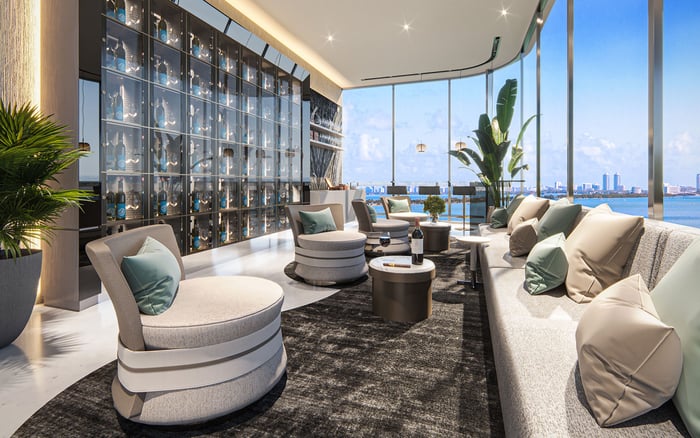
The Cove Residences pairs planned shared wellness facilities with an announced in-home healthcare program. For buyers, the essential distinction is between an advertised amenity, healthcare eligibility within a residence, and the operating rules that determine actual access.

At The Cove Residences Edgewater, the wellness proposition combines planned communal facilities with an announced in-home healthcare service. The planned 40-story waterfront condominium at 456 NE 29th Street in Miami's Edgewater neighborhood raises a practical question: how will that offering work for an owner, visiting family, and their preferred practitioners?
For a private client, the answer rests on three distinct considerations: facility capacity, user eligibility, and practitioner access. An attractive amenity collection does not establish how many people can use it comfortably. A healthcare benefit available to guests inside a residence does not grant them access to the shared spa. A medical-provider partnership does not establish permission for independently hired professionals.
That distinction is central to evaluating Cove Miami. Buyers should assess the advertised spaces and the announced service offering separately, then request the documents governing how each will operate.
The advertised wellness program includes a fitness center with a spin auditorium, a yoga room, and outdoor meditation and Zen-garden space. The planned spa includes a cold plunge, massage rooms, hammam, and sauna. Together, these spaces suggest a varied setting for exercise, quiet time, and personal treatments. They do not establish the staffing or scheduling behind them.
A bayfront infinity-edge pool and private cabanas broaden the amenity offering. These are planned or advertised features-not evidence of completed facilities, guaranteed availability, or unrestricted use. Their practical value to a household will depend on the eventual operating arrangements.
For buyers also considering Aria Reserve Miami, the useful comparison is not simply the length of an amenity list. It is whether each property's documented access arrangements suit the household's routines. Equivalent operating rules should not be presumed across projects.
The available amenity information does not establish wellness-facility square footage, maximum occupancy, treatment-room count, fitness-station count, or daily booking capacity. It therefore cannot support a reliable estimate of peak-hour availability or simultaneous treatments.
The reference to massage rooms identifies a planned use, not the number of appointments those rooms could accommodate. Likewise, a spin auditorium does not establish a station count or class schedule. Those operational details are separate from a facility's inclusion in the advertised program.
A buyer expecting a morning workout followed by a treatment should request room counts, occupancy limits, operating hours, and booking windows. Ask whether appointments require advance reservations, whether recurring bookings are possible, and how cancellations or no-shows would be handled. These are questions to resolve, not policies to assume.
The project has announced a healthcare partnership for personalized medical care delivered directly in residents' homes. The announced offering includes physician house calls, diagnostics and testing, recovery treatments, and prescription delivery. IV therapy, vitamin treatments, anti-aging programs, and joint-recovery services are also described within the program.
Healthcare-concierge membership is described as included with ownership at no additional membership cost, beginning when residents move in. That is a statement about membership-not a promise that every consultation, treatment, prescription, or test will be free. Detailed charges and exclusions are not established in the available information.
The described eligibility attaches to the residence rather than exclusively to its named owner. Owners, family members, and guests are described as eligible to use the program when services are delivered within the residence. Buyers should obtain the agreement's definitions of eligible users, particularly if tenants or other occupancy arrangements are contemplated.
For clients comparing EDITION Edgewater with Cove, the same discipline applies: distinguish physical facilities from any service agreement. Neither an amenity's existence nor hospitality language alone establishes who may receive a service or what it costs.
Guest eligibility for in-home healthcare does not establish independent access to the shared gym, spa, sauna, hammam, pool, or treatment rooms. A visiting relative's eligibility to receive care in an apartment is not a guest pass for communal facilities.
The available amenity descriptions do not establish guest-pass procedures, guest quotas, age restrictions, reservation requirements, or guest-access hours. Nor do they establish whether a nonresident guest may independently book a massage-room treatment or use the cold plunge and sauna.
For households that entertain frequently, the key distinction is between an accompanied visitor and a guest using the facilities independently. Request written clarification for both situations, including whether an owner must be present. Silence should be read as neither permission nor prohibition. The goal is to understand the rules before relying on an assumed guest experience.
Planned massage rooms do not establish that therapists or other practitioners will be permanently employed by the condominium. The announced healthcare partnership likewise does not establish unrestricted entry for an owner's independently hired physician, trainer, massage therapist, or other professional.
Three permissions require separate attention: building access, service delivery inside a private residence, and use of shared treatment rooms. The available information does not establish practitioner-approval requirements, licensing or insurance documentation, or permission for outside practitioners to work in communal rooms.
A buyer with an established care team should ask management to address each intended arrangement explicitly. Request any credential requirements, scheduling procedures, waivers, charges, and restrictions on equipment or shared-space use. When considering alternatives such as The Well Bay Harbor Islands, apply the same questions rather than assuming comparable access rights.
The condominium declaration, rules and regulations, amenities handbook, guest policy, and healthcare-concierge agreement should form the core of the review. Have the relevant provisions examined together, paying particular attention to whether they consistently address the household's intended use.
Request written answers on capacity, booking priority, guest limits, treatment-room rights, practitioner credentials, operating hours, waivers, service charges, and tenant eligibility. If a policy remains unsettled, treat it as an unresolved purchase consideration rather than filling the gap with an expectation.
The Cove's advertised offering gives buyers a meaningful wellness proposition to evaluate. Its suitability for a particular owner depends on the less visible details: when facilities can be used, who may enter them, and which professionals may provide services there. Precision on those points turns an appealing program into an informed ownership decision.
For a discreet discussion of your South Florida residential priorities, connect with MILLION.
If branded residences are on your mind — as a home or as an allocation — we would be glad to share what we are seeing, privately.
Begin a quiet conversationThe planned waterfront condominium is at 456 NE 29th Street in Miami's Edgewater neighborhood.
The advertised program includes a fitness center with a spin auditorium, yoga room, outdoor meditation and Zen-garden space, and a spa with cold plunge, massage rooms, hammam, and sauna.
The available information does not establish facility square footage, maximum occupancy, treatment-room or fitness-station counts, or daily booking capacity.
The announced program includes physician house calls, diagnostics and testing, recovery treatments, prescription delivery, IV therapy, vitamin treatments, anti-aging programs, and joint-recovery services.
Membership is described as included at no additional membership cost beginning when residents move in. That does not establish that individual services, prescriptions, or tests are free.
Owners, family members, and guests are described as eligible to use the program when services are delivered within the residence. Eligibility is associated with the residence rather than exclusively with the named owner.
No shared-amenity entitlement is established by the described in-home healthcare eligibility. Guest access to the gym, spa, pool, and treatment rooms requires separate clarification.
The available amenity information does not establish that permission or the applicable reservation requirements. Buyers should request the guest and treatment-room policies.
Permission for outside practitioners to use shared treatment rooms is not established. Approval procedures and licensing or insurance requirements also require clarification.
Request the condominium declaration, rules and regulations, amenities handbook, guest policy, and healthcare-concierge agreement. Review capacity, booking rights, service charges, practitioner access, and tenant eligibility.