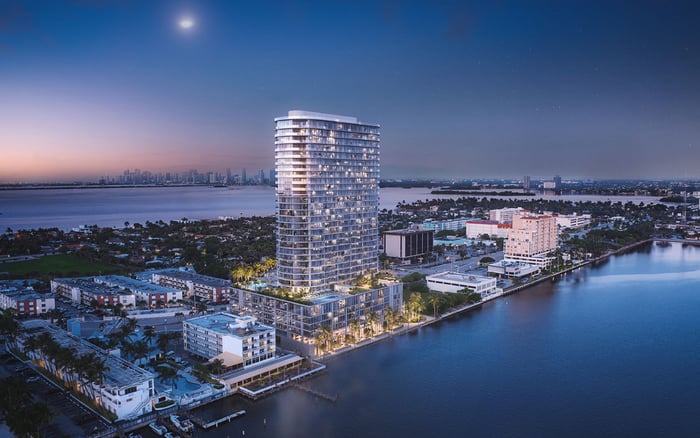
A disciplined North Bay Village purchase review connects reserve funding, insurance renewals and municipal construction schedules to test whether a residence can deliver genuinely low-intervention ownership.

The appeal of a lock-and-leave residence is not simply the ability to close the door. It is the confidence that the building’s finances, insurance and maintenance arrangements will remain clear while you are elsewhere. In North Bay Village, that confidence calls for a review extending beyond the apartment to the association’s obligations and any public works around its entrance.
Read three calendars together: component replacements, insurance renewals and capital-project schedules. A reserve contribution that looks comfortable in isolation may warrant closer scrutiny when substantial work and a policy renewal fall within the same ownership period. The objective is not to eliminate uncertainty, but to distinguish funded obligations from unresolved decisions.
For buyers considering Continuum Club & Residences North Bay Village, this framework is a starting point for questions, not a conclusion about the project’s finances, insurance or construction status.
Begin with the current reserve study or structural integrity reserve study funding schedule, as applicable. Request component replacement costs, remaining useful lives and planned contributions. Reconcile those assumptions with engineering findings, active contracts and unpaid commitments. A projected balance is useful only when its underlying obligations are visible.
Distinguish cash already held from contributions expected later, and estimated work from contracted work. Ask which costs have been updated, which remain preliminary and whether amounts committed to one component are being counted as available funding for another. A single reserve-balance figure is not a complete financial diagnosis.
Compare three years of budgets and financial statements with 24-36 months of board minutes, delinquency information and approved or proposed assessments. Look for consistency between what directors discuss, what the budget funds and what the replacement schedule anticipates. An unresolved discrepancy is a question for the association, not evidence of misconduct.
For each material obligation, record the expected payment date, funding source, approval status and remaining uncertainty. Have qualified advisers confirm applicable legal requirements rather than inferring current inspection deadlines or reserve rules from an older document.
Request master-policy declarations, the replacement-cost valuation, wind and flood coverage details, deductibles, exclusions and open claims. Add renewal quotations and any nonrenewal notice. Keep the existing policy and the next renewal clearly separated: current coverage does not establish the next premium or its terms.
Ask the insurance adviser to explain the potential cash demand of deductibles and uninsured exposures, and how the association expects to meet it. Compare that explanation with the reserve schedule and operating budget. Do not assume money assigned to planned replacements is also an unrestricted insurance buffer.
If a flood-insurance discount is presented in purchase materials, ask the insurance adviser to confirm whether it applies to the relevant policy and how it affects the quoted premium. Do not treat a discount claim as evidence of total insurance costs or adequate coverage.
For a buyer evaluating Shoma Bay North Bay Village, the useful comparison is documentary: what is in force, what is quoted and what remains an assumption. Project identity alone answers none of those questions.
Ask for current municipal capital-project information covering any stormwater, roadway, utility, park or waterfront-access work near the residence. These categories belong in a purchase review because ownership also involves arrivals, deliveries and arranging service while away.
Match any identified project locations with the building and its approach routes. Request each relevant project’s scope, budget, reported progress and timeline. Follow that review with questions about staging, lane changes, truck routes, utility interruptions and entrance access.
Treat published schedules as planning information, not confirmation that work has finished. Request an updated status before treating any scheduled milestone as achieved. Equally, a project’s inclusion in a capital plan does not prove that a particular residence will experience disruption.
When assessing Tula Residences North Bay Village, apply the same address-level discipline: identify potentially relevant work, then confirm its actual relationship to access.
Review municipal budget allocations separately from actual expenditures and current project status. Before combining figures from different budget documents, confirm that they describe comparable, non-overlapping measures.
Public allocations do not demonstrate an association’s reserve adequacy or settle its private repair obligations. Keep municipal projects and association projects in separate columns, then align their anticipated dates. This makes overlapping work easier to discuss without suggesting that one budget finances the other.
Do not build purchase calculations around assessment assistance unless current program terms, availability and your eligibility have been confirmed. Ask whether any assistance under consideration distinguishes primary residences from second homes or investment properties.
If you expect to be absent, ask management who receives assessment notices, renewal updates and work-access requests. Clarify emergency contact arrangements and the process for authorizing entry. These questions test whether the ownership arrangement fits your travel pattern without assuming a particular service is included.
Conclude with a dated, one-page decision sheet covering committed capital work, reserve contributions, assessment status, insurance renewal timing and potentially relevant municipal construction. Label each item as documented, estimated or unresolved. Identify who must answer each outstanding question before the purchase decision.
The strongest lock-and-leave proposition is not necessarily the lowest monthly charge. It is an ownership structure whose obligations are clear, whose funding assumptions can be tested and whose practical demands fit the time you intend to spend away.
For a discreet perspective on North Bay Village ownership, explore MILLION.
If branded residences are on your mind — as a home or as an allocation — we would be glad to share what we are seeing, privately.
Begin a quiet conversationIt is a coordinated review of reserve funding, insurance renewals, capital work and access arrangements. The aim is to understand financial and practical obligations before committing to ownership.
Request the current reserve study or applicable structural integrity reserve study funding schedule, component costs and remaining useful lives. Compare them with engineering findings, contracts and unpaid commitments.
As a due-diligence starting point, compare three years of budgets and financial statements with 24–36 months of board minutes. Include delinquency information and approved or proposed assessments.
Obtain master-policy declarations, replacement-cost valuation, wind and flood terms, deductibles, exclusions and open claims. Review renewal quotations and any nonrenewal notice separately from current coverage.
Ask the insurance adviser to confirm its applicability to the relevant policy and its effect on the quoted premium. A discount claim does not establish total insurance costs or adequate coverage.
No; a planned milestone is not evidence that work has finished. Seek updated project status before assuming completion.
Request the scope, location, budget, reported progress and timeline for potentially relevant work. Use those details to ask specific questions about access and utility interruptions.
Confirm that the figures describe comparable, non-overlapping measures before combining them. Keep budget allocations separate from actual expenditures and association obligations.
Do not assume eligibility or availability without confirming current program terms. Ask whether the rules distinguish primary residences from second homes or investment properties.
No; a project-specific conclusion requires its own reserve, insurance, engineering and assessment documents.