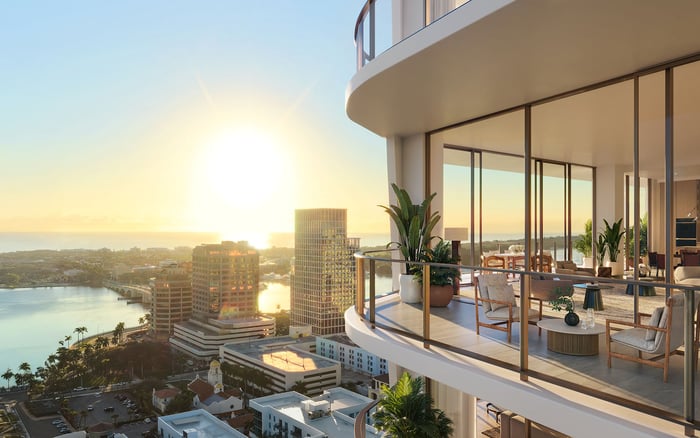
Banyan Tree’s planned garage and Nora’s district parking offer different propositions. A family-office review should separate physical capacity from enforceable storage rights, valet protection, and residential EV access.

For a family office, residential parking is more than an arrival experience. It is an operating arrangement involving access, custody, insurance, and the ability to keep vehicles available when needed. A beautifully managed entrance may satisfy the lifestyle brief without establishing a durable right to store a second car or charge an electric vehicle overnight.
The comparison between Banyan Tree Residences West Palm Beach and Nora House begins with that distinction. Banyan Tree’s planned integrated garage and Nora’s district parking system offer different propositions. Neither, on its own, establishes enforceable residence-specific entitlements. The acquisition review should separate physical capacity, contractual rights, and service continuity before assigning value to any of them.
Banyan Tree’s project address is 400 Hibiscus Street. The planned development comprises a 22-story tower with 88 condominium residences and a four-level parking garage. Approximately 11,000 square feet of ground-floor commercial space raises another diligence question: how will residential access interact with commercial demand?
The number of garage levels does not establish the stall count, the number of spaces attached to a residence, or whether owners may self-park. Request the declaration, parking exhibit, and applicable purchase-contract provisions. Those documents should distinguish separately owned spaces, exclusive-use rights, and assignments subject to change.
The commercial component makes that separation especially important. Ask whether entrances, circulation, visitor spaces, and valet queues are shared, and whether commercial users can affect resident availability. These are questions to resolve, not confirmed operating conditions.
For households maintaining multiple vehicles, document the treatment of additional cars, guest arrivals, extended storage, vehicle dimensions, and reassignment. A four-level garage is a meaningful design feature; a protected allocation is the asset-level commitment that matters.
Sanctuary Club access and branded-residence services do not establish residence-by-residence parking entitlements at Banyan Tree. Hospitality benefits and vehicle custody should therefore be reviewed as separate obligations, even when the arrival experience presents them as one seamless service.
The same distinction applies to a broader shortlist that includes Mr. C Residences West Palm Beach. The comparison should rest on documents, not reputation: what rights attach to the residence, who delivers the service, and what remedies survive a change in operator? No parking equivalence should be assumed between projects.
For Banyan Tree, the city approval includes a valet-review condition allowing operational changes or permit revocation. Confirm how residents would retain access if that authority were exercised. Do not assume self-parking, replacement staffing, or alternative storage would automatically be available.
Nora House is presented as a residential project in the Nora District. The district’s stated parking capacity exceeds 400 surface spaces, with two valet pickup/drop-off options along North Railroad Avenue. This is district-level capacity, not evidence that an individual Nora House residence receives a guaranteed space.
The premium parking area lies between 8th and 10th Streets, with access from 8th and 9th Streets. The general lot is near 11th Street and Spruce Avenue. Visitor parking requires a session using the applicable lot’s zone number. These arrangements describe district access; they do not establish private residential storage rights.
Premium parking offers a complimentary first hour, followed by hourly charges, with a $15 maximum total charge and a three-hour maximum stay. That time limit matters: short-stay parking should not be treated as an overnight-storage solution. A complete vehicle-storage schedule, separately deeded parking rights, and guaranteed owner valet priority remain undisclosed for Nora House.
Nora’s stated valet hours are Monday through Friday, 3-11 p.m., and Saturday through Sunday, 11 a.m.-11 p.m. Its stands are near Sunday Motor Co. at 7th Street and North Railroad Avenue, and in front of Del Mar on North Railroad Avenue.
Those hours define a practical diligence agenda. Ask how an owner retrieves a vehicle before service begins or after it ends, whether residential service follows a separate schedule, and whether owners receive priority. District hours are not a promise of round-the-clock household access.
For either property, request the operator agreement and insurance certificates. Review garage-keepers coverage, applicable limits and deductibles, theft and damage exclusions, claims deadlines, and owner indemnification. Ask who handles a claim when a vehicle moves between storage, the arrival point, and a charger. Valet service is a custody arrangement, not proof of comprehensive protection.
Six EV charging stations are identified in Nora’s premium parking area north of 9th Street. Their reservation for Nora House owners and any private residential charging entitlements remain unconfirmed. The parking tariff does not establish charger fees.
For Banyan Tree, charger count, location, and allocation remain unresolved. Do not include a specific charging amenity in the acquisition model without contractual confirmation.
At both projects, ask who owns the equipment, who receives priority, and how charging is scheduled. Confirm electrical capacity, metering, fees, maintenance responsibility, load management, and rights to install a private charger. Establish who pays for future upgrades and whether an owner can retain access as demand increases.
The useful distinction is between a nearby charger and a dependable charging arrangement attached to the residence. A household planning regular EV use should assess parking duration and charging access together, rather than treating them as independent amenities.
A family-office comparison should maintain three distinct categories: confirmed contractual entitlements, published operating information, and unresolved questions. Development plans, district prices, and service hours may change; executed obligations deserve different treatment from public descriptions.
Apply the same framework when considering Alba West Palm Beach alongside these two properties. The purpose is not to presume matching facilities, but to compare parking rights, custody terms, and charging responsibilities on a consistent basis.
The conclusion is deliberately conditional. Banyan Tree’s planned garage offers a different proposition from Nora’s district system, but physical form alone does not determine which better serves a household. Until executed documents establish the relevant rights, assign no value to guaranteed vehicle storage, exclusive charging, or comprehensive valet protection.
For a discreet residential review centered on documented ownership rights, explore MILLION.
If branded residences are on your mind — as a home or as an allocation — we would be glad to share what we are seeing, privately.
Begin a quiet conversationThe planned development includes a four-level parking garage within a 22-story tower with 88 condominium residences. That description does not establish each residence’s allocation.
Residence-by-residence parking entitlements remain unconfirmed. Confirm allocations and their legal status in the declaration, parking exhibit, and purchase documents.
Approximately 11,000 square feet of planned ground-floor commercial space makes resident-versus-commercial access an important question. Confirm whether circulation, queues, or visitor spaces would be shared.
The city approval includes review of valet operations, with the ability to require changes or revoke the permit. Buyers should confirm how resident parking access would continue under either outcome.
No individual residential allocation is established by that inventory. It describes a district-level surface-parking resource.
The stated hours are Monday through Friday, 3–11 p.m., and Saturday through Sunday, 11 a.m.–11 p.m. Separate residential service hours or owner priority are not established by those district hours.
Its terms include a three-hour maximum stay, so those terms do not establish an overnight-storage solution. Any residential storage arrangement needs separate confirmation.
Owner-reserved access and private residential charging rights remain unconfirmed. The chargers are located in the premium parking area north of 9th Street.
No. The parking charges do not establish charger fees.
Request the declaration, parking exhibit, applicable purchase provisions, valet operator agreement, and insurance certificates. Also obtain written charging terms covering allocation, capacity, fees, maintenance, and upgrade costs.