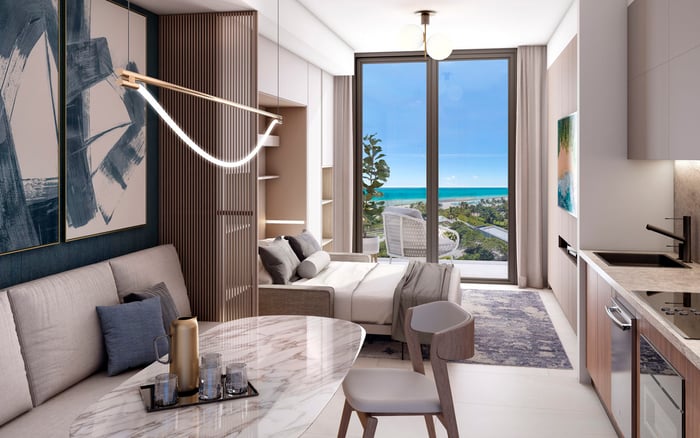
A discreet purchase framework for North Bay Village residences, connecting closet capacity, documented storage rights, environmental controls, and seasonal household management.
A well-run seasonal residence should feel effortless on arrival. Wardrobes are ready, bicycles are accessible, and personal possessions remain private when guests or household staff are present. For a family office purchasing in North Bay Village, that ease should be built into the acquisition, not improvised after closing.
Storage is not a single amenity. Owner closets, conditioned rooms, bicycle facilities, and overflow space serve distinct purposes and may carry different rights. The purchase brief should separate physical capacity from legal entitlement, environmental suitability, and day-to-day access. An attractive floor plan answers only part of the question.
Begin with a household inventory, then test each candidate residence against it. Frequently used goods belong within the home; sensitive belongings need suitably controlled private storage; durable seasonal items require expressly permitted overflow space. This allocation makes storage requirements specific before price and contract terms are settled.
When assessing Continuum Club & Residences North Bay Village, request the residence-specific closet plans. Confirm whether the proposed layout can accommodate a lockable, owner-only compartment and whether household staff could access service supplies without entering private areas.
Measure usable cubic feet, not just the closet footprint. Shelving depth, hanging clearance, door swing, ventilation, and the dimensions of luggage or garment cases determine what fits. Separate storage volume from circulation space, and test whether the arrangement still works when the residence is fully occupied.
For an owner-reserved closet, confirm whether the intended locking arrangement is permitted and who would hold access credentials. Map how staff could retrieve linens, luggage, or seasonal clothing without entering private bedrooms. Where that separation is impossible, consider reserving bedroom closets for personal belongings and placing service inventory elsewhere, subject to documented permissions.
Ask whether separate storage is available, whether it is included with the residence or offered at additional cost, and whether a suitable space can be secured for the proposed purchase. Do not treat a general amenity description as confirmation of availability.
Request the declaration, any storage allocation schedule, association rules, fee schedule, and proposed storage agreement. Have counsel establish whether the space is deeded, appurtenant to the residence, assigned, or separately contracted. Confirm its identifier, dimensions, access arrangements, transfer terms, and recurring charges in writing. If storage is essential to the purchase, ask counsel how to document that dependency in the transaction.
Do not infer humidity control or suitability for art, wine, or documents from a temperature-control description. Request operating specifications, humidity information, monitoring arrangements, leak protection, and insurance terms before allocating sensitive belongings. Establish who receives an alert and who may enter if a problem occurs while the family is away.
For Shoma Bay North Bay Village, use the same diligence process: ask which storage facilities, if any, serve the proposed residence and obtain their allocation terms and environmental specifications. Resolve those points before counting any facility toward the household's required capacity.
Assess any bicycle room as an operating facility, not merely an amenity label. Verify access controls, rack assignments, usable clearances, and the route between the room and the building exit. Confirm whether authorized staff can retrieve equipment on the owner's behalf.
Do not assume electric-bicycle storage includes charging permission. Obtain written battery-storage and charging rules, and check coverage for theft or damage. A secure room and an acceptable battery policy answer different questions; neither should be inferred from the other.
For any proposed bicycle, paddleboard, or kayak storage, verify current availability, allocation procedures, and equipment dimensions rather than assuming every residence receives a dedicated position.
For watersports equipment, walk the proposed retrieval route and confirm handling arrangements. Ask where wet equipment may be placed and what rules govern its return. Settle these operational details before assigning staff responsibility for preparing equipment ahead of each visit.
If a private garage is offered, evaluate its acquisition separately from any proposed use for trunks, shelving, or seasonal furnishings. Obtain written confirmation of permitted uses before counting it as household storage capacity.
Apply the same discipline to any boat slip or dock access under consideration. Confirm permission for dockside equipment storage independently of vessel accommodation.
Have any proposed balcony or terrace storage checked against applicable code provisions and building rules. Do not treat outdoor space as uncommitted overflow capacity or assume that a use permitted at another property will be allowed here.
Create one seasonal register recording each item's owner, category, location, replacement value, and last inspection date. Use consistent location identifiers so the family office, household manager, and authorized staff work from the same record. Assign responsibility for updates whenever goods move between the residence and storage.
Before each arrival, reconcile expected belongings with the register and inspect items scheduled for use. At departure, record their returned locations and condition. Maintain a separate access record identifying who may enter each space and how authorization can be withdrawn when staffing changes.
Include hurricane procedures, delivery access, and insurance responsibilities in the operating plan. Decide who may authorize relocation of belongings, where they may go, and how that movement will be recorded. Any alternative location must itself be permitted and suitable; an emergency plan should not depend on an unapproved hallway, balcony, or garage arrangement.
Use the same written questions when considering Tula Residences North Bay Village, without presuming that another project's amenities apply. A consistent diligence brief supports useful comparisons while keeping each property's permissions distinct.
The final acquisition budget should include any storage purchase costs, recurring charges, insurance, and permitted fit-out. Before closing, reconcile physical measurements with the inventory and governing documents. Treat advertised amenities as items to verify, not proof of completed facilities, current availability, or enforceable rights.
For a family office, the objective is not simply more space. It is a residence whose belongings, access permissions, and seasonal routines can be managed quietly and predictably.
Explore North Bay Village residences with MILLION.
If branded residences are on your mind — as a home or as an allocation — we would be glad to share what we are seeing, privately.
Begin a quiet conversationNo; obtain written confirmation of inclusion, availability, cost, and the rights attached to the proposed space.
A closet layout alone does not establish lockable owner-only compartments or separate staff access. Confirm the intended locking arrangement and access permissions.
Do not assume humidity control from a temperature-control description. Request environmental specifications and monitoring details before assigning sensitive belongings.
Request the declaration, any storage allocation schedule, association rules, fee schedule, and separate storage agreement. Have counsel confirm whether the space is deeded, appurtenant, assigned, or separately contracted.
Do not infer charging permission from storage availability. Confirm battery-storage and charging rules in writing, along with access controls and insurance coverage.
Count it as overflow capacity only after confirming that the intended use is permitted. Check restrictions before planning shelving, trunks, or seasonal furnishings.
Ask which storage facilities, if any, serve the proposed residence and obtain their allocation terms. Verify environmental specifications before assigning sensitive household inventory.
Do not assume it does. Confirm permission for dockside equipment storage independently of vessel accommodation.
Have the proposed use checked against applicable code provisions and building rules. Do not count the space as overflow capacity until permission is confirmed.
Record each item's owner, category, location, replacement value, and last inspection date. Assign responsibility for updates whenever goods are moved or inspected.