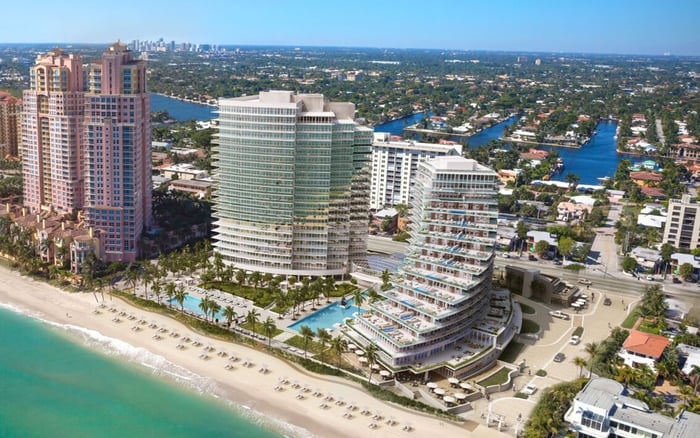
A family-office framework for evaluating Fort Lauderdale residences through emergency medical access, documented caregiver parking rights, elevator continuity, and resident-specific mobility planning.

For a family office evaluating a Fort Lauderdale residence, the most consequential amenity may be the ability to maintain daily life when circumstances change. An overnight caregiver arrival, a resident's return from surgery, or an elevator outage warrants the same disciplined attention as privacy, views, and interior design.
The purchase brief should address three connected questions: how emergency responders reach the resident, how support staff enter and park, and how the household functions when vertical transportation is interrupted. These are acquisition criteria, not matters to resolve after furnishing the apartment.
Begin with a resident-specific brief developed with the household and its care team. Identify mobility equipment, assistance requirements, caregiver schedules, and essential powered medical equipment. Keep sensitive clinical information separate from the property comparison, while giving advisers enough operational detail to evaluate suitability.
Broward Health Medical Center, at 1600 S. Andrews Avenue, Fort Lauderdale, FL 33316, is a relevant reference point for a Broward purchase plan. It provides adult emergency and trauma care and holds a Florida Level I trauma designation. Pediatric Level I trauma services are available on the same campus.
Those capabilities provide a useful medical reference point, not a guarantee of access from a particular residence. A trauma designation does not establish ambulance response time, journey duration, or a hospital's suitability for every resident's ongoing care. Ask the household's clinicians to help identify the services relevant to its circumstances.
For a shortlist that includes Sixth & Rio Fort Lauderdale, prepare a route assessment for the proposed residence rather than assigning a neighborhood-wide medical-access score. Separate routine appointments, scheduled medical transport, and emergency response. Each requires a different operating plan; a familiar private-car route should not become a promise about emergency transport.
A useful access map begins outside the property and ends at the resident's door. Review potential bridge crossings, gates, vehicle approaches, valet queues, and ambulance stopping points. Ask management how responders are admitted and who coordinates access when the household's usual contact is absent.
Then inspect the internal path: entrance doors, security checkpoints, corridors, elevator lobbies, and the apartment threshold. Record dimensions and turning constraints for professional review. A generous lobby alone does not establish that the full route accommodates a stretcher or the resident's equipment.
When considering Four Seasons Hotel & Private Residences Fort Lauderdale, apply the same door-to-door diligence rather than treating the residential brand as evidence of medical readiness. Request the relevant written procedures and distinguish documented arrangements from unanswered questions for management. Repeat the exercise for each finalist using the same checklist.
Evaluate caregiver access as a recurring household requirement, not an occasional guest visit. Request written association rules covering regular and overnight caregivers, shift changes, medical-transport vans, accessible guest spaces, valet hours, and loading permissions. Ask how a replacement caregiver receives access when the regular staff member cannot attend.
Fort Lauderdale's residential parking permit program concerns street parking within designated permit districts. It does not establish a reserved caregiver space or private condominium loading privileges. Municipal parking arrangements and building-specific permissions belong in separate parts of the acquisition file.
For any proposed space, confirm whether the right is deeded, assigned, leased, valet-controlled, or first-come. Measure vehicle clearance and inspect the route from the parking position to the elevator, including thresholds and constrained transfer areas. Counsel should review the documents supporting the proposed arrangement.
A buyer evaluating Auberge Beach Residences & Spa Fort Lauderdale should request these details for the specific purchase under consideration. The objective is not simply a place to leave a car, but a workable arrival and departure plan across the household's actual care schedule.
For an upper-floor residence, assess the apartment and its vertical transportation together. Request elevator counts, car and door dimensions, maintenance and outage records, and modernization history. Ask which elevators serve the unit and how access is managed if one becomes unavailable.
Emergency power requires separate documentation. Establish which equipment is covered, under what operating conditions, and what restrictions apply. The presence of a generator does not confirm that all elevators, apartment outlets, or essential medical equipment will remain powered.
If St. Regis® Residences Bahia Mar Fort Lauderdale enters the shortlist, focus the review on the proposed unit and documented systems. Where arrangements are prospective, distinguish design commitments from operating records and seek appropriate professional review before relying on them.
Obtain separate protocols for medical emergencies, elevator outages, fire evacuation, and hurricane shutdown and restart. Do not collapse these scenarios into a generic evacuation plan. Coordinate a resident-specific response with qualified advisers and building management rather than improvising around an assumption that an elevator will remain available.
Inside the residence, test the proposed layout against the household's actual needs. Assess zero-step access, doorway and circulation clearances, bathroom adaptability, reachable controls, and space for assistance. Evaluate the furnished plan as well as the empty rooms; the intended furniture arrangement belongs in the mobility review.
Inspect the full path between the bed, bathroom, apartment entrance, elevator, and ambulance-access point. Ask suitable professionals to evaluate equipment fit and necessary adaptations rather than relying on visual impressions. Obtain written clarification of any approvals needed for proposed changes before treating them as feasible.
Develop a backup arrangement for essential medical equipment with the care team. Separately, identify alternative lodging that can support the resident if the apartment becomes impractical to access. Neither a lower floor nor a larger floor plan should substitute for this assessment.
Before committing, assemble a decision sheet for each finalist: documented arrangements, unresolved questions, required adaptations, and the person responsible for each follow-up. Have counsel address material reliance on parking permissions or proposed changes, and qualified technical advisers review the relevant systems.
After purchase, maintain an emergency binder, caregiver roster, access instructions, resident-specific support plan, and alternative lodging arrangements. Assign responsibility for keeping them current as staffing, equipment, and building procedures change. For a family office, luxury should include a residence whose practical requirements are understood before they become urgent.
Explore Fort Lauderdale residences with a more deliberate purchase brief at MILLION.
If branded residences are on your mind — as a home or as an allocation — we would be glad to share what we are seeing, privately.
Begin a quiet conversationBroward Health Medical Center at 1600 S. Andrews Avenue provides adult emergency and trauma care and holds a Florida Level I trauma designation. Its location does not establish travel time from any particular residence.
Yes, pediatric Level I trauma services are available on the same campus. The household's clinicians should help identify care arrangements appropriate to the resident.
No. Review routes, bridge crossings, gates, vehicle queues, and responder access without treating distance as a response-time guarantee.
The city program concerns street parking within designated residential permit districts. It does not establish a reserved caregiver space or private condominium loading privileges.
Request rules for recurring and overnight caregivers, shift changes, medical-transport vans, accessible guest spaces, valet hours, and loading. Clarify access procedures for replacement caregivers as well.
Confirm whether it is deeded, assigned, leased, valet-controlled, or first-come. Measure vehicle clearance and inspect the route from the space to the elevator.
Request elevator counts and dimensions, maintenance and outage records, modernization history, and emergency-power documentation. Establish which elevators serve the proposed unit.
Do not assume it does. Obtain documentation identifying covered equipment, operating conditions, and restrictions, and develop equipment-specific backup arrangements with the care team.
Inspect the entire route from the unit through doors, corridors, and elevators to the ambulance-access point. Have suitable professionals evaluate dimensions and turning constraints.
Maintain an emergency binder, caregiver roster, access instructions, resident-specific support plan, and alternative lodging arrangements. Assign responsibility for updates as household needs and building procedures change.