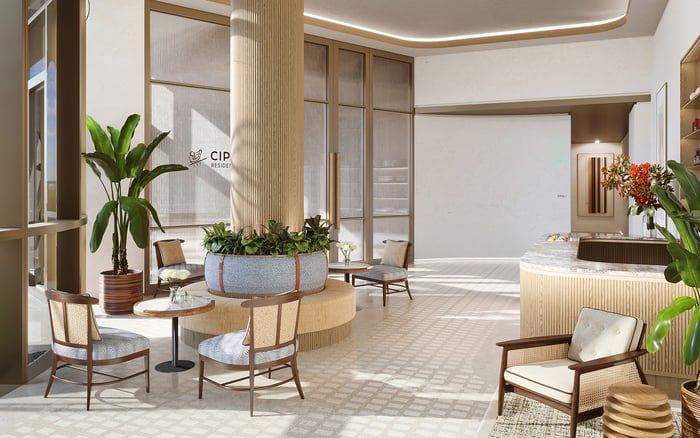
A discreet operating framework for a Brickell family base during Miami’s major event periods, with practical guidance on staggered arrivals, separate staff lodging, residence zoning, transport coordination, and privacy.

For a family office, a Miami event residence should offer something more valuable than proximity: continuity. Principals need space to work, children need an undisturbed routine, and guests need a gracious welcome without turning the household into an event headquarters. Brickell can serve as that base, provided the operating plan separates residential life from venue logistics.
A useful strategy is a two-zone arrangement: Brickell for principals, family life, and selected hospitality; venue-adjacent staging for support, where suitable accommodation and access can be confirmed. This is a proposed operating model, not a universal standard. The aim is to reduce unnecessary movement through the residence while preserving service quality.
For buyers considering Cipriani Residences Brickell, the question is not simply whether a home can entertain beautifully. It is whether its permitted use, layout, and management arrangements can support the household’s actual event-week requirements.
Two 2026 calendar anchors illustrate different operational demands. The F1 Miami Grand Prix was scheduled for May 1-3, with a Sprint format adding competitive sessions before Sunday’s Grand Prix. Its purpose-built circuit surrounds Hard Rock Stadium in Miami Gardens-not Brickell or Miami Beach. A Brickell base therefore requires a separate northbound transport operation.
Art Basel Miami Beach runs December 4-6, 2026, at the Miami Beach Convention Center in South Beach. Treat invitation-only attendance separately from public fair dates. A December 3 Vernissage date should not become a blanket assumption about every guest’s preview access; confirm each invitation before finalizing movements.
These events provide a framework, not a complete annual calendar. For each stay, create an attendance matrix identifying who must be where, the confirmed admission window, and whether returning home between engagements is genuinely necessary. Preserve unscheduled time rather than filling every interval with a transfer.
Appoint one movement coordinator with authority to reconcile flight changes, vehicles, building access, and household readiness. The family office should retain the complete schedule; each driver, host, or staff member should receive only the information needed for their assignment.
Organize arrivals into three categories:
Staff and vendors: Schedule setup, deliveries, and room preparation before family arrivals, within building-approved hours.
Principals: Arrange a direct handover from arrival point to residence, with access cleared and essential rooms ready.
Family and guests: Stagger arrivals around room readiness and the household’s preferred welcome arrangements.
Maintain separate instructions for commercial-airport and private-aviation arrivals. Record the confirmed arrival point, passenger contact, baggage requirements, receiving staff member, and fallback contact. Do not circulate the full household manifest to every provider.
Apply the same discipline to departures. Late luggage collection, guest checkouts, and vendor removal should not all converge on the principal’s departure window.
Treat staff accommodation as a separate workstream, not an assumption attached to the principal residence. Consider senior household staff, rotating event teams, and overnight or security personnel individually. Their schedules, rest requirements, and need for proximity may differ substantially.
Senior staff may benefit from lodging near the family base. Event teams may be better positioned near their assigned venue. Overnight personnel need a clearly agreed arrangement that respects occupancy rules and household privacy. These recommendations do not establish room availability, permission for staff stays, or minimum booking periods.
When evaluating Una Residences Brickell, request written confirmation of the relevant residence’s occupancy permissions, visitor procedures, and service-access arrangements before incorporating it into an accommodation plan. A desirable address does not, by itself, resolve staffing logistics.
Assign each lodging arrangement a named owner responsible for check-in, transport, schedule changes, and checkout. Keep staff room assignments out of guest-facing itineraries.
A workable residence plan separates private family rooms, principal work areas, guest hospitality, and service logistics. These boundaries can be operational rather than architectural: a room reserved for calls, a corridor kept private, or a defined delivery handover point.
The hospitality zone should let guests arrive, gather, and depart without passing through bedrooms or confidential workspaces. The service zone should accommodate approved deliveries and household preparation without turning family areas into overflow storage. Set clear opening and closing times for entertaining.
For a residence under consideration at The Residences at 1428 Brickell, test the actual floor plan against these four functions. Do not assume separate entrances, private elevator permissions, or service-elevator availability. Each depends on the specific layout and building approval.
A simple annotated plan can assign rooms and permitted circulation without distributing sensitive household details. Staff should know where their duties begin and end; guests need only know where they are welcome.
At Baccarat Residences Brickell, 24-hour attended security services and controlled access are relevant features. They do not, however, establish short-term occupancy rights, staff access, service-elevator arrangements, or readiness for a particular event stay.
The family office should confirm its own visitor protocol with management. Pre-clear names, establish an approval contact, and define how unlisted arrivals will be handled. Use individual access permissions where available and authorized, rather than sharing credentials broadly.
Restrict address distribution to those who need it. Keep event credentials, passports, and sensitive documents in secure storage. Ask guests and vendors not to circulate room assignments, household schedules, or arrival details. These measures are intended to reduce unnecessary exposure, not guarantee absolute privacy.
Base departure decisions on current traffic, venue instructions, and the day’s confirmed access arrangements. Southbound Brickell Avenue between 5 and 7 p.m. deserves particular scrutiny, but a fixed congestion assumption is not a live routing plan. Likewise, a generous buffer is a planning allowance, not a guaranteed journey time.
Before each operating day, reconcile passenger lists, driver contacts, pickup instructions, residence permissions, and changes to the hospitality schedule. Give the movement coordinator a clear escalation path when a guest adds a companion or a principal changes plans.
The strongest residence strategy protects the family’s ordinary rhythms while allowing extraordinary days to unfold elsewhere. For a discreet review of a Brickell residence against your household’s operating priorities, connect with MILLION.
If branded residences are on your mind — as a home or as an allocation — we would be glad to share what we are seeing, privately.
Begin a quiet conversationA two-zone plan can preserve family routines while placing selected support functions nearer the event. It is a recommended strategy, not an established requirement.
The Miami Grand Prix takes place on a purpose-built circuit around Hard Rock Stadium in Miami Gardens, rather than in Brickell or Miami Beach.
The race weekend was scheduled for May 1–3, 2026, using a Sprint format with competitive sessions before Sunday’s Grand Prix.
Art Basel Miami Beach runs December 4–6, 2026, at the Miami Beach Convention Center in South Beach.
No; a December 3 Vernissage date does not confirm every invitation-only access window. Check each guest’s invitation individually.
Separate staff and vendor setup, principal arrivals, and family or guest arrivals into coordinated windows. One named movement coordinator should reconcile transport, access, and household readiness.
Do not assume staff accommodation is available or permitted. Assess separate lodging for senior household staff, rotating teams, and overnight personnel based on duties and confirmed occupancy rules.
Separate private family space, principal work areas, guest hospitality, and service logistics. These boundaries must reflect the actual layout and permitted building access.
No; advertised security features do not confirm occupancy rights, staff permissions, service access, or operational readiness for a particular household.
Pre-clear visitors, restrict address distribution, and share role-specific itineraries rather than the full household schedule. Use authorized individual access permissions where available and secure sensitive documents.