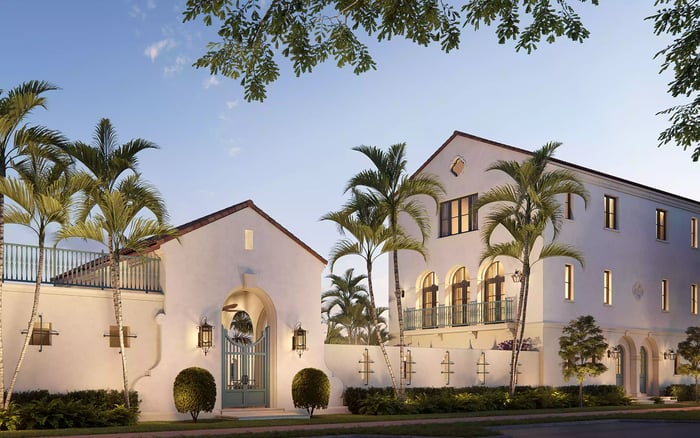
For a family office comparing Coconut Grove and Coral Gables, the decisive questions concern actual occupancy, homestead eligibility, property-specific insurance and a first-year budget that looks beyond the seller’s tax bill.

For a family office choosing between Coconut Grove and Coral Gables, the acquisition decision should begin with how the residence will be used-not which address appears more economical. A permanent home, a seasonal retreat and a residence maintained for occasional family visits each raise different questions that must be resolved before an operating budget is credible.
The most useful comparison separates three decisions: the household’s residence plans, the ownership structure and the property’s insurable characteristics. Homestead eligibility follows Florida’s permanent-residence framework in both locations. Insurance requires property-specific underwriting. First-year costs call for a fresh tax forecast and an explicit service plan.
Whether the shortlist includes Four Seasons Residences Coconut Grove or Ponce Park Coral Gables, project selection should not substitute for those separate reviews. The objective is a residence whose ownership and operating arrangements support the family’s actual life.
Prepare a written occupancy brief before seeking quotations. Describe intended family use, anticipated periods away, any staff presence and whether rental use is contemplated. Ask the insurance adviser to obtain written confirmation of how the proposed policy treats that arrangement.
Do not assume that a staff-managed property is treated identically to a continuously occupied home, or that an intended homestead designation settles insurance occupancy. These are distinct questions. Confirm policy definitions, any vacancy provisions and the treatment of seasonal or rental use against the proposed contract; do not infer them from neighborhood or price.
For a family office, the brief also serves as a coordination document. Counsel, the tax adviser, the property manager and the insurance adviser should work from the same intended use. If the family’s plans change before closing, revisit both the coverage proposal and the homestead assumptions before approving the budget.
Bay-adjacent Coconut Grove properties can be more sensitive to coastal exposure than inland Coral Gables properties. That does not establish a universal insurance advantage for Coral Gables. Dwelling limits, roof age and material, wind mitigation, coastal distance, flood zone, construction class, claims history and ZIP code all belong in the comparison.
Obtain matched, property-specific quotations with clearly stated limits, deductibles and coverage terms. Examples that differ in property value, construction features and exposure cannot isolate a neighborhood premium and should not serve as a luxury-estate budget.
If the search includes Park Grove Coconut Grove alongside a single-family residence, request the relevant insurance documents for each ownership format. Ask advisers to distinguish any association-level coverage from the protection the individual owner proposes to purchase. Do not carry a detached-home budget into that comparison unchanged.
Flood deserves a separate review. Standard National Flood Insurance Program residential limits of $250,000 for buildings and $100,000 for contents can leave a substantial gap for a high-value residence. Ask the adviser to assess the applicable protection and any additional coverage needed, rather than treating the presence of a flood policy as proof of adequate limits.
Coconut Grove and Coral Gables share the same Florida homestead eligibility framework. The central issue is qualifying ownership and permanent residence, not neighborhood preference. Applicants generally must establish permanent residence by January 1 and file by March 1 of the relevant tax year.
The first $25,000 of the homestead exemption applies to all property taxes, including school taxes. The additional exemption excludes school-district taxes. Confirm the applicable tax year’s additional exemption amount before modeling savings; the exemption is not a dollar-for-dollar reduction in the tax bill.
A family office’s involvement does not itself establish eligibility. Before selecting a title-holding arrangement, obtain advice on whether the proposed ownership structure and the occupant’s circumstances qualify. Do not include homestead savings merely because the family intends to spend meaningful time in Florida.
For a buyer considering The Village at Coral Gables, the practical question is the same as for a Grove purchase: will the qualifying owner establish permanent residence on the required timetable? Resolve that question before treating the benefit as part of the acquisition economics.
The seller’s tax bill is historical information, not a reliable forecast for the buyer. A change in ownership generally triggers reassessment at just value the following January 1. A seller’s protected assessment can therefore make the property’s apparent carrying cost misleading.
Request a buyer-specific estimate that reflects reassessment and identifies any assumed exemptions separately. Show the expected timing within the first twelve months of ownership and the following tax year, so a closing-date cash requirement is not confused with an ongoing annual obligation.
Eligible owners moving between Florida homesteads may transfer up to $500,000 of their Save Our Homes assessment difference. This is not a $500,000 tax credit. Portability generally requires establishing the new homestead within three assessment years after abandoning the previous one. Keep projected portability savings conditional until eligibility and the transferable amount are confirmed.
Rather than applying a neighborhood-wide operating allowance, organize the acquisition budget into three layers. Support each with property-specific documents, written quotations or clearly identified planning allowances.
Recurring operations: Obtain estimates for taxes, insurance, applicable association charges, utilities, staffing, landscaping, pool care, security and relevant generator or waterfront maintenance. Include only services and features applicable to the residence.
Initial expenditure: Separate any proposed inspections, setup work, equipment purchases and immediate repairs from recurring operations. Request scopes and quotations rather than burying these items in a single annual allowance.
Contingency and risk reserves: Identify proposed deductible reserves, maintenance contingencies and unquoted work separately. A reserve allocation should not be presented as an expected expense.
For every line, record its basis, timing and responsible adviser. This produces a more useful comparison than an unsupported all-in total and reveals where two properties are being budgeted to different service standards.
Neither neighborhood should win on an assumed homestead advantage or a generalized insurance discount. The stronger candidate is the residence whose actual occupancy, title structure, coverage terms and documented expenses align with the household’s objectives. Preserve the lifestyle choice, but test its financial assumptions before committing.
Explore residences in Coconut Grove and Coral Gables with MILLION.
If branded residences are on your mind — as a home or as an allocation — we would be glad to share what we are seeing, privately.
Begin a quiet conversationNo. Qualifying owners in both locations follow the same Florida framework, with eligibility tied to permanent residence and qualifying ownership rather than neighborhood.
Applicants generally must establish permanent residence by January 1 and file by March 1 of the relevant tax year. Confirm eligibility and filing requirements for the intended purchase.
The first $25,000 applies to all property taxes, including school taxes, while the additional exemption excludes school-district taxes. Confirm the applicable year’s additional exemption amount before estimating savings.
No automatic eligibility should be assumed. Have counsel and the tax adviser review the proposed ownership structure and the occupant’s circumstances before including homestead savings.
No. Eligible owners may transfer up to $500,000 of their Save Our Homes assessment difference, not receive that amount as a tax credit.
The new Florida homestead generally must be established within three assessment years after abandoning the previous homestead. Confirm the applicable timing and transferable amount.
A change in ownership generally triggers reassessment at just value the following January 1. The seller’s protected assessment may not reflect the buyer’s future tax obligation.
No universal neighborhood advantage is established. Compare property-specific quotations reflecting dwelling limits, roof characteristics, mitigation, exposure and other underwriting variables.
Do not assume that it does. Describe the intended occupancy and staff arrangements, then obtain written confirmation of their treatment under the proposed policy.
Separate recurring operations, initial expenditure and contingency reserves. Support the comparison with buyer-specific tax estimates, insurance quotations and property-specific service budgets.