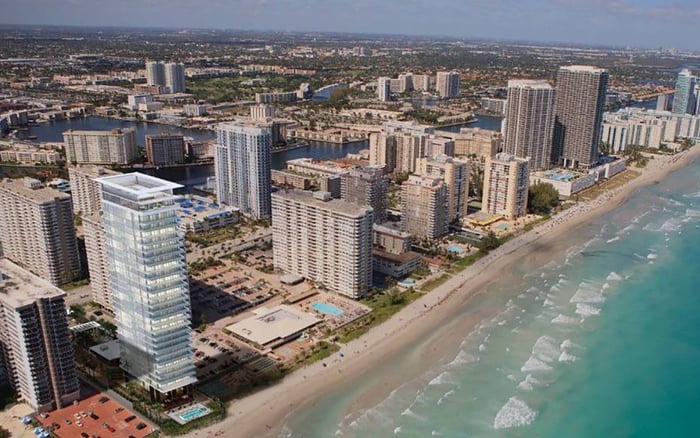
A practical guide to evaluating condominium insurance in Hallandale Beach, from replacement-cost valuations and claim authority to deductible allocation and the limits of owner-level protection.

For a Hallandale Beach condominium buyer, insurance diligence belongs alongside the floor plan, finishes, and ownership budget. The essential question is not simply whether the building is insured. It is what property is covered, who controls a claim, and how the uninsured portion of a loss could become an owner's obligation.
Across this Broward market, Florida's statewide condominium framework-not a separate city insurance regime-provides the starting point. A buyer considering 2000 Ocean Hallandale Beach should request the same clarity prudent at any condominium: the actual policy, the governing documents, and a written explanation of potential financial exposure. A project's identity is not evidence of its insurance terms.
The most useful review separates three issues that can otherwise blur together: replacement-cost valuation, the policy's appraisal provisions, and the association's authority to manage claims and allocate costs.
A replacement-cost insurance appraisal establishes the valuation used for association coverage. It is distinct from an appraisal provision that may appear in a policy to address a post-loss disagreement.
Florida's condominium insurance framework recognizes independent insurance appraisals and updates as a basis for replacement-cost valuation. The 2026 statutory wording requires replacement cost to be determined at least once every three years. Buyers should still have counsel confirm the applicable requirements rather than assume every policy must follow an identical appraisal-based approach.
Request the latest replacement-cost appraisal or valuation update and ask the insurance professional to reconcile it with the insured values. Confirm when the valuation was completed and which property it addresses.
Separately, obtain the policy's actual appraisal clause, if one exists. Ask counsel to examine its trigger, deadlines, appraiser selection, umpire procedure, costs, and relationship to any coverage dispute. Do not presume a universal procedure or assume that invoking appraisal resolves coverage questions. Establish what the contract says before a disagreement makes those words consequential.
Claim administration is as much a governance question as an insurance question. Request the declaration, bylaws, management agreement, and relevant board resolutions to identify who may report, negotiate, litigate, or settle association claims.
Ask for a written authority map identifying each function, the person or body authorized to perform it, and any required approval. A management contact alone does not establish the full scope of authority. Have counsel reconcile the documents rather than rely on a general assurance that management handles insurance.
For a purchase at Shell Bay by Auberge Hallandale, this is a document request, not an assumption about the project's arrangements. If a claim remains open, seek correspondence showing its status, unresolved issues, and decisions still awaiting authorization.
The objective is to understand who can act and what remains outstanding before the buyer's contractual review deadlines.
An association's board may establish property-insurance deductibles, subject to statutory conditions. Those deductibles must be consistent with industry standards and prevailing practice for comparable communities, taking into account size, age, construction, facilities, and location.
The board may consider available funds, including reserves, and predetermined assessment authority. Deductibles must also be established at a properly noticed board meeting under the applicable condominium meeting procedures.
For the buyer, these requirements suggest a practical document sequence:
Obtain the deductible schedule and the endorsements governing its application.
Read the relevant board notices, minutes, and resolutions.
Compare the potential uninsured amount with funds actually available for that purpose.
Have counsel identify the applicable allocation provisions and assessment authority.
Request a written scenario showing how a loss could affect the specific unit.
Do not assume a deductible is divided equally among residences. Allocation requires a review of the governing documents and applicable statutory rules. Nor should a substantial reserve balance be treated as entirely available to absorb an insurance loss; ask which funds can be used.
The useful comparison is not simply one building's deductible against another's. It is the deductible, accessible funding, and the unit's potential share considered together. If available funds do not cover the uninsured portion of a loss, owners may face an assessment.
The association's master policy does not automatically insure everything inside a residence. Florida's framework generally assigns building and common-element coverage to the association while allocating specified unit-level property to individual owners.
Flooring, wall and ceiling coverings, appliances, built-in cabinets and countertops, and window treatments deserve particular attention. For a buyer drawn to a residence's interiors, the insurance boundary warrants the same scrutiny as the specification schedule.
Ask an insurance professional to compare the proposed HO-6 policy with the master policy's exclusions, deductibles, and owner-assigned property. Request a side-by-side responsibility schedule rather than accept a shorthand description of interior coverage.
A buyer also considering Jade Signature Sunny Isles Beach can use the same review structure in Sunny Isles Beach. The questions apply across communities; the answers must come from each property's documents.
Florida separately regulates condominium unit-owner insurance and required loss-assessment coverage. That coverage is not blanket protection against every association assessment. Covered losses, limits, and the owner's policy deductible matter.
Ask the insurance professional to compare the proposed coverage with the unit's potential share of an association loss. Distinguish an assessment the policy might cover from an obligation the owner would need to fund without reimbursement. Required coverage should not be mistaken for complete financial protection.
For coastal diligence, review windstorm, named-storm, flood, water damage, roof, ordinance-and-law, equipment, and mold provisions separately. Request an explanation of relevant coverage, exclusions, and deductibles rather than infer protection from the property's location or presentation.
Assemble a single review file containing the master policy and endorsements, deductible schedule, latest replacement-cost appraisal or update, claims history, open-claim correspondence, budget, reserves, board minutes, and assessment notices.
Investigate substantial deductibles paired with limited available funds, unresolved claims, conflicting responsibility statements, and pending assessments before contractual deadlines. Ask counsel and the insurance professional to reconcile discrepancies in writing and identify any remaining financial exposure.
The goal is not a promise of ownership without insurance risk. It is a clear understanding of the property being insured, the people authorized to act, and the obligations that may remain with the buyer. That clarity makes insurance diligence part of a considered acquisition-not an administrative task deferred until closing.
For a considered approach to your South Florida property search, explore MILLION.
If branded residences are on your mind — as a home or as an allocation — we would be glad to share what we are seeing, privately.
Begin a quiet conversationThis diligence review concerns statewide Florida condominium rules applicable to Hallandale Beach, not a separate city insurance or deductible-allocation regime.
No. Replacement-cost valuation helps establish association coverage, while any post-loss appraisal provision must be examined in the actual policy.
The 2026 statutory wording requires replacement cost to be determined at least once every three years. Counsel should confirm the applicable requirements for the association.
Buyers should have counsel review the declaration, bylaws, management agreement, and board resolutions to identify settlement authority and any required approvals.
Yes, subject to statutory conditions, including comparable-community considerations and establishment at a properly noticed board meeting.
Buyers should not assume equal allocation. The applicable statutory rules and governing documents must be reviewed to determine the unit's potential share.
No. Specified unit-level property is assigned to owners, making flooring, coverings, appliances, cabinets, countertops, and window treatments important review categories.
No. Protection depends on covered losses, policy limits, and the deductible, so proposed coverage should be compared with potential owner exposure.
Request the master policy and endorsements, deductible schedule, latest replacement-cost appraisal or update, governing documents, claims history, budget, reserves, board minutes, and assessment notices.
Investigate substantial deductibles with limited available funds, unresolved claims, conflicting responsibility statements, and pending assessments with counsel and an insurance professional.