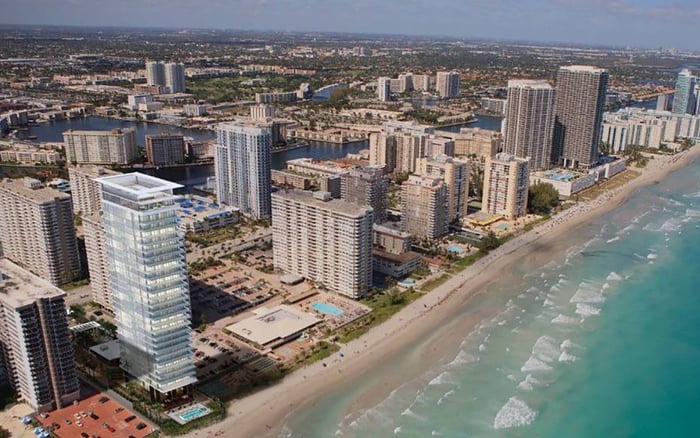
A practical framework for evaluating Hallandale Beach residences through emergency access, caregiver parking, elevator reliability, and the daily realities of high-floor mobility.

For a Hallandale Beach buyer planning around in-home care or reduced mobility, a residence should be evaluated as a sequence of movements: arriving, parking, entering, ascending, and reaching the front door. The view remains part of the pleasure of ownership. The route determines whether a workable daily routine supports that pleasure.
This is a particularly useful lens when considering 2000 Ocean Hallandale Beach. Rather than infer suitability from presentation, request an address-specific access review. A municipal program, a staffed entrance, and an elevator answer different questions; none alone establishes that a home will accommodate a particular resident’s needs.
Organize diligence into three connected maps: emergency access, caregiver access, and high-floor mobility. Each should identify the physical route, the permissions required, and the fallback when normal operations are interrupted.
Begin by confirming the primary 911 emergency medical service arrangements for the exact address with the appropriate local emergency-services contact. Separately, discuss suitable emergency-department options with the resident’s clinician. A nearby hospital name or a community-service relationship does not confirm a transport destination.
The building review should follow the responder’s path. Inspect the ambulance approach, stopping location, entrance, elevator connection, corridor, and unit doorway. Ask management how responders gain access after hours, who handles elevator override procedures, and what happens if the resident cannot open the door. Have management explain the curb-to-unit stretcher route; a generous lobby is no substitute for that review.
Keep street arrival separate from patient access. An emergency service’s average-arrival objective is not a guaranteed response time for a condominium, nor does it establish the time needed to reach someone on a high floor. The practical question is what must happen between arrival at the property and arrival beside the resident.
Record who is responsible for each access step and ask how those arrangements remain available outside ordinary management hours.
Hallandale Beach offers a caregiver parking permit for people providing in-home health or personal-care services to residents. The application requires a resident affidavit confirming the caregiving relationship. A qualifying vehicle may be owned or leased by the caregiver, or it may be a commercial vehicle owned or leased by the caregiver’s agency.
Resident and caregiver permits are separate monthly options; do not assume their conditions are interchangeable. Designated residential parking areas include Golden Isles Drive, Diana Drive, and Three Islands, but the applicable zone must be confirmed for the address under consideration.
For eligible residents and their registered vehicles, resident-zone permits cover the qualifying zone 24 hours a day, seven days a week, subject to restrictions. They do not provide citywide parking privileges; parking elsewhere requires the applicable hourly payment. Monthly permits are issued by calendar month, are nonrefundable, and are not prorated.
A city permit does not confer permission to enter a private garage. When evaluating Shell Bay by Auberge Hallandale, obtain the property’s written caregiver rules rather than carrying municipal assumptions into the purchase decision. Confirm recurring visitor registration, overnight stays, guest spaces, valet use, accessible parking, and loading arrangements.
For current municipal permit questions, contact Parking Services at (954) 457-1400, Monday through Thursday, 8 a.m. to 5 p.m., or [email protected]. Confirm caregiver-specific restrictions directly before building a staffing schedule around a permit.
A useful parking test should mirror the intended routine. Visit at the caregiver’s likely arrival and departure times, including an evening or overnight shift if relevant. Check where the vehicle may stop, where it may remain, and how equipment moves from the vehicle to the residence.
Ask management to explain the process for a substitute caregiver, an agency vehicle, and two caregivers overlapping at a shift change. These are diligence questions, not assumptions about what a property permits. Written answers help distinguish dependable access from a courtesy that depends on a particular staff member.
For buyers comparing Broward residences with Turnberry Ocean Club Sunny Isles in Sunny Isles Beach, carry the same operational checklist across the search-not Hallandale Beach permit rules. Each property and jurisdiction requires its own parking and entry review.
Test the full sidewalk-to-unit and garage-to-unit routes using the resident’s actual wheelchair, walker, or other mobility equipment. Verify step-free access, doorway clearance, turning space, thresholds, and elevator dimensions. A route that looks straightforward during a showing may still require a practical trial.
Confirm service-elevator availability and the rules governing its use. Ask whether the proposed daily route depends on staff assistance, a particular entrance, or an elevator that may be unavailable at certain times. Where management identifies an alternative route, test it.
Hallandale Beach maintains an ADA accessibility program and transition plan for public facilities. That public commitment does not establish the suitability of a private condominium. Evaluate the residence, its common areas, and its operating procedures separately, with the resident’s needs setting the standard.
Request the building’s emergency plan and distinguish normal elevator operation from storm and outage procedures. Ask when elevators are shut down, what equipment the generator serves, and whether it supports any elevator operation. A generator’s presence does not confirm uninterrupted access or power inside the unit.
For residents using powered medical equipment, identify charging arrangements and discuss a suitable backup plan with the resident’s care team. Confirm how management communicates during an interruption and what arrangements exist for residents unable to use stairs. Informal assurances of assistance are not a documented plan.
Request current elevator, generator, and fire-system inspection records. Review them alongside the emergency procedures, not as substitutes for them. Equipment condition, operating policy, and resident-specific support answer different questions.
Before committing, assemble a concise access file: the mapped responder route, written caregiver parking rules, tested mobility routes, inspection records, and the outage plan. Assign every unresolved item to the person responsible for answering it. A reassuring tour should not close an operational question that remains undocumented.
The objective is not to predict every emergency. It is to choose a home whose everyday conveniences and contingency arrangements have been examined with the same care as its finishes and outlook.
For a discreet property search shaped around these priorities, explore MILLION.
If branded residences are on your mind — as a home or as an allocation — we would be glad to share what we are seeing, privately.
Begin a quiet conversationYes. The permit is for people providing in-home health or personal-care services to residents, and the application requires a resident affidavit confirming the caregiving relationship.
A qualifying vehicle may be owned or leased by the caregiver, or it may be a commercial vehicle owned or leased by the caregiver’s agency. Confirm the applicable permit requirements before arranging parking.
Do not assume it does. Obtain the property’s written rules for caregiver entry, parking, recurring visits, and overnight access separately.
Designated areas include Golden Isles Drive, Diana Drive, and Three Islands. Confirm the zone applicable to the exact address.
No. It covers the qualifying zone around the clock, subject to restrictions; parking elsewhere requires the applicable hourly payment.
Monthly permits are issued by calendar month and are nonrefundable and not prorated. Consider that timing when coordinating a move or caregiver start date.
Confirm address-specific emergency-service arrangements and inspect the complete ambulance-to-unit route. Ask management about after-hours entry, elevator override, and access if the resident cannot open the door.
No. An average-arrival objective is not a guaranteed response time, and reaching the property is distinct from reaching the resident’s unit.
Test sidewalk and garage routes with the resident’s actual mobility equipment. Verify step-free access, clearances, elevator dimensions, and service-elevator availability.
Request the emergency plan and confirm actual generator coverage, elevator shutdown procedures, communications, and arrangements for residents unable to use stairs. Coordinate medical-device backup needs with the resident’s care team.