A practical framework for Bal Harbour buyers to distinguish private arrival from exclusive elevator control, verify guest authorization, and trace service routes before committing to a residence.
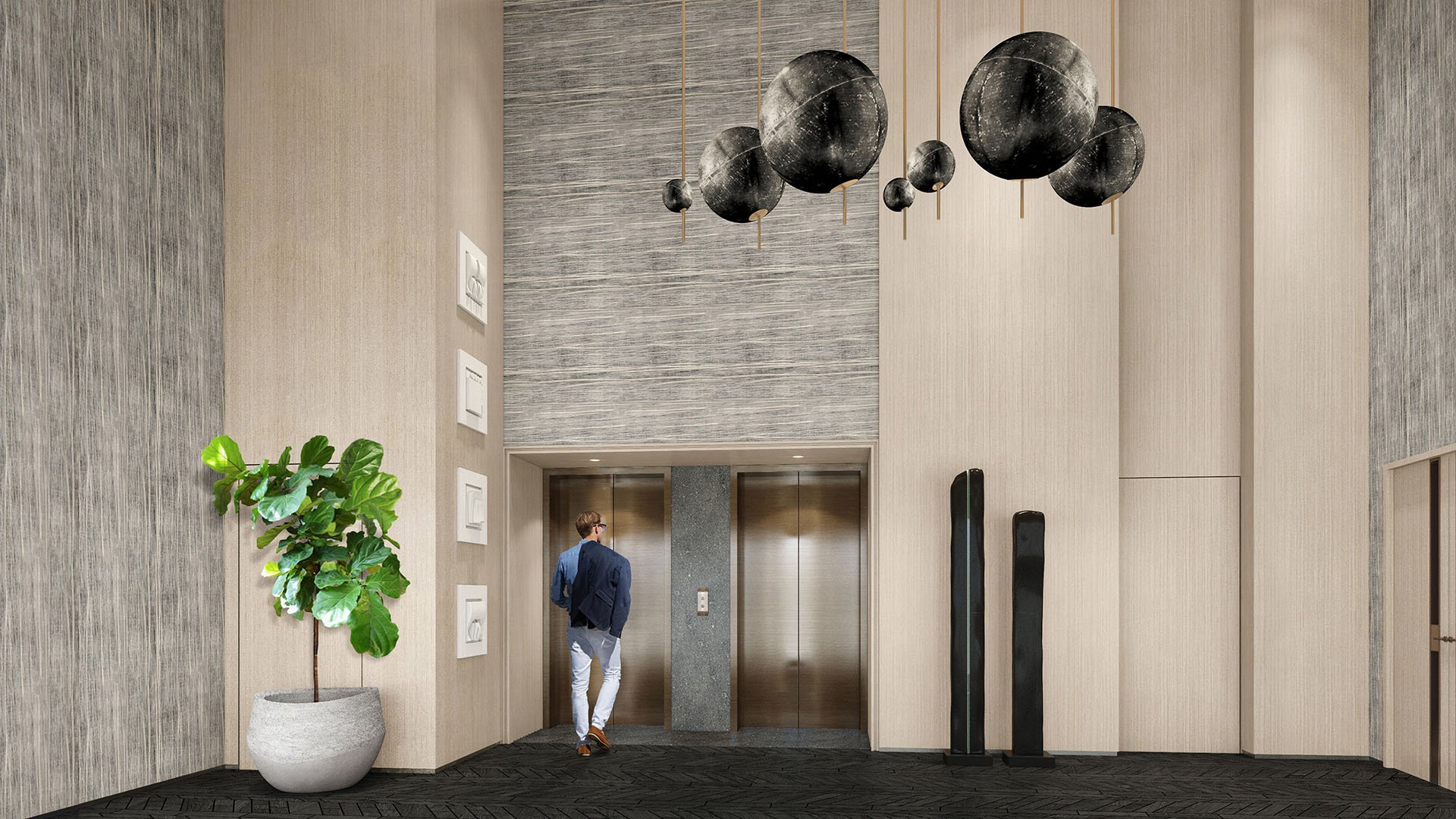
In Bal Harbour, an elevator opening into a residence can make arrival feel exceptionally discreet. Yet the architectural experience and the access-control system are distinct. A private gallery describes a space; it does not establish who can authorize the elevator, which other residences the car serves, or how visitors and household staff reach the door.
For a buyer, the question is not simply whether an apartment has a private elevator. It is whether the full arrival sequence delivers the privacy the household expects. Evaluate three connected elements: elevator control, visitor authentication, and service-entry separation. Treat each as a separate diligence item rather than letting one attractive feature stand in for all three.
The Palace illustrates why unit-level confirmation matters. Private elevators opening directly into residences are advertised, and one apartment is marketed with two private elevators providing direct entry. That apartment-specific description should not be extended to every residence or read as proof that each elevator car is exclusive to a single home.
At Majestic Tower, 9601 Collins Avenue, private elevator access is advertised for selected units. The distinction matters: the building's identity alone cannot establish the configuration of the apartment under consideration. Its separately advertised 24-hour security system does not explain how a visitor gains floor authorization.
At Oceana Bal Harbour, advertised private elevator galleries open directly into residences. Request the specific unit plan, common-area plan, elevator schedule, and current access rules. Ask management to distinguish a dedicated car from a shared car serving private or semi-private foyers. These arrangements may feel similar during a quiet showing while offering different degrees of exclusivity.
If Rivage Bal Harbour is also on your shortlist, carry over those questions-not another building's answers. Compare residences against the same standard of evidence without presuming equivalent access arrangements.
With management's permission, arrange a demonstration from vehicle arrival to the residence door. Follow each step: entrance, lobby screening, elevator authorization, floor selection, vestibule access, and the final threshold. At every transition, ask who grants access and whether that permission applies only to the intended destination.
The demonstration should explain ordinary operation, not attempt to defeat the system. Ask management to show the approved resident and guest journeys and explain how they differ. Establish whether the elevator opens into the apartment itself, an enclosed foyer, or a landing shared with another residence.
Then separate design from permissions. A beautiful vestibule may offer visual privacy without answering who can reach it. Clarify which credentials permit access, who administers them, and how changes are recorded. The objective is a clear account of the residence's authorized access sequence, not a collection of reassuring adjectives.
A staffed entrance is a starting point, not a complete visitor protocol. At Oceana, advertised security includes a 24/7 manned gated entry. At One Bal Harbour, advertised features include on-site 24/7 security and a gated entrance. Neither description, by itself, establishes how an individual visitor receives residential-floor authorization.
Request the written guest procedure and discuss the details that matter to your household: whether identification is required, how resident confirmation occurs, whether an escort is used, and whether visits are logged. Ask how the procedure handles an unannounced caller, an overnight arrival, or a guest arriving when the owner is unavailable. These are questions to verify, not practices to assume.
At Harbour House, advertised features include controlled access, a 24-hour front desk, concierge, and security services. Those features support a discussion about staffed arrival; they are not evidence of private elevator foyers or a particular authentication method. Keep staffing, physical layout, and authorization rules separate in your comparison.
One Bal Harbour is attached to the Ritz-Carlton Hotel and is described as offering private elevator foyers. A private foyer does not prove that the elevator car serves only one residence, nor does the hotel's presence establish how residential access is managed. Request a comparison of residential routes with hotel, restaurant, valet, and beach circulation.
At St. Regis Bal Harbour, dedicated residential arrival and elevator systems are described as separate from resort circulation, while residents retain access to resort services. Descriptions also include private or semi-private elevator foyers, with private foyers in selected units. Confirm both the residential route and the particular apartment's landing arrangement.
For a search extending into Surfside and The Surf Club Four Seasons Surfside, maintain the same distinction between access to hospitality services and control over residential arrival. Request property-specific confirmation rather than assuming the Bal Harbour examples establish another address's operating model.
At Oceana, advertised features include high-speed elevators and a separate service elevator. A separate car is a concrete feature to investigate, but it does not establish end-to-end service separation. The loading entrance, staff corridors, landings, and permissions still require confirmation.
Ask management to walk the authorized route from the loading area to the service elevator and, where applicable, the apartment's service door. Identify shared landings and any points where service and residential circulation intersect. Confirm operating hours, reservation requirements, and who can authorize a vendor's access.
Include the household's actual needs: furniture installation, contractors, recurring staff, and food deliveries. Ask whether each follows the same route and what happens outside normal service hours. A clear distinction between the main and service entrances matters less if the permitted routes converge before the residence threshold.
Bring the findings together in a concise, residence-specific record. For each privacy claim, note the relevant plan, management's explanation, the observed authorized route, and any unresolved question. Compare marketing language with current rules, relevant board minutes, and elevator modernization records. Do not treat the original description as a permanent operating commitment.
Review credential administration with equal care. Ask how lost cards are disabled, how former employees lose access, how contractors receive temporary permissions, and how standing household-staff credentials are authorized, revoked, and logged. Request the applicable policy without seeking other residents' personal information or sensitive system details.
If access privacy is decisive, discuss precise contractual representations with counsel. The strongest purchase decision distinguishes what is advertised, what the specific apartment provides, and what current rules permit. Discretion is most valuable when its boundaries are understood before closing.
For a considered approach to your Bal Harbour residence search, explore MILLION.
If branded residences are on your mind — as a home or as an allocation — we would be glad to share what we are seeing, privately.
Begin a quiet conversationNo. A private foyer does not establish that the car serves only one residence; confirm the elevator schedule and unit-specific arrangement.
Request the unit plan, common-area plan, elevator schedule, and current access rules. Compare them with management's explanation of the authorized arrival route.
The supplied apartment-level description advertises two private elevators for one residence. It does not establish that configuration throughout the building.
Private elevator access is advertised for selected units. Confirm the arrangement for the particular apartment being considered.
Oceana advertises a separate service elevator. Buyers should still verify the loading entrance, corridors, landings, and vendor permissions.
No. Staffing and security descriptions do not establish identification requirements, resident confirmation, or residential-floor authorization procedures.
Confirm the private foyer configuration and residential-floor authorization process. Compare residential routes with hotel, restaurant, valet, and beach circulation.
Descriptions include private or semi-private elevator foyers and private foyers in selected units. Exclusive foyer access should be confirmed for the specific residence.
Ask how standing credentials are authorized, revoked, and logged, including when an employee leaves. Also confirm the permitted entrance and route to the apartment.
Reconcile plans, current rules, and management confirmation before committing. Discuss precise contractual representations with counsel if the access arrangement is decisive.