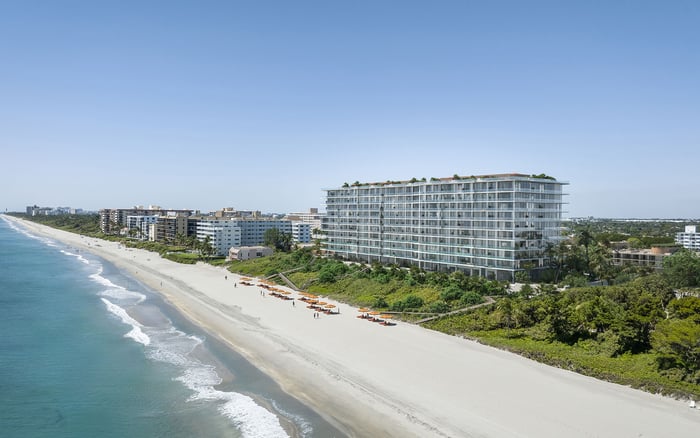
A practical framework for evaluating condominium insurance exposure in Hillsboro Beach, from master-policy deductibles and HO-6 limits to loss-assessment coverage and closing diligence.

In Hillsboro Beach, condominium insurance diligence should begin with the association’s current documents rather than an HO-6 premium alone. The objective is to understand how the master policy, governing documents, and proposed unit policy divide responsibility after a loss.
For an Oceanfront or Waterfront residence, buyers should identify which losses the association retains, how costs may be allocated among owners, and whether the proposed HO-6 policy would respond. The same review is relevant to a Resale, Investment, or Second-home purchase.
This framework applies when considering Rosewood Residences Hillsboro Beach and comparing nearby coastal properties. The quality of a residence does not replace policy-level review.
Request the current master-policy declarations and review them alongside the condominium declaration, bylaws, and other governing documents. Ask qualified insurance and legal advisers to identify which building elements, unit components, finishes, fixtures, improvements, and personal property fall to the association or owner.
Do not rely on broad descriptions such as “walls in” or “bare walls” without confirming how the controlling documents apply to the specific residence. If the unit has upgraded interiors, obtain an appropriate replacement-cost evaluation before selecting the HO-6 dwelling limit.
Record the master policy’s stated insured values, limits, covered property, deductibles, exclusions, and relevant endorsements. Confirm that the documents reviewed are current and apply to the association being considered.
Identify whether each master-policy deductible is stated as a percentage or a fixed amount. If it is percentage-based, confirm the value to which the percentage applies and ask the association’s insurance representative to explain the calculation in writing.
Review hurricane, wind, named-storm, flood, and other deductibles separately rather than assuming one figure applies to every event. Then verify how the governing documents permit an association cost to be allocated among owners.
Do not assume that a deductible will be divided equally among residences. Apply the same document-based discipline when comparing Armani Casa Residences Pompano Beach and The Ritz-Carlton Residences® Pompano Beach, without presuming that different associations structure coverage or allocations alike.
Ask whether the proposed HO-6 policy has a separate hurricane or named-storm deductible and how that deductible is calculated. The analysis should distinguish between damage assigned to the unit owner and any association cost allocated to the owner.
For loss-assessment coverage, obtain written confirmation of the limit, covered causes of loss, deductible, exclusions, and any sublimit relevant to a master-policy deductible. Do not treat a headline endorsement limit as confirmation that the entire amount applies to every assessment.
Have the insurance adviser explain the conditions that must be satisfied before coverage can respond. The explanation should address the originating event, the association’s basis for the assessment, the applicable policy period, and any notice requirements.
A special assessment should not be presumed insured merely because the association has imposed it. Ask the insurance adviser to evaluate the event giving rise to the assessment and the exact HO-6 language before estimating reimbursement.
Review maintenance, reserve funding, upgrades, deterioration, deductibles, exclusions, and exhausted limits as separate categories. This prevents the phrase “fully insured” from obscuring costs that may remain with the association or unit owners.
Optional loss-assessment limits should be considered in light of the building’s current insurance documents, the allocation provisions in the governing documents, the proposed HO-6 terms, and the buyer’s capacity to retain risk.
Before closing, compare the master-policy declarations, governing documents, current budget, assessment disclosures, meeting materials made available during diligence, and proposed HO-6 declarations. Direct policy-interpretation questions to qualified insurance and legal professionals.
Ask the insurance adviser to model several document-based scenarios, including damage within the residence, an owner allocation associated with a master-policy deductible, and a loss that reaches a stated policy limit. For each scenario, record the association deductible, allocation method, estimated owner share, HO-6 coverage trigger, applicable sublimit, exclusions, and owner-policy deductible.
The goal is not to predict a future claim. It is to establish which documents govern each layer, what remains uncertain, and how much financial exposure the buyer is prepared to retain.
What should a Hillsboro Beach condominium buyer review first? Start with the current master-policy declarations and governing documents, then compare them with the proposed HO-6 policy.
Why should the master policy and condominium documents be read together? The policy describes insurance terms, while the governing documents help establish responsibility for property and allocated costs.
How should a buyer evaluate HO-6 dwelling coverage? Confirm which interior components and improvements are the owner’s responsibility, then obtain an appropriate replacement-cost evaluation.
What should a buyer verify about a wind deductible? Confirm whether it is percentage-based or fixed, what value any percentage uses, and how an association cost may be allocated.
Should buyers assume an association deductible is divided equally? No. The allocation method should be verified in the applicable governing documents with qualified advisers.
Can the HO-6 policy have a separate storm deductible? Review the proposed policy for any hurricane or named-storm deductible and ask the insurer to explain how it would be calculated.
What details matter in loss-assessment coverage? Verify the limit, covered causes of loss, deductible, exclusions, sublimits, policy period, and notice requirements.
Does every special assessment qualify for insurance reimbursement? Do not presume coverage; the originating event, assessment basis, and exact policy language require review.
Which closing documents help reveal retained insurance risk? Review the insurance declarations, governing documents, budget, assessment disclosures, available meeting materials, and proposed HO-6 declarations.
Who should interpret condominium insurance and allocation provisions? Direct insurance questions to a qualified insurance professional and legal questions to qualified counsel familiar with the transaction.
For a confidential assessment and a building-by-building shortlist, connect with MILLION.
If branded residences are on your mind — as a home or as an allocation — we would be glad to share what we are seeing, privately.
Begin a quiet conversation