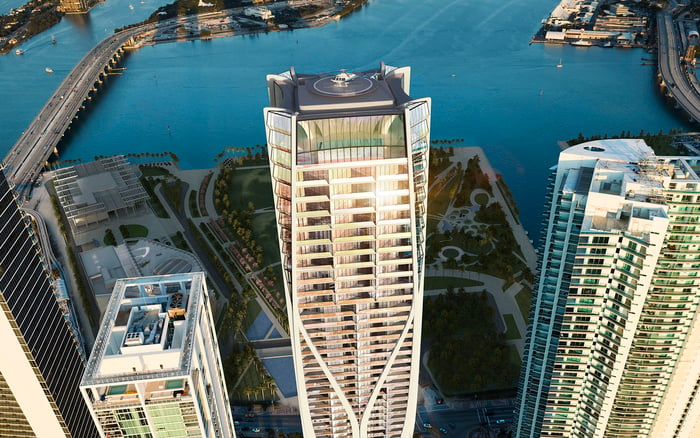
A buyer-focused framework for reviewing circulation, public areas, access controls, and residence-owner privacy when considering Bentley Residences Sunny Isles and EDITION Edgewater.

For buyers considering Bentley Residences Sunny Isles and EDITION Edgewater, privacy should be evaluated as an operating sequence rather than an aesthetic promise. The central questions are who may enter the property, where each user is directed, which credentials open each threshold, and where residents could encounter other users between the curb and their residence.
A hospitality-associated name does not, by itself, establish that hotel guests will use a property. Likewise, a residential presentation does not explain how visitors, staff, vendors, or event invitees will move through a building. Buyers should verify the actual operating plan through current project and condominium documents.
A useful review begins at the property line and follows each user category to its destination. Buyers should separately trace residents, personal guests, hospitality-related users if applicable, valets, delivery workers, contractors, domestic staff, building employees, and emergency personnel.
The review should identify the relevant arrival areas, parking zones, lobby thresholds, elevator banks, residential floors, amenities, loading areas, and back-of-house spaces. It should also establish where routes remain separate and where they intersect.
Buyers comparing other South Florida residences, including The Ritz-Carlton Residences® Sunny Isles and Aria Reserve Miami, can apply the same method. The objective is to compare documented access arrangements rather than infer privacy from branding, renderings, or lobby design.
Public-facing and shared spaces deserve careful attention because privacy can change throughout the day. Buyers should ask whether any lobby, lounge, wellness area, pool, dining space, meeting room, or event area may be used by non-residents and under what conditions.
If hotel guests or hospitality-related users are contemplated, the documents should clarify whether they have separate arrivals, elevators, amenities, or service routes. If no such users are contemplated, buyers should still examine access for resident guests, private events, vendors, deliveries, and building personnel.
Amenity rules should explain who may authorize guests, how access is registered, whether credentials expire, and whether private functions can affect resident use. Buyers should also ask how the building manages peak arrivals, deliveries, maintenance periods, and emergency operations.
An access matrix can turn a broad privacy discussion into a practical review. For every user category, it should identify permitted entrances, parking or loading areas, doors, elevators, floors, amenities, and service zones.
The matrix should be reconciled with stacked floor plans, elevator diagrams, amenity rules, security procedures, and relevant governing or operating documents. Any inconsistency between a sales presentation and the controlling documents should be resolved before a purchase decision.
Buyers should also determine who controls access policies and whether those policies may change. A circulation plan may appear private at launch, but the governing framework determines how access is administered over time.
Residence-owner privacy depends on the cumulative strength of multiple thresholds. A private arrival loses value if residents must cross a heavily used public area, while a restricted elevator may offer limited protection if amenities or service corridors remain broadly accessible.
The goal is not necessarily absolute separation. It is a documented circulation plan that matches the buyer’s expectations regarding discretion, convenience, guest access, staffing, deliveries, and shared-space use.
Before signing, buyers should request current written materials and review them with appropriate legal and technical advisers. Plans, rules, access schedules, and operating documents provide a stronger basis for evaluating privacy than renderings or verbal descriptions alone.
Why should buyers review circulation before purchasing? Circulation determines where residents may encounter guests, staff, vendors, or other users between arrival and the residence.
Does a hospitality-associated brand confirm that hotel guests will use the property? No. Buyers should verify whether hospitality-related users are contemplated and what access they may receive.
What is a curb-to-residence route review? It traces each user category from the property entrance through arrival areas, elevators, shared spaces, and residential floors.
What should an access matrix include? It should identify which entrances, doors, elevators, floors, amenities, parking areas, and service zones each user type may access.
Which documents can help evaluate privacy? Buyers can request stacked plans, elevator diagrams, amenity rules, access schedules, security procedures, and governing or operating documents.
Why do amenity rules matter? They may clarify who can use shared spaces, invite guests, hold functions, and authorize access.
Should buyers examine service circulation? Yes. Delivery, contractor, employee, and maintenance routes can affect privacy even when resident arrivals are controlled.
Can renderings prove that circulation is separate? No. Renderings illustrate design intent but do not establish operating permissions or access controls.
Who should clarify conflicts between marketing and governing documents? Buyers should seek clarification from the appropriate project representatives and review controlling documents with qualified advisers.
What is the central privacy question for these projects? The key question is whether documented access arrangements align with the owner’s expectations for arrivals, shared spaces, guests, and services.
If you'd like a private walkthrough and a curated shortlist, connect with MILLION.
If branded residences are on your mind — as a home or as an allocation — we would be glad to share what we are seeing, privately.
Begin a quiet conversation