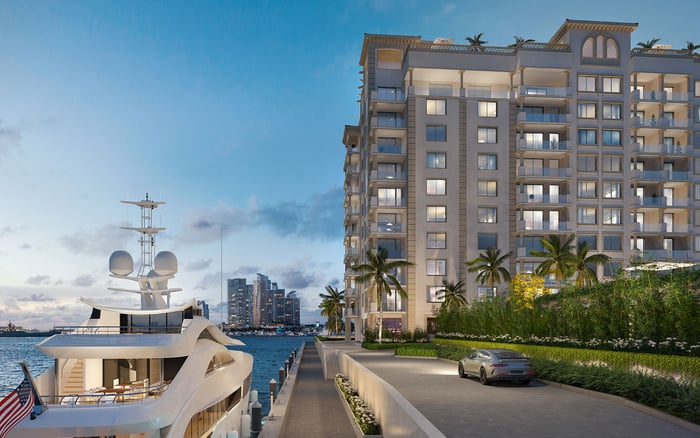
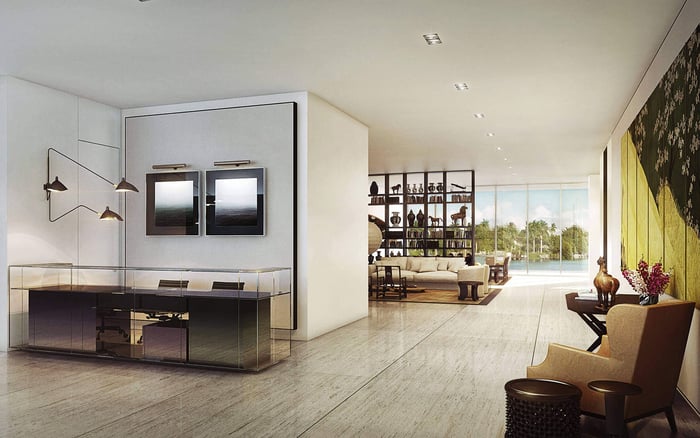
A discreet residence depends on the full journey from curb to home. This buyer-focused review explains how to assess private arrival, elevator access, household-staff circulation, deliveries, and visitor control when considering 57 Ocean Miami Beach and Delano Residences & Hotel Miami.

In an ultra-premium South Florida residence, privacy is not defined by a single lobby desk, camera, or elevator. It emerges from the way a property manages each transition between the street, vehicle drop-off, reception area, elevators, amenity spaces, service areas, and the home itself.
That operating sequence deserves close attention when comparing 57 Ocean Miami Beach with Delano Residences & Hotel Miami. Rather than relying on renderings or broad service language, buyers should establish who may use each route, where access is granted, and how simultaneous arrivals are handled.
Residential privacy is best evaluated as a complete journey, not a single amenity.
A useful review begins at the street. Buyers should identify where residents, guests, rideshare vehicles, household employees, vendors, and deliveries are expected to arrive. The next question is whether those groups proceed through the same entrance or move into separate circulation paths.
At each property, request the most current arrival and circulation materials available. Trace the route from vehicle handoff to the residential elevator and note every point where a resident may encounter other users. Review sightlines, waiting areas, door locations, reception procedures, and the distance between the arrival point and controlled residential access.
The physical design is only one part of the assessment. Buyers should also ask who manages the arrival area, how an unexpected guest is handled, where a driver waits, and what occurs when multiple vehicles reach the property at once. A polished entrance can still feel exposed if queues, waiting visitors, or service activity collect beside the resident route.
The names and positioning of 57 Ocean Miami Beach and Delano Residences & Hotel Miami may set different expectations, but buyers should avoid assuming that either scale or branding guarantees a particular level of privacy. The relevant evidence is the project-specific circulation plan and the operating protocol intended to support it.
For 57 Ocean, buyers can focus on how the principal residential journey is protected from guest, vendor, and delivery movement. Questions should cover the point at which access becomes controlled, how visitors reach an approved residence, and whether service activity uses a distinct path.
For Delano Residences & Hotel Miami, the review should pay particular attention to the relationship between residential and hospitality-oriented movement. Buyers should ask whether different user groups have separate entrances, reception areas, elevator banks, or destination controls. If any spaces or routes are shared, the operating documents should explain where separation begins and how residential access remains controlled.
This same method applies when considering other South Florida service-led properties, including Setai Residences Miami Beach and Faena Residences Miami Downtown Miami. The important exercise is to map each user group from arrival to destination rather than treating access control as a single front-desk function.
Elevators are a critical link between a public or semi-public arrival and a private residence. Buyers should determine whether access is controlled by floor, destination, time window, credential type, or staff authorization. They should also ask whether a guest can select an unapproved floor and what happens if a host does not respond.
The elevator review should extend beyond the resident cab. Identify any service elevators, transfer levels, shared vestibules, and back-of-house connections. A route that appears separate on a plan may still create encounters if residents and service personnel converge at the same landing or corridor.
Buyers should request a clear explanation of normal operations and exception handling. Power interruptions, access-system failures, moves, events, large deliveries, and maintenance work can alter the intended circulation pattern. The goal is not to eliminate every overlap but to understand how the building plans to manage it.
Household employees should be evaluated as a distinct user group rather than placed automatically in the visitor category. A nanny, chef, housekeeper, personal assistant, trainer, or wellness professional may need recurring access, may carry equipment, or may arrive while the owner is away.
Ask whether recurring staff can receive credentials limited by floor, day, or time. Determine who creates, changes, and revokes those permissions. Buyers should also establish whether household employees enter through the principal lobby, a staffed service entrance, or another controlled point.
The route itself matters as much as the credential. Follow the proposed path from arrival or parking to screening, elevator access, and the residence. If supplies or equipment are involved, confirm where they can be unloaded and whether the route crosses resident gathering areas.
Privacy also has an information component. Buyers may wish to ask what arrival records are maintained, who can view them, and how staff access is handled when an owner changes household personnel. Any answers should be confirmed in the applicable project or building documents rather than inferred from general marketing language.
Parcels, groceries, flowers, luggage, catered items, furnishings, and maintenance materials create different circulation needs. A buyer should determine where each type of delivery is received, screened, stored, and released.
Review whether delivery personnel proceed beyond a receiving area or whether building staff complete the final movement. Ask how oversized items are scheduled, where refrigerated or time-sensitive goods wait, and how an owner is notified. For direct-to-residence service, verify the approved elevator and corridor route.
A service elevator does not by itself establish separation. The loading point, holding space, screening process, credential procedure, and final approach to the residence must work together. Buyers should look for a complete operating sequence rather than a single service feature.
Visitor control begins before arrival. Establish who may approve a guest, how approval is communicated, and whether advance registration is required. At arrival, determine how identity is checked and whether a credential is digital, physical, escorted, or issued through another method.
Then follow the guest beyond reception. Buyers should ask whether access is restricted to an approved floor or destination, where a visitor waits if the resident is unavailable, and how credentials expire. Drivers, contractors, event attendees, vendors, and household employees may require different rules, so each category should be addressed separately.
Departure procedures also deserve attention. Ask whether temporary credentials deactivate automatically, whether guests can re-enter without renewed approval, and how management responds to a lost credential. The answers can reveal whether access control functions as an integrated system or a collection of disconnected steps.
Documents and diagrams should be supplemented by observation whenever possible. Visit during a busy period and trace the journey from the street to the residential access point. Note vehicle queues, lobby activity, waiting locations, elevator dispatch, and any overlap with service movement.
Ask the sales or management team to explain several realistic scenarios: an owner arriving with luggage, a guest reaching the correct floor, a household employee entering while the owner is away, a grocery delivery, and a large scheduled delivery. Compare each explanation with the physical plan and available operating materials.
The choice between 57 Ocean Miami Beach and Delano Residences & Hotel Miami should reflect the buyer's preferred operating experience as well as the architecture. Careful review of arrival paths, staff circulation, visitor credentials, elevator controls, and delivery procedures can help distinguish an appealing presentation from a privacy system suited to daily life.
For discreet guidance when evaluating South Florida residences, connect with MILLION.
If branded residences are on your mind — as a home or as an allocation — we would be glad to share what we are seeing, privately.
Begin a quiet conversationThe full route shows where residents may encounter guests, staff, vendors, or deliveries. It also reveals where access first becomes controlled.
Buyers should review entrances, waiting areas, sightlines, vehicle queues, and the path from drop-off to residential access.
They should compare project-specific circulation plans and operating procedures rather than relying on branding or broad service language.
Buyers should ask whether credentials restrict users by floor, destination, time, or authorization and how exceptions are handled.
Household employees may need recurring or owner-absent access. Their credentials and routes should therefore be evaluated independently from ordinary guest access.
They should trace the route from arrival and screening through elevator access, shared corridors, and the residence.
They should ask where deliveries are received, screened, stored, and transferred and whether delivery personnel can proceed beyond receiving areas.
Buyers should verify who approves visitors, how identity is checked, what destinations are permitted, and when access expires.
Departure procedures determine whether temporary credentials deactivate properly and whether a visitor can re-enter without renewed approval.
A busy arrival period can provide a clearer view of vehicle flow, visitor waiting, elevator use, and service activity.