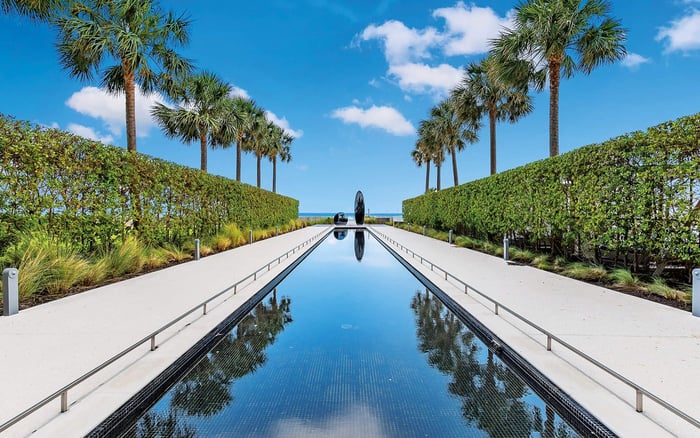
For Sydney households relocating to Miami, Key Biscayne offers an unusually composed residential setting near the urban core. The decisive issue is not mileage, but whether work, school, and travel patterns suit an island served by one mainland road corridor.

For Sydney buyers moving a company, assuming a leadership role, or establishing a family office in Miami, Key Biscayne can appear to satisfy two ambitions at once: proximity to the commercial center and meaningful distance from its intensity. The island village sits about seven miles south of downtown Miami, defined by beaches, parks, residential streets, and a strong sense of community.
That geography, however, changes the logic of relocation. Key Biscayne is primarily an executive and family residential base, not a dense office district. Leadership can live on the island while maintaining an office in Brickell or another mainland business center, but the household must organize its routine around the Rickenbacker Causeway, the island's only road connection to the mainland.
The defining variable is not distance alone, but dependence on one corridor.
Sydney purchasers should not be treated as a uniform buyer category. The more useful lens is the internationally mobile executive household: where leadership works, when children travel, how often flights depart, and how much schedule variability the family can comfortably absorb.
The Key Biscayne-to-Brickell drive spans a broad practical range. About 16 minutes is typical under normal conditions, while Brickell and downtown are roughly 15 to 20 minutes away outside peak traffic. A wider range of 15 to 25 minutes better illustrates how conditions can alter the experience. A 12-minute trip is best understood as a favorable case, not a dependable daily promise.
The causeway is approximately 3.6 miles long and carries cars, buses, bicycles, and rideshare traffic. As the only road link, it offers none of the alternative driving routes available in mainland neighborhoods. That constraint matters more than a simple map measurement, particularly when a board meeting, school arrival, or airport check-in leaves little tolerance for delay.
Metrobus Route 26 connects the island with Brickell Station in approximately 23 minutes. Residents' mean journey to work is 23.7 minutes. Both figures add context, but neither substitutes for testing the buyer's exact door-to-door journey.
Executives comparing an island residence such as Oceana Key Biscayne with a mainland option such as Una Residences Brickell should therefore compare routines, not merely properties. The relevant calculation includes garage departure, causeway conditions, office arrival, parking, and the return trip during the household's normal hours.
Key Biscayne is most practical when the corporate and residential addresses serve different purposes. The office can remain in Brickell, Downtown Miami, or another mainland district, while the island becomes the private home base. This separation can suit established professionals and end users who value a calmer residential environment over immediate access to dense office inventory.
The operating model should be tested before the home is selected. A chief executive with fixed early meetings has a different tolerance from a principal who controls the calendar or works partly from home. The same applies to a household managing multiple school runs, frequent mainland appointments, or staff moving between home and office.
For a corporate move, the residence should be mapped against the actual workplace rather than a generalized neighborhood estimate. Buyers should make trial journeys for intended arrival times, repeat them during busier periods, and assess the return schedule. The objective is not to prove that the commute is short, but to establish whether its variability fits the way leadership actually works.
Choosing Key Biscayne exchanges some mainland convenience for greater physical separation from Miami's urban core. For many buyers, that is precisely the point. The island presents a family-oriented alternative with waterfront character, beaches, parks, and residential streets, while remaining relatively close to the city's principal business districts.
Yet it should be weighed against other primary-neighborhood strategies. Coconut Grove may appeal to households seeking a mainland residential setting, with Park Grove Coconut Grove providing a relevant point of comparison. Coral Gables can enter the discussion for buyers evaluating another established mainland base, including residences such as Ponce Park Coral Gables. These alternatives do not reproduce Key Biscayne's island separation, but they eliminate dependence on its single road connection.
The correct primary neighborhood is the one that best aligns three calendars: work, school, and travel. A household whose daily center of gravity remains near Brickell may accept the causeway in exchange for island life. One with commitments distributed widely across the mainland may place greater value on route choice.
Miami International Airport is about 30 minutes from Key Biscayne. That can work for frequent flyers, but reliability should be tested around the household's usual departure windows. An executive taking early international flights may experience the route differently from a family leaving during a busy weekday period.
Airport planning should also account for the first stage of every trip: reaching the mainland. For Sydney-connected households accustomed to long-haul travel, this does not necessarily disqualify the island. It simply makes airport buffers, driver scheduling, and causeway conditions part of the travel protocol rather than an afterthought.
Before committing, buyers should conduct a live relocation rehearsal. Drive from the prospective home to the office for the required arrival time. Repeat the journey for school drop-off, afternoon activities, and a realistic airport departure. Include rideshare or driver arrangements where they will form part of the household's lifestyle.
This is equally important for a primary purchase and a second home that may later become a full-time base. The island works best for buyers who actively choose its separation and can accommodate one mainland corridor. It is less naturally aligned with purchasers who require spontaneous, multidirectional access to dense office inventory throughout the day.
The result is a precise trade: Key Biscayne does not remove the city from daily life, but it places a threshold between home and the urban core. For the right executive household, that threshold creates privacy and residential clarity. For another, it may introduce more logistical structure than the business and family calendar can support.
For discreet guidance on comparing Key Biscayne with Miami's mainland neighborhoods, connect with MILLION.
If branded residences are on your mind — as a home or as an allocation — we would be glad to share what we are seeing, privately.
Begin a quiet conversationKey Biscayne is about seven miles south of downtown Miami.
The Rickenbacker Causeway is the island's only road connection to mainland Miami.
Typical estimates cluster around 15 to 20 minutes, while a broader 15 to 25 minute range better reflects changing traffic conditions.
It can represent a favorable trip, but it should not be treated as a guaranteed daily commute.
Yes. The island is most practical as a residential home base while the office remains in Brickell or another mainland business district.
Yes. Metrobus Route 26 connects Key Biscayne with Brickell Station, with a published scheduled trip of approximately 23 minutes.
A neighborhood estimate places the airport drive at about 30 minutes, though buyers should test it at their normal departure times.
No. It functions primarily as an executive and family residential base rather than a dense downtown-style office district.
They should test actual trips to the office, school, activities, and airport at the times those journeys will normally occur.
It is well aligned with established professionals and families who value island separation and can accommodate dependence on one mainland corridor.