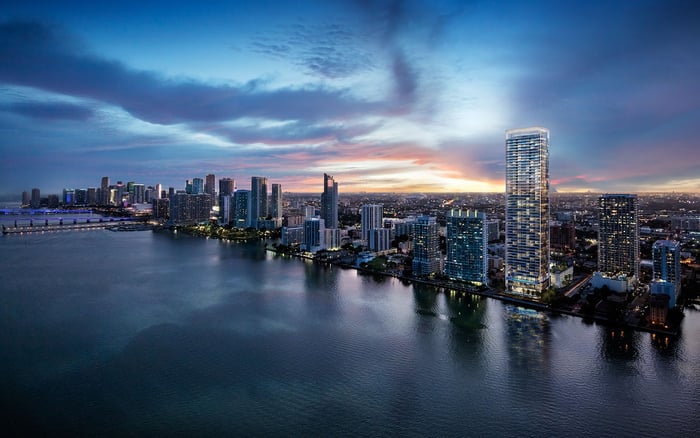
A discreet buyer’s guide to the brand licensing questions that matter before purchasing a branded or design-led luxury residence in Edgewater.

In Edgewater, where design-led towers and lifestyle-forward residences compete for sophisticated buyers, a brand name can read as shorthand for taste, service, and long-term desirability. Yet for a purchaser, the more important question is not whether the name is recognizable. It is what rights, obligations, and limitations sit behind that name.
Brand licensing terms determine how a residence may use a hospitality, fashion, design, wellness, or culinary identity. They can influence everything from amenity programming and staff presentation to marketing language, owner expectations, association budgets, and resale perception. The strongest buyers treat the name as a contractual asset, not a decorative feature.
This is especially relevant in the branded residences conversation, where the promise of a curated lifestyle often appears before the full operating documents have been fully digested. The approach is simple: admire the brand, but interrogate the license.
The first question is who actually holds the licensing agreement. Is it the developer, the condominium association, a hotel operator, a management company, or another affiliated entity? The answer matters because the party holding the agreement may not be the same party an owner deals with after closing.
Buyers should ask whether the brand has approval rights over architecture, interiors, amenity design, service protocols, signage, uniforms, marketing, residential rules, or future modifications. A meaningful brand relationship often requires ongoing compliance. That can be valuable, but it can also create approval layers and costs that should be visible before purchase.
When comparing an Edgewater residence such as EDITION Edgewater, the question is not simply what the brand evokes. It is whether the documents explain how the brand presence is maintained, governed, funded, and protected over time.
A brand license is not necessarily perpetual. Before buying, ask for the initial term, renewal options, renewal conditions, and the party responsible for exercising those options. A residence marketed with a brand today may depend on a contract with its own calendar, performance standards, and termination rights.
The essential questions are direct: when does the license begin, when can it end, who can renew it, and what happens if it is not renewed? Buyers should also ask whether owners receive notice of a pending expiration, whether the association has any consent role, and whether the brand can be replaced with another name.
For high-value purchasers, this is not a technicality. If the brand identity is a major reason for paying a premium, the duration and durability of that identity should be understood with the same seriousness as views, floor plan, parking, and monthly carrying costs.
Termination provisions deserve careful review. A license may end because of time, default, sale of the project, failure to meet standards, nonpayment of fees, brand strategy changes, or other contractual events. The issue is not whether termination is likely. The issue is whether the buyer understands the consequences if it occurs.
Ask whether the building must remove signage, change uniforms, rename amenities, revise marketing materials, discontinue branded services, or stop using certain design marks. Ask who pays for that transition. Ask whether owners have any claim if the brand is removed, or whether the purchase documents make clear that no brand relationship is guaranteed forever.
For buyers considering Villa Miami and other lifestyle-driven residences, this is where elegance meets legal precision. The brand may shape the feeling of the property, but the termination clause shapes the risk profile.
Branding can imply service, but implication is not enough. Ask for a written schedule of services. Which services are included in regular association fees, which are optional, and which are billed separately? Are there residential concierge services, dining privileges, wellness programming, housekeeping options, reservation access, valet protocols, or private event support? If so, who provides them and under what standard?
A brand standards manual may govern service delivery, presentation, and operating quality. Buyers should ask whether that manual is binding, whether it can change, and whether changes may increase owner costs. If the brand has audit rights, inspection rights, or the ability to require upgrades, the financial pathway should be transparent.
This level of review is not about dampening desire. It is about distinguishing atmosphere from obligation.
A brand license can carry fees. These may appear directly, indirectly, upfront, ongoing, fixed, variable, or embedded within management and operating costs. Ask whether licensing costs are paid by the developer, the association, unit owners, commercial components, or some combination of parties.
Buyers should request clarity on whether future brand compliance could require capital improvements, staff training, replacement materials, technology systems, uniforms, amenity refreshes, or design updates. Even modest recurring obligations deserve attention when multiplied across years of ownership.
At a project such as Aria Reserve Miami, or at any new-construction residence in Edgewater, the broader lesson is the same: the operating budget should be read alongside the lifestyle narrative. Luxury is most durable when its costs are legible.
Brand restrictions may affect how an owner markets a residence for resale or lease. Ask whether owners and brokers can use the brand name in listing copy, photography, signage, social media, or private presentations. Ask whether the brand must approve language, images, or promotional materials.
If rental use is important, ask whether the licensing agreement or condominium documents impose standards on guests, minimum stays, branded service access, or conduct within shared spaces. A buyer who values flexibility should understand whether the brand identity comes with additional rules designed to preserve exclusivity.
For purchasers studying The Cove Residences Edgewater alongside branded alternatives, this is a useful comparison point. Sometimes the most valuable amenity is clarity: knowing exactly which promises are contractual, which are operational, and which are aspirational.
The right questions belong early in the purchase process, before finishes, views, and amenity renderings dominate the decision. Request the license summary if available, condominium declaration, association budget, management agreement, service schedules, brand standards references, disclosure language, and any buyer acknowledgments tied to branding.
Then have counsel review the documents with a narrow brief: identify the brand term, renewal mechanics, termination triggers, cost responsibilities, owner rights, association obligations, marketing restrictions, and remedies. A luxury purchase should feel intuitive, but it should be documented with precision.
Edgewater rewards buyers who can evaluate both the emotional and contractual dimensions of a residence. The best brand relationships elevate daily life without leaving owners guessing about governance, costs, or continuity.
What is a brand licensing agreement? It is a contract that allows a development to use a brand name, identity, standards, or service framework under defined conditions.
Should I assume the brand will remain forever? No. Ask for the license term, renewal rights, and termination provisions before relying on the name as a long-term value factor.
Who usually pays for brand-related costs? The answer depends on the documents. Ask whether costs sit with the developer, association, owners, commercial users, or a combination.
Can a brand require future upgrades? It may, if the governing documents or standards allow it. Buyers should ask who approves upgrades and who funds them.
Does branding guarantee hotel-level service? Not automatically. Request a written schedule showing which services are included, optional, limited, or separately billed.
Can I use the brand name when reselling my unit? Possibly, but there may be restrictions. Ask whether listing language, images, or promotional materials require approval.
What happens if the license terminates? The building may need to stop using the brand name or modify branded elements. The cost and process should be reviewed in advance.
Are branded residences always better for resale? Not always. Resale depends on design, location, operations, fees, market conditions, and the durability of the brand relationship.
Should my attorney review the brand documents? Yes. Counsel should review the licensing structure, buyer acknowledgments, budget implications, and owner rights before contract execution.
What is the best way to shortlist comparable options for touring? Start with location fit, delivery status, and daily lifestyle priorities, then compare stacks and elevations to validate views and privacy.
For a confidential assessment and a building-by-building shortlist, connect with MILLION.
If branded residences are on your mind — as a home or as an allocation — we would be glad to share what we are seeing, privately.
Begin a quiet conversation