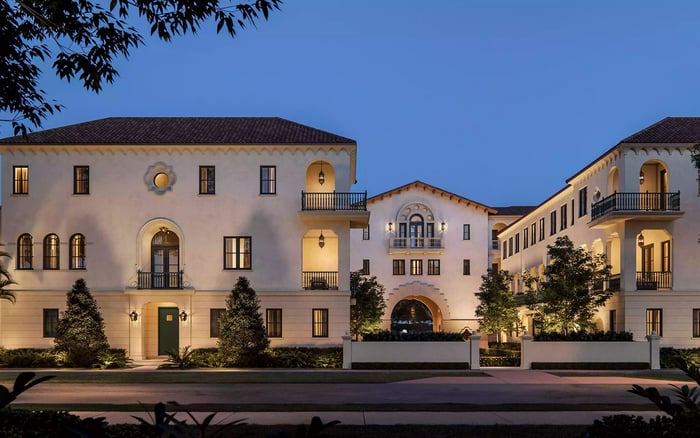
Private elevator access and valet service should be tested as operating systems, not accepted as brochure language. Before offering on a Coral Gables condominium, buyers should map every arrival path, inspect governing documents, observe peak periods and understand how the building performs when normal operations are interrupted.

In a Coral Gables luxury condominium, arrival is an extension of the residence. The experience begins as a vehicle enters the property, continues through valet and lobby circulation, and concludes at the elevator foyer. If any link is congested, unexpectedly shared or reliant on informal practices, the privacy promised inside the home becomes less convincing.
Buyers should treat private elevator access and valet flow as operating systems, not decorative amenities. Marketing language may promise an intimate arrival, but the consequential questions are who can enter, where vehicles queue, how credentials function and what happens during peak demand or an outage.
This framework is useful when comparing offerings such as Cora Merrick Park, Ponce Park Coral Gables and The Village at Coral Gables. It does not suggest that these properties share the same systems. Instead, it gives buyers a consistent method for examining each one.
Begin by determining whether the elevator cab is dedicated to one residence or serves multiple homes, floors or building uses. Then establish where it opens: directly into the residence, into a private foyer or into a shared corridor. Each arrangement can produce a distinctly different experience, even when described as private.
Ownership and control matter as much as architecture. Ask whether the foyer is deeded with the unit, assigned as a limited common element or classified as a general common element. That distinction may affect maintenance responsibility, decorating rights, access and the association’s authority over the space.
Request a precise access map. Can residents from another floor select the buyer’s level? Can management, housekeeping, contractors, delivery personnel or emergency responders enter the foyer? Is authorization managed through a key, fob, mobile credential, biometric device or staffed console? Buyers should know who administers permissions and how quickly a lost or compromised credential can be disabled.
A polished resident route does not, by itself, establish privacy. Trace the path taken by guests, domestic staff, vendors, food deliveries, parcels and movers. Ask how each person is identified, approved and directed-and whether the resident can time-limit or revoke access.
In a mixed-use property, determine whether residential elevators are separated from hotel, restaurant, office, event and service circulation. Confirm that separation through plans and an on-site walk rather than inferring it from lobby finishes. Buyers comparing Coral Gables with nearby Coconut Grove options, including Four Seasons Residences Coconut Grove, can apply the same circulation test without assuming that one operating model suits every building.
Valet quality is not simply a matter of courtesy. It depends on physical capacity, staffing, vehicle storage, key control and the ability to absorb overlapping demand. Ask how many resident, guest, employee, rideshare and delivery vehicles the arrival area can accommodate without obstructing the entrance or street circulation.
Request typical and worst-case retrieval expectations, then ask how staffing adjusts during weekday departures, dinner hours, weekends and private events. If the property includes another active use, determine whether resident vehicles are parked and dispatched separately. Buyers should also establish whether residents may self-park, spaces can be reserved, charging equipment is permitted and a vehicle can be retrieved without valet assistance.
Observe the property more than once. A quiet midday showing reveals little about evening arrivals or weekend departures. Spend time in the arrival area, watch queues form and time several retrievals. Note whether rideshares, deliveries and waiting guests compete for the same curb space.
Identify who operates the valet, then review procedures for vehicle inspection, key custody, damage claims and incident reporting. Confirm which insurance applies and how responsibility is allocated among the association, property manager and valet operator. The service contract may be more revealing than a general amenity description.
Next, examine abnormal conditions. What happens to elevator access controls, garage gates and vehicle retrieval during a power outage? Are backup systems available, and which equipment takes priority? Ask how elevator pits, garage ramps and valet areas are protected from water intrusion, and how residents reach their homes or vehicles if a component is temporarily unavailable.
Before making an offer, compare verbal representations with the condominium declaration, floor plans, association rules, operating budget, reserve information and relevant service contracts. Seek clear answers on foyer classification, elevator maintenance, staffing costs, valet obligations and resident parking rights.
The practical objective is alignment. The sales narrative, physical layout, legal documents and daily operation should describe the same experience. If they do not, the buyer should resolve the discrepancy before determining price, contingencies or closing expectations.
A well-designed private arrival should remain discreet when the building is busy, a guest appears unexpectedly or normal systems are interrupted. That continuity is the amenity worth underwriting.
Does private elevator access always mean a dedicated cab? No. Determine whether the cab serves one residence, multiple units or several floors.
Why does the elevator foyer’s legal classification matter? It can affect control, maintenance obligations, decorating rights and access.
Should buyers test guest access before making an offer? Yes. Request a demonstration of authorization, time limits and revocation.
Who else may be able to access a residential floor? Staff, contractors, delivery personnel or emergency responders may have authorized access.
What should buyers ask about mixed-use circulation? Ask whether residential routes are separated from hotel, dining, office and service traffic.
When is the best time to observe valet operations? Visit during evening, weekend, event or commuting peaks-not only at midday.
What valet capacity questions are most useful? Ask about queue space, peak staffing, vehicle storage and worst-case retrieval times.
Can a resident avoid using valet service? That depends on the property’s rules, parking configuration and operating procedures.
What should happen during a power outage? Buyers should verify backup plans for elevators, access controls, gates and vehicle retrieval.
Which documents deserve review before an offer? Review the declaration, plans, rules, budget, reserves and applicable service contracts.
For a confidential assessment and a building-by-building shortlist, connect with MILLION.
If branded residences are on your mind — as a home or as an allocation — we would be glad to share what we are seeing, privately.
Begin a quiet conversation