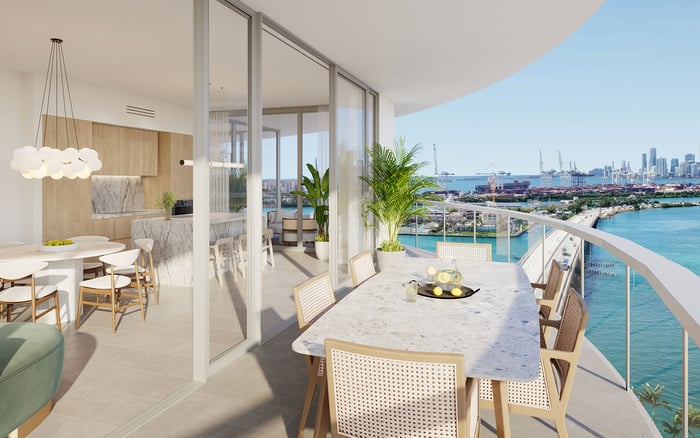
A disciplined review of reserves, insurance deductibles, and owner-controlled budgets helps buyers distinguish polished condominium operations from durable financial stewardship.

At the ultra-premium end of South Florida real estate, ownership quality extends beyond architecture, amenities, and service. It also rests on the condominium association’s ability to fund operations, anticipate capital work, and respond to insurable events without destabilizing owners’ finances.
That distinction matters when considering Onda Bay Harbor in Bay Harbor Islands alongside St. Regis® Residences Sunny Isles in Sunny Isles Beach. Their identities differ, but the essential diligence remains consistent: examine the owner-controlled operating budget, reserve schedule, reserve cash, and separately stated insurance costs as a connected financial system.
These are not merely accounting details. They shape the predictability of ownership, the association’s capacity to maintain the property, and the possibility that a future capital need could require an additional owner contribution.
The most elegant ownership experience is supported by disciplined financial planning.
Reserve funding should not be treated as a generic percentage of operating expenses. Each contribution should be evaluated against a component’s estimated replacement or deferred-maintenance cost and its remaining useful life. The reserve schedule therefore deserves the same scrutiny as the headline monthly assessment.
For each significant component, a buyer should identify four elements: what is being funded, its expected cost, its remaining useful life, and the contribution assigned to that obligation. Potential nonrecurring work may involve roofing, elevators, exterior repairs, paving, mechanical systems, or amenity areas. The project-specific schedule and supporting records should make the timing and funding logic clear.
Equally important is the distinction between the reserve balance already held in cash and the annual reserve contribution shown in the budget. One is accumulated liquidity; the other is the current year’s funding flow. A substantial annual contribution does not, by itself, establish that the association holds sufficient cash for nearer-term work.
Buyers should also determine whether reserve assumptions have been updated as building conditions, project timing, or estimated costs have changed. An older schedule can still provide context, but current decisions should be tested against current documents and available cash.
Insurance presents two distinct budget questions. The first is the recurring cost of premiums. The second is the master policy’s deductible, which may influence the association’s immediate cash requirement after a covered loss. Buyers should review each separately rather than allowing the premium line to stand in for the association’s broader risk position.
Relevant documents include the association’s insurance declarations, deductible provisions, budgeted premium expense, and any documented plan for meeting a deductible. The analysis should clarify the intended source of liquidity and whether a loss could create an additional demand on owners. Qualified Florida condominium counsel and insurance professionals should interpret the governing documents, policy terms, and available funding options for the specific property.
A deductible also should not be viewed in isolation. Its practical significance depends on the policy language, the association’s liquidity, the governing documents, and the circumstances of a particular loss. The goal is not to apply a universal cash benchmark but to understand the association’s documented capacity to respond.
A developer-period budget may not reflect the full pattern of owner-controlled operations. After turnover, buyers should examine a budget that clearly separates projected income, operating costs, and reserve contributions, then compare those projections with actual performance.
Typical operating categories can include personnel, management, utilities, landscaping, cleaning, security, insurance, professional fees, and reserve contributions. In a service-intensive property, buyers should ask whether staffing and maintenance assumptions align with the experience residents expect, without presuming that every elevated expense is discretionary.
The practical review begins by identifying operating lines that repeatedly exceed plan, confirming whether reserve contributions were made as budgeted, and checking that insurance costs remain separately visible. The reserve schedule should be reconciled with the cash actually held. Contracts, payables, receivables, pending capital work, and documented financial commitments can then be reviewed for additional context.
A single year-over-year percentage comparison may obscure why an owner’s total obligation changed. Operating expenses, reserve funding, insurance, and nonrecurring work should be analyzed separately so that buyers can distinguish routine changes from property-specific financial demands.
The financial profile of a boutique Bay Harbor Islands condominium should not be judged by simply matching its assessment against that of a larger, service-led property in Sunny Isles Beach. Scale, staffing, shared systems, amenity operations, and reserve components may differ. The better comparison tests whether each association’s financial structure is internally coherent.
That approach also applies when reviewing nearby alternatives such as The Well Bay Harbor Islands and Bentley Residences Sunny Isles. The purpose is not to identify the lowest assessment. It is to determine what the assessment funds, whether reserve assumptions are component-based, and how deductible exposure could translate into owner liquidity needs.
This is particularly relevant to branded residences, where service expectations can influence operating assumptions, and to investment decisions in which carrying-cost stability affects the ownership thesis. The same discipline belongs in any buyer review: compare the full financial architecture rather than isolated monthly figures.
A focused document review should establish the current reserve cash balance, annual reserve contribution, and schedule of funded components. It should identify near-term capital items and show whether their expected timing aligns with available funding. Material differences between scheduled needs and cash on hand warrant an explanation.
The insurance review should establish the premium, deductible structure, coverage period, and association’s intended source of deductible liquidity. Buyers should also ask qualified insurance professionals whether their personal coverage and loss-assessment protection align with the condominium documents and master policy.
Finally, review the owner-controlled budget against actual operating results. Ask how staffing, utilities, maintenance, professional services, and insurance have performed relative to plan. Confirm that reserve activity can be distinguished from operating cash and that the budget presents both operating and reserve requirements clearly.
For Onda Bay Harbor and St. Regis® Residences Sunny Isles, the most defensible conclusion will come from property-specific documents rather than branding or aesthetics. A refined property can still present financial complexity, while a higher assessment may reflect deliberate funding rather than inefficiency. The objective is not superficial economy; it is an ownership structure defined by transparent assumptions, careful planning, and manageable exposure.
For discreet guidance on South Florida luxury condominium ownership, connect with MILLION.
If branded residences are on your mind — as a home or as an allocation — we would be glad to share what we are seeing, privately.
Begin a quiet conversationReview each funded component, its estimated cost, remaining useful life, and assigned contribution. These elements show whether funding is connected to anticipated capital needs.
No. Reserve contributions address anticipated capital or deferred-maintenance needs, while operating expenses cover ongoing property operations.
Buyers should focus on every significant component identified in the property-specific reserve schedule. Supporting records should explain its estimated cost, timing, and funding approach.
No. Reserve cash is the accumulated balance, while the annual contribution is the amount added through the current budget.
A deductible may create a liquidity need after a covered loss. Buyers should understand its structure and the association’s documented plan for responding.
No universal benchmark is established here. The appropriate review depends on the policy, governing documents, available liquidity, and property-specific circumstances.
Compare the owner-controlled budget with actual operations, reserve cash, the reserve schedule, insurance costs, contracts, and documented capital commitments.
Categories may include personnel, management, utilities, cleaning, security, insurance, professional fees, maintenance, and reserve contributions.
A single percentage can conceal different causes of change. Reviewing operations, reserves, insurance, and nonrecurring work separately provides clearer context.
No. A useful comparison considers what each assessment funds, reserve assumptions, service expectations, and potential deductible exposure.