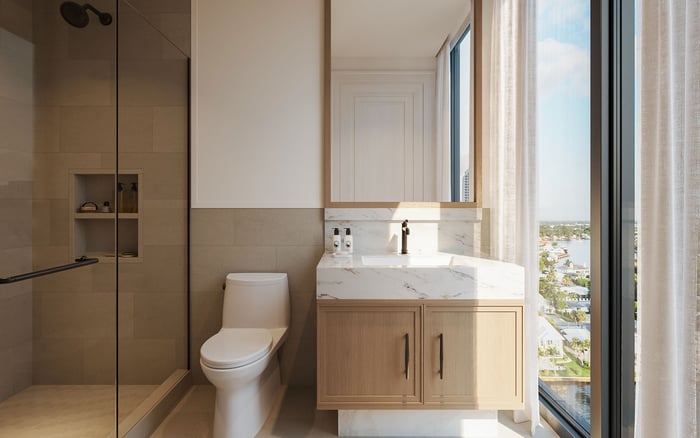
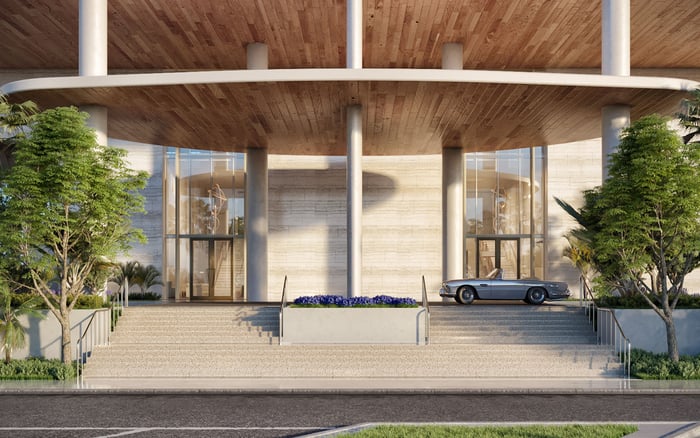
A buyer-focused comparison of how Auberge Beach and Bentley Residences separate owner arrivals from amenity, guest, staff, valet, and service circulation.
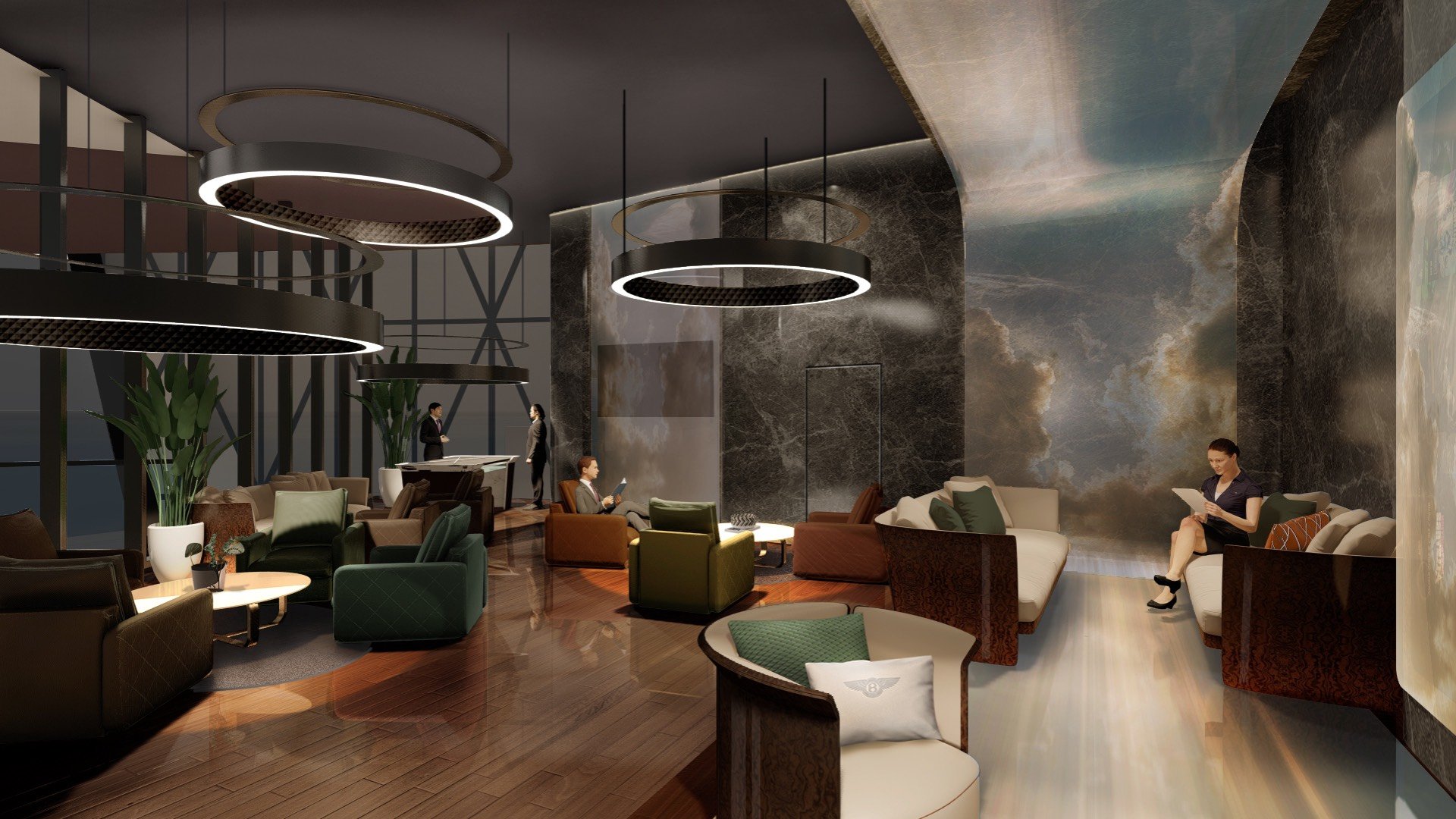
In an oceanfront condominium, privacy is defined not only by a guarded entrance or attentive concierge, but also by circulation: where an owner arrives, which lobby a guest enters, how staff reach a residence, where deliveries are transferred, and whether amenity traffic intersects with the route home.
That distinction is especially important at Auberge Beach Residences & Spa Fort Lauderdale and Bentley Residences Sunny Isles. Both pair private residences with hospitality-oriented service and extensive shared amenities. Yet their principal privacy mechanisms differ materially. Auberge relies primarily on private passenger-elevator access, while Bentley introduces a vehicular elevator leading to private in-residence garages.
For buyers comparing Branded Residences across Fort Lauderdale Beach and Sunny Isles Beach, the essential question is not whether a property feels like a resort. It is whether each category of user has a clearly controlled route through it.
In luxury residential design, privacy is often best understood as a circulation plan.
Restaurants, spas, lounges, meeting rooms, and pool decks can give a condominium the social character of a hotel. Their presence alone does not mean outside patrons may enter freely. Access may be reserved for owners, registered guests, club members, invitees, or users paying particular fees.
This distinction matters at Auberge, a residential condominium managed under an Auberge hospitality brand rather than a conventional hotel. Its beachfront club-style program includes an indoor-outdoor lounge and restaurant, spa, meeting rooms, a children’s center, pools, and gardens. The principal club amenities were planned at ground level, establishing an amenity zone beneath the private residences.
The operating details merit closer attention. Owners’ beach-club memberships are included in association common expenses, while food, beverages, and certain privileges may involve additional charges. Access and pricing are therefore separate considerations. Buyers should not interpret a fee-based service as evidence that the underlying area is open to unrestricted public use.
The two-tower Auberge development at 2200 North Ocean Boulevard contains 171 residences, each marketed with private elevator access. This arrangement reduces reliance on conventional shared residential corridors and a common passenger-elevator bank. The transition from managed arrival to private foyer is therefore central to the building’s residential experience.
Every residence also has a private terrace, and some have private terrace pools. These private outdoor spaces can reduce an owner’s reliance on shared pool areas, particularly when discretion is preferred to the social atmosphere of a club deck.
Select residences are described with separate service entrances. Where available, that second threshold can help distinguish the movement of household staff, maintenance personnel, or service providers from the owner’s principal entrance. It does not eliminate operational contact elsewhere in the building, but it can create a more orderly final approach to the home.
The critical diligence question is how the private elevator is controlled in daily use. A purchaser should verify who may authorize a floor, how personal guests are registered, whether vendors receive temporary credentials, and where deliveries change hands. The private elevator provides the architectural foundation; access protocols determine how effectively it performs.
A buyer exploring hospitality-led living elsewhere in the city may also compare the arrival sequence at Four Seasons Hotel & Private Residences Fort Lauderdale, while recognizing that each property’s governing documents and operating rules are distinct.
At 18401 Collins Avenue, Bentley Residences approaches owner circulation from the vehicle inward. Each residence is designed with a private three- or four-car garage reached through the Dezervator vehicular elevator system. The concept allows residents to travel toward their apartments while remaining inside their cars, minimizing routine reliance on shared parking decks and passenger-elevator lobbies.
This vehicle-to-residence sequence is Bentley’s defining privacy proposition. It transforms the garage from a remote building function into part of the private residential domain. For owners who value discreet departures, protected car storage, or fewer shared transitions, that arrangement may carry greater practical significance than the scale of the lobby.
Bentley nevertheless retains collective arrival and operational functions, including 24-hour valet, 24-hour security, and multilingual concierge service. It also plans more than 20,000 square feet of amenities across three levels, together with a three-story ocean-facing lobby. Dining, wellness, entertainment, children’s, gaming, pool, and pet facilities all generate legitimate movement beyond the private garages.
Its restaurant is planned for breakfast, lunch, and dinner, complemented by poolside food-and-beverage service and an emphasis on in-residence dining. Access rights for owners, personal guests, and outside patrons are not fully distinguished. Buyers should therefore verify restaurant reservations, guest sponsorship, elevator credentials, and after-hours amenity rules rather than draw conclusions from the hospitality program.
For additional Sunny Isles context, The Ritz-Carlton Residences® Sunny Isles offers another relevant point of comparison for buyers assessing branded service against residential separation.
Auberge and Bentley address different portions of the privacy journey. Auberge’s private passenger elevators protect vertical movement from the residential arrival point to the private foyer. Bentley extends controlled circulation deeper into the arrival sequence by transporting the owner’s vehicle to a private garage at the residence.
Neither approach means an owner will never encounter another user. Valets, concierges, security personnel, personal guests, staff, contractors, and emergency teams remain part of a fully serviced tower. The more useful measure is whether their routes are separated where appropriate, credentialed when necessary, and governed by clear operating rules.
The choice is partly behavioral. An owner who routinely uses valet service and shared amenities may experience Bentley differently from one who drives directly to a sky garage. At Auberge, an owner who favors a terrace pool and in-residence entertaining may interact less with the ground-level club environment than a resident who uses the restaurant, spa, and shared pools daily.
Within MILLION's Buyer's Guides, circulation deserves the same scrutiny as views, floor plans, and finishes. During a private tour, buyers should trace several journeys rather than inspect only the ceremonial arrival.
First, follow the owner’s route from the street or garage to the residence. Identify every credential point, waiting area, staffed threshold, and potential crossover with amenity users. Second, trace a personal guest’s experience from registration through elevator authorization. Third, determine where valets, household staff, deliveries, contractors, and maintenance personnel enter, wait, transfer goods, and reach the unit.
At Auberge, confirm private-elevator controls, service-entry availability for the specific residence, beach-club rights, and which services require separate payment. At Bentley, examine the intended Dezervator process, garage capacity for the selected residence, valet alternatives, passenger access, and contingency procedures if the vehicular system is unavailable.
Finally, request the condominium declaration, club agreement, house rules, current operating policies, and any credentialing procedures relevant to guests and vendors. Emergency access should also be understood. Architecture establishes the possible routes; governance determines who may use them, when, and under what supervision.
Auberge offers a club-oriented ground plane with private elevator access above it. Bentley makes the private automobile garage part of the residence itself. Both concepts can support discretion, but neither should be evaluated through amenity descriptions alone. The most sophisticated purchase decision examines the complete sequence from curb to front door, then confirms that the legal and operating framework aligns with the architectural promise.
For discreet guidance on evaluating South Florida’s most private residential arrivals, connect with MILLION.
If branded residences are on your mind — as a home or as an allocation — we would be glad to share what we are seeing, privately.
Begin a quiet conversationNo. It is a residential condominium with Auberge hospitality branding and management, not a conventional hotel.
The two-tower development contains 171 residences, all marketed with private elevator access.
Available details do not establish unrestricted public access. Buyers should verify eligibility and guest rules in current governing and operating documents.
Private passenger-elevator access to residences is the principal circulation feature, reducing reliance on conventional shared residential corridors and elevator banks.
Every residence has a private terrace, and some residences also include private terrace pools.
It is a vehicular elevator system designed to carry residents in their cars toward private garages located at their residences.
Each residence is designed with a private three- or four-car garage.
Yes. Planned operations include 24-hour valet, 24-hour security, and multilingual concierge service.
Available details identify shared amenity spaces but do not fully distinguish access for owners, personal guests, and outside patrons.
Buyers should confirm guest registration, elevator credentials, service routes, delivery procedures, parking handoffs, emergency access, and after-hours amenity rules.