Five active Edgewater developments offer distinct starting points for a private-client entertaining brief. Aria Reserve leads on its stated delivery timeline, while Villa Miami has the clearest culinary-design connection. Kitchen ventilation, delivery logistics and catering permissions remain essential items for written confirmation.
An elegant dinner at home depends on more than a beautiful kitchen. For a household employing a private chef, the decisive details are extraction, preparation space, ingredient receiving and a service route that keeps equipment out of the guest experience. A bay-facing dining room sets the atmosphere; building operations determine whether hosting feels effortless.
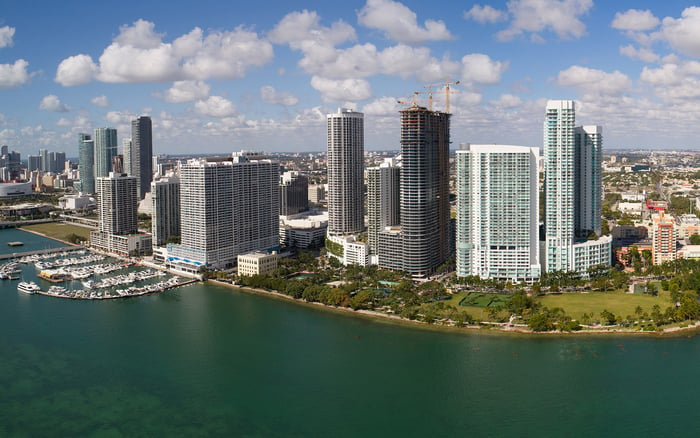
Edgewater’s active developments offer distinct starting points for that conversation. Aria Reserve Miami brings a waterfront, twin-tower setting to the brief, while the five projects below span stated delivery targets, pre-leasing and earlier construction milestones. Their order reflects those milestones and relevance to entertaining-not a verified hierarchy of kitchen performance or catering services. All delivery and move-in dates remain stated targets, not confirmation of completion.
1. Aria Reserve Miami, North Tower | Edgewater waterfront
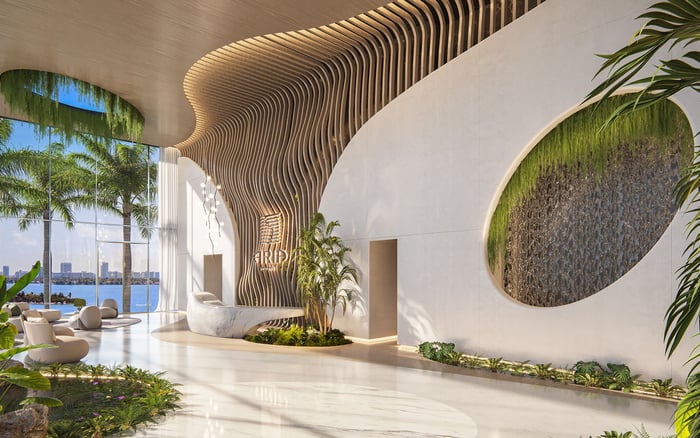
Aria Reserve comprises two 62-story towers. The North Tower had a stated Q3 2026 delivery target, while the South Tower had received a temporary certificate of occupancy. The distinction matters: a milestone at one tower does not establish readiness at the other. The North Tower’s target date calls for a fresh status check, not an assumption that handovers have occurred.
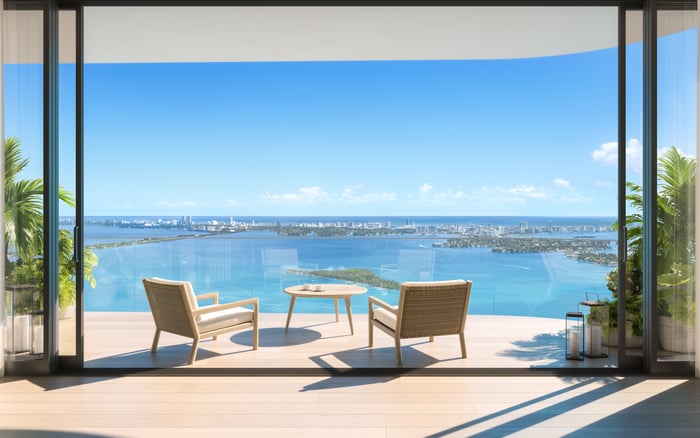
For entertaining, terraces described as 11 feet deep offer a useful dimension to assess-not evidence of outdoor-cooking permission. Private-chef facilities, catering access and delivery procedures remain unconfirmed. Request the residence-specific kitchen specification and the North Tower’s service rules before drawing operational conclusions.
2. Neo Edgewater | 2600 Biscayne Boulevard
Neo Edgewater contains 399 residences within a mixed-use development. Pre-leasing has launched, with first move-ins scheduled for October 2026. That places it high on the briefing agenda for households considering a nearer-term move, though the scheduled date does not establish that occupancy has begun.
The central question is how residential and commercial deliveries will be separated. Ask for the loading route, service-elevator reservation procedure and food-receiving protocol. For a chef arriving with ingredients and equipment, these arrangements deserve as much scrutiny as the kitchen layout. Mixed-use scale alone establishes neither a logistical advantage nor a constraint.
3. Villa Miami | 710 NE 29th Street
Villa Miami has the strongest documented culinary-design connection in this group: Mario Carbone designed its residential kitchens. The disclosed program describes 64 villa-sized residences, with customizable three- and four-bedroom configurations at the time of disclosure. Confirm final inventory and available layouts. As of June 2026, construction had reached approximately the 37th floor, with completion targeted for late 2027.
The planned culinary offering includes a two-level, bay-facing Major Food Group restaurant. This makes Villa Miami a priority for a chef-led design review. Neither the kitchen designer nor the restaurant, however, establishes exhaust performance, outside-caterer permission or restaurant-to-residence service rights. Those remain separate technical and contractual questions.
4. 2900 Terrace | 401 NE 29th Street
The 32-story rental tower being built by Coastal Construction includes 324 residences and 15,536 square feet of ground-floor retail. Structural topping out occurred nearly three months ahead of schedule, with completion expected in Q4 2027. That milestone supports its place on an active-development shortlist; it does not confirm finished operations.
For a private-client rental brief, focus on the lease and building rules governing visiting chefs, deliveries and events. Ground-floor retail should not be treated as resident catering support. Request written clarification of staging areas, after-hours access and waste removal, especially if regular staffed dinners are part of the household’s plans.
5. Edge House | Edgewater, Miami
Edge House is described as an approximately 57-story, 592-unit development, with foundation and early construction activity identified in 2026. It belongs in an earlier-stage conversation than projects with pre-leasing or topping-out milestones.
Treat kitchen ventilation, delivery handling and catering access as design-stage diligence, not established amenities. Ask which specifications are committed, which operating policies remain pending and when those policies will be available. Distinguish a proposed service arrangement from one incorporated into governing documents or a finalized specification.
At Villa Miami, the culinary-design connection offers a compelling starting point. The next step is practical: have the intended chef review the actual residence plan, appliance schedule and storage arrangement rather than rely on a presentation kitchen.
Test preparation, cooking, plating and cleanup as separate activities. Identify where groceries enter, where equipment can wait and whether staff can work without occupying the principal entertaining space. These are review questions, not confirmed features of any project in the ranking.
Ventilation requires a written response of its own. The available specifications do not establish whether hoods are exterior-ducted or recirculating, nor do they establish exhaust volume, make-up air, odor control or allowable appliance loads across these five developments. Request those details for the selected residence, including any limits on substitutions. A designer’s name cannot substitute for mechanical documentation.
Ask management to walk through a complete dinner-service arrival: vehicle access, unloading, receiving, elevator travel and entry to the residence. Obtain loading-dock clearance and service-elevator dimensions before assuming catering carts or equipment will fit.
Reservation windows, after-hours access and refrigerated receiving deserve equally explicit answers. Establish who accepts perishable deliveries and what happens when neither the household nor the chef is available. Where commercial uses share the development, clarify which routes and facilities residents may use.
Carry the same questions into a broader Edgewater search that includes EDITION Edgewater, without presuming equivalent capabilities. Compare written operating arrangements, not simply amenity descriptions.
A generous terrace can inform an entertaining plan without authorizing cooking equipment. At Aria Reserve, the stated 11-foot depth is a spatial consideration; permitted appliances and outdoor-cooking rules still require confirmation.
Catering permissions likewise have several distinct layers. Confirm outside-chef permissions, staging space, event staffing, waste routes and any restaurant-to-residence service rights. A restaurant in the building does not automatically grant private catering access. Nor does concierge availability establish that food handling or event coordination is included.
For a household prioritizing timing, Aria Reserve and Neo Edgewater warrant immediate status checks. For one prioritizing documented culinary design, Villa Miami deserves the earliest chef consultation. At 2900 Terrace and Edge House, construction milestones frame the conversation, while operating rules still require direct confirmation.
Before committing, assemble three essentials: the residence’s kitchen and mechanical specifications, the building’s delivery procedures, and its written chef and catering permissions. The most persuasive entertaining proposition works from arrival through cleanup-not merely in photographs.
For a discreet Edgewater search shaped around your household’s entertaining requirements, connect with MILLION.
If branded residences are on your mind — as a home or as an allocation — we would be glad to share what we are seeing, privately.
Begin a quiet conversationVilla Miami has residential kitchens designed by Mario Carbone. That connection does not establish ventilation performance or catering permissions.
Its stated Q3 2026 delivery target places it first on the activity-focused shortlist. The ranking does not certify completion or superior kitchen functionality.
Pre-leasing has launched and first move-ins were scheduled for October 2026. Those milestones do not confirm that occupancy has begun.
No. Its planned two-level Major Food Group restaurant does not establish restaurant-to-residence service rights or resident catering access.
No. Exterior ducting, exhaust volume, make-up air, odor control and allowable appliance loads require residence-specific confirmation.
Request loading clearance, service-elevator dimensions and reservation rules, refrigerated receiving availability, after-hours access and food-delivery protocols.
The stated 11-foot terrace depth does not confirm outdoor-cooking permission. Permitted appliances and building rules must be checked separately.
The 32-story rental tower reached structural topping out nearly three months ahead of schedule. Completion remains targeted for Q4 2027.
Foundation and early construction activity were identified in 2026. Kitchen and catering capabilities should be treated as design-stage diligence rather than confirmed amenities.
Obtain residence-specific kitchen and mechanical specifications, delivery procedures, and written chef and catering permissions. These distinguish design appeal from usable household functionality.