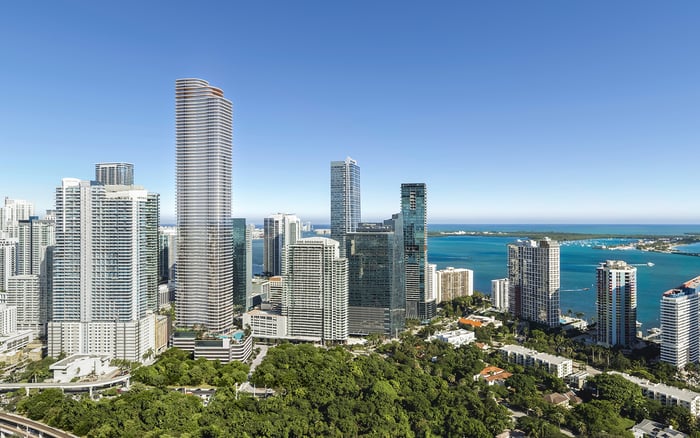
A buyer-focused framework for comparing service, privacy, and long-term ownership costs across three Brickell condominium projects without relying on unverified assumptions.

A luxury condominium decision extends beyond finishes and initial purchase terms. Service, privacy, and ownership cost can shape the experience long after closing, so each deserves a separate review.
The comparison set includes 2200 Brickell, Baccarat Residences Brickell, and The Residences at 1428 Brickell. Because no project-specific fact table is available here, buyers should not infer operating structures, access arrangements, fees, or policies from names, branding, or marketing language. Current condominium documents should govern the analysis.
Service is most useful when it removes friction from an owner's routine. Before comparing projects, buyers can list the forms of assistance they expect to use, how frequently they expect to use them, and whether they prefer visible attention or understated residential support.
That exercise helps separate meaningful service from an amenity inventory. It also creates practical questions for each property: Which services are included, which require separate payment, how are requests handled, and what operating provisions support delivery? Answers should be verified rather than assumed.
Buyers should also consider whether their preferences are likely to change during the planned ownership period. A service model that suits a primary residence may not serve a second-home owner in the same way, and the value of any offering depends on actual use.
Privacy becomes easier to evaluate when translated into daily moments: entering the property, receiving guests, accessing shared areas, accepting deliveries, and moving between a residence and amenities. Buyers can use those moments to identify the arrangements that matter most to them.
The review should focus on documented procedures and physical circulation rather than broad positioning. Access rules, shared-space provisions, staffing practices, and any interfaces with nonresidential uses require confirmation in current materials when applicable.
Service and privacy should then be considered together. A higher level of attention does not automatically create greater discretion, while a smaller-scale environment does not establish a particular privacy outcome. The relevant question is whether the documented operating model matches the owner's expectations.
Purchase price is only one part of the financial analysis. A long-horizon model can separate recurring condominium charges from property taxes, insurance, residence-specific expenses, and potential assessments. Buyers should obtain current figures for each project rather than estimate them from branding or amenity descriptions.
A 10-year framework can be tested under several scenarios instead of relying on a single projection. The purpose is not to predict exact future costs, but to see how changes in variable expenses could affect the total holding profile.
The model should also distinguish expenses associated with the individual residence from those supporting common areas, operations, and services. That separation helps a buyer understand what is being funded and which assumptions require further documentation.
Each priority should lead to a document request. Service questions call for current operating information and an explanation of what is included. Privacy questions call for confirmation of access and shared-area provisions. Cost questions call for current budgets, assessments, insurance information, tax guidance, and other applicable materials.
Rental rules, hotel relationships, public-access arrangements, reserves, special assessments, and exact privacy features should not be presumed. If any of these issues affects the purchase decision, the buyer should confirm it through current documents and appropriate professional review.
A consistent checklist makes the three projects easier to compare without forcing them into assumptions that may not apply. The strongest fit is the residence whose verified service structure, privacy arrangements, and cost profile align with the buyer's intended use and holding period.
What should buyers compare first? Begin with the intended use of the residence and rank service, privacy, and long-term cost according to personal importance.
Can branding establish the level of service? No. Buyers should confirm included services, optional services, procedures, and related costs through current project materials.
How can privacy be evaluated? Review documented access procedures, guest handling, deliveries, shared spaces, and circulation arrangements that affect daily life.
Is purchase price enough to compare the projects? No. The analysis should also consider recurring charges, taxes, insurance, residence-specific expenses, and potential assessments.
Why use a 10-year ownership model? A longer horizon helps show how recurring and variable expenses may influence the overall holding profile under different scenarios.
Should future costs be treated as certain? No. Scenario testing can illustrate sensitivity, but current figures and future changes still require careful review.
Can buyers assume rental rules are the same across the projects? No. Any rental provisions should be checked in the current governing documents for the specific property.
Should hotel or public-access arrangements be inferred from a project name? No. Any such component or arrangement must be verified in current documentation.
Which documents matter for cost analysis? Buyers should request applicable budgets, assessment information, insurance materials, tax guidance, and other current financial documents.
What makes one project the best fit? The best fit is the one whose verified operations, privacy provisions, and ownership-cost profile align with the buyer's priorities.
When you're ready to tour or underwrite the options, connect with MILLION.
If branded residences are on your mind — as a home or as an allocation — we would be glad to share what we are seeing, privately.
Begin a quiet conversation