A discreet arrival in Coral Gables begins with the exact dock-to-bay route. This private-client briefing connects vessel clearance and dock suitability with luggage handling, driver coordination and property-specific security planning.

A successful yacht-to-residence arrival in Coral Gables should feel uneventful: guests step ashore, luggage follows, and the household is ready. That simplicity calls for planning before a purchase, not improvisation after a cruise. A beautiful dock is only one part of the journey. The route from Biscayne Bay, the vessel’s dimensions, the landing arrangement and the final approach to the front door must work together.
For a private-client buyer, the question is not simply whether a property has ocean access. It is whether a particular vessel can reach and use its dock-and whether the household can complete the transfer comfortably. Waterfront access is a route, not a label.
Air draft-the vessel’s height above the waterline-is the central overhead constraint wherever a fixed bridge separates the residence from the bay. Length alone cannot answer the clearance question. Nor should a vessel’s description as a tender, hardtop or flybridge yacht substitute for its actual dimensions.
Do not rely on a general clearance estimate or historical planning figure to establish passage. Identify the limiting bridge on the particular dock-to-bay route and have the captain assess clearance for the intended journey.
Before relying on residential dock access, ask the captain to verify the complete route, current clearance information, relevant water levels and the vessel’s actual operating configuration. Confirm underwater draft and maneuvering requirements separately. Resolving the overhead restriction is not enough if approach depth or turning space remains uncertain.
When evaluating a home in Gables Estates, Cocoplum or Gables by the Sea, require a property-specific dock-to-bay assessment. Do not assume a neighborhood description establishes the route, depth or bridge conditions for an individual residence.
If a property is described as having no-fixed-bridge access, verify that claim for the full route. Even confirmed no-fixed-bridge access removes only one potential restriction; canal depth, turning space and dock suitability still need separate checks. Ask the captain to assess the proposed vessel rather than relying on a general statement of yacht capacity.
A residence need not meet every boating requirement at its own boundary. If the preferred yacht cannot use the home’s route or dock, an external berth with a suitable tender or road transfer is an option to investigate. Establish the berth, landing permissions, vessel suitability and transport availability separately; none should be assumed to come with the residence.
For buyers also considering Ponce Park Coral Gables, separating the residential decision from the yacht’s berth provides a useful basis for comparison. Evaluate the home on its own merits, then test the complete arrival plan without assuming project-provided boating or transfer services.
The same discipline applies when a search extends into Coconut Grove. Compare the number of handoffs, the permissions required and the household’s tolerance for an additional journey. An unverified drive-time estimate is no substitute for a workable transfer arrangement.
Passenger comfort and luggage capacity are distinct planning problems. Before selecting a tender or vehicle, establish the passenger count, bag count and dimensions of unusually large items. Ask whether the proposed arrangement can accommodate everything together or whether a separate luggage transfer would be preferable.
Walk the proposed dock-to-door route with the people expected to manage it. Identify who receives each bag, where it may be placed temporarily and whether steps, changes in level or a lengthy carry affect the plan. Confirm any intended service entrance rather than treating discreet access as an existing amenity.
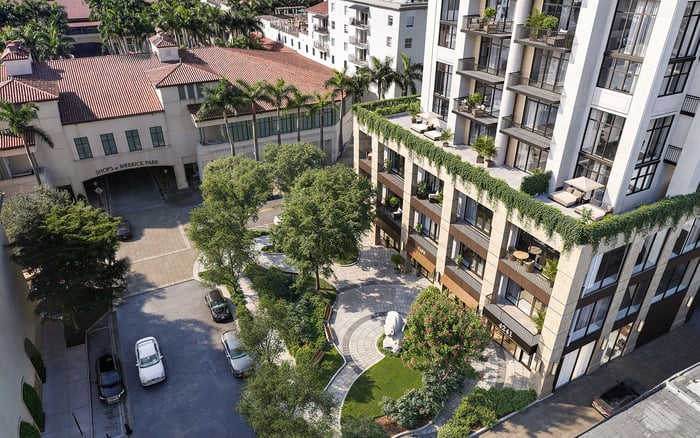
A buyer evaluating Cora Merrick Park can apply the same questions to the final vehicle-to-residence segment: where may unloading occur, who may assist, and what arrangements require advance approval? These are due-diligence questions, not representations of included services. Guests should not have to coordinate baggage on arrival.
For any residence with controlled entry, confirm the applicable driver-clearance procedure. Ask the community or property representative what information is required and when it must be submitted. Proposed details might include driver names, vehicle plates, passenger arrangements and an arrival window.
Confirm a permitted waiting and unloading location. Permission to enter a community does not necessarily allow a driver to wait beside a dock or occupy a service area. Establish who will communicate a changed arrival time and where the vehicle should wait if the yacht is delayed.
Keep responsibilities clear: designate a household contact to coordinate with the captain, driver and authorized property representative. Request confirmation of the agreed arrangements before departure. The goal is not elaborate choreography, but clarity about who controls each handoff.
Guarded vehicle entry does not establish waterside protection, luggage screening or an escorted transfer service. Ask specifically which arrangements apply to the residence and landing, who may receive guests, and how temporary staff or substitute drivers are authorized.
For discretion, consider limiting itinerary circulation to those who need it and agreeing on a procedure for unexpected substitutions. Assign a named person to any proposed luggage custody or guest escort arrangement rather than assuming someone on site will take over.
For a household comparing The Village at Coral Gables with a canal-front home, keep residential preferences and transfer responsibilities in separate columns. Neither a project name nor a neighborhood reputation establishes a yacht-arrival service.
Before committing, assemble a concise brief covering the verified vessel route, dock suitability, any external berth or landing permissions, luggage handling, driver access and security responsibilities. Include a fallback if the intended waterborne arrival cannot proceed, with permissions and transport availability checked in advance.
The right residence is not necessarily the one promising the shortest journey from yacht to door. It is the one whose arrival arrangements can be understood, verified and repeated without avoidable friction.
Explore your next Coral Gables residence with MILLION.
If branded residences are on your mind — as a home or as an allocation — we would be glad to share what we are seeing, privately.
Begin a quiet conversationNot necessarily; an ocean-access description does not establish suitability for a particular yacht. Verify the exact route, bridge conditions and vessel dimensions.
Air draft is the vessel’s height above the waterline. It is the key overhead constraint when a fixed bridge lies on the route.
A general estimate does not establish safe passage. Ask the captain to verify current, route-specific clearance, relevant water levels and the vessel’s actual operating configuration.
No. Underwater draft, canal depth, turning space and the individual dock still need to be assessed.
No; require a property-specific dock-to-bay assessment. Confirm the route, bridge conditions, depth and dock suitability for the intended vessel.
An external berth with a suitable tender or road transfer is a planning option. Berth availability, landing permissions and transport arrangements must be confirmed separately.
Establish bag counts, bulky-item dimensions, transport capacity and responsibility for each handoff. Confirm the unloading location and dock-to-door handling arrangements.
Ask about required authorization details, arrival timing and permitted waiting or unloading locations. Do not assume entry approval includes permission to stage beside a dock.
No. Guarded vehicle entry does not by itself verify waterside protection, luggage screening or an escorted transfer service.
Include the vessel route, dock suitability, required permissions, luggage handling, driver access and security responsibilities. Add a separately confirmed fallback arrival plan.