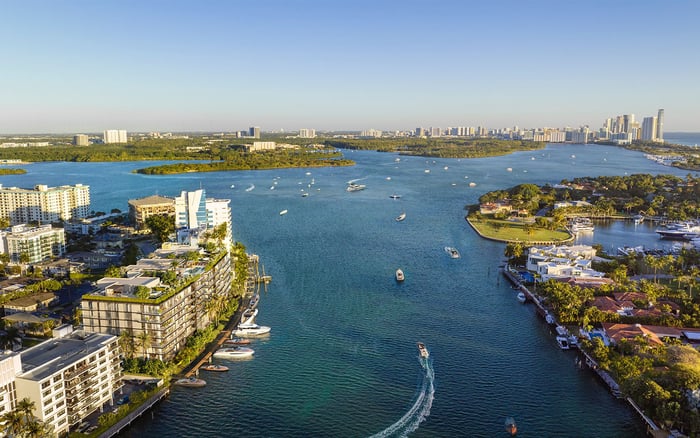
A considered Bay Harbor Islands purchase includes more than a review of finishes and floor plans. Understanding insurance valuations, master-policy claim authority, and deductible allocation helps buyers assess the financial responsibilities that accompany condominium ownership.

A well-considered condominium purchase examines both the residence and the association responsibilities that accompany it. In Bay Harbor Islands, insurance belongs firmly in the second category. The essential questions extend beyond whether a building is insured: how is its replacement value established, who controls a master-policy claim, and how do owners share costs the insurer does not pay?
For a buyer considering Alana Bay Harbor Islands, those questions deserve a place alongside the review of the residence. Florida’s condominium insurance framework provides the statewide starting point. The declaration, association records, and actual policies help clarify what that framework means for ownership.
The objective is clarity, not an assumption that insurance eliminates every financial exposure. A carefully assembled ownership file should distinguish valuation, claim authority, and deductible allocation before those subjects become urgent.
In insurance, appraisal can describe two distinct exercises. A replacement-cost insurance appraisal establishes the property’s insurance valuation. It informs coverage placement rather than resolving a disagreement over damage after an event.
The replacement-cost valuation should be supported by an independent insurance appraisal or an update of a previous appraisal at least once every three years. During diligence, request the latest document, its effective date, and any subsequent update. Then ask the association’s insurance adviser to explain how it relates to the coverage in place. The valuation and the policy serve different purposes; reviewing one does not replace reviewing the other.
A contractual post-loss appraisal serves another purpose: addressing disagreement about the amount of loss. A clause may allow either policy party to demand appraisal in writing, require each to appoint a competent, impartial appraiser, and refer unresolved differences to an umpire.
Treat that structure as an example, not language guaranteed to appear in every contract. Read the actual clause. A current replacement-cost appraisal does not itself establish who may invoke post-loss appraisal or which procedural steps apply.
The association generally handles its master-policy claim. An individual owner’s HO-6 policy addresses separately insured unit interests; understanding the division requires review of the statutory allocation and both policies. Avoid reducing that division to a simple interior-versus-exterior rule. Such shorthand can obscure which property each contract actually insures.
When reviewing a possible purchase at Bay Harbor Towers, ask how the association identifies the person authorized to communicate with its insurer and make claim decisions. Relevant board minutes or resolutions may clarify that authority. Ask separately who can authorize an appraisal demand and who can approve decisions arising from the claim.
An owner’s financial interest in the outcome does not automatically entitle that owner to invoke the master policy’s appraisal clause. Distinguish access to information and participation in association governance from contractual claim authority. For an active dispute, have counsel examine the policy and association authorization rather than relying on informal assurances.
Florida condominium law gives the association’s board authority to determine insurance-policy deductibles. That decision belongs within a properly noticed board-meeting process, not an informal selection by an individual director.
Deductibles may be based on available funds, including reserve accounts, or predetermined assessment authority existing when insurance is obtained. For a buyer, the deductible is therefore more than a number on a declarations page. It also raises a question about how the association plans to absorb or fund a loss.
Request the deductible schedule and the relevant minutes or resolutions. Ask the association to explain which financial resources or assessment authority it considered when selecting the deductibles. Do not assume that a reference to reserves establishes unrestricted access to every reserve dollar; obtain an explanation of the contemplated funding arrangement.
For someone evaluating Onda Bay Harbor, a useful comparison extends beyond the stated insurance premium. Consider coverage, retained deductible exposure, and the process through which that exposure could reach owners together.
Property-insurance deductibles and uninsured damages above the association’s coverage are generally common expenses, subject to statutory exceptions. Common-expense treatment generally distributes the obligation through the association’s assessment process. It does not automatically place the entire deductible on owners whose residences sustained physical damage.
That distinction matters even when an owner’s unit remains unaffected. Physical damage to a residence and financial participation in an association expense are separate questions. Conversely, damage inside a residence does not by itself establish that its owner must absorb the association’s deductible.
Read any declaration provision assigning deductible responsibility alongside applicable Florida condominium law. Do not assume that governing-document language overrides statutory requirements. If a proposed allocation depends on an exception, ask counsel to identify the applicable basis and explain how it fits the circumstances.
The ownership file should also connect legal allocation to practical budgeting. Ask how a common expense would be allocated under the applicable framework, rather than assuming equal shares or a charge limited to affected units.
Florida condominium unit-owner residential property policies must include at least $2,000 in property loss-assessment coverage for qualifying assessments arising from the same direct loss, regardless of the number of assessments. The deductible applicable to that statutory coverage may not exceed $250.
Those figures establish a coverage floor and its associated deductible limit-not a promise that every association assessment will be paid. Multiple assessments from the same direct loss do not automatically create a fresh statutory minimum for each assessment.
A buyer considering The Well Bay Harbor Islands should ask a personal insurance adviser to compare the proposed HO-6 protection with the association’s deductible structure. Confirm the actual loss-assessment limit, applicable conditions, and treatment of the exposure under discussion. The statutory minimum is a starting point for that conversation, not an individualized recommendation.
Keep the declaration, bylaws, master-policy declarations, latest replacement-cost appraisal, deductible schedule, and relevant board minutes or resolutions together. For appraisal rights and claim procedures, request the applicable policy wording as well. This is a practical set of documents for review, not a claim that every document must exist in a prescribed format.
Before committing, seek clear answers to three questions: what establishes the insured valuation, who is authorized to act on the association’s claim, and how could retained costs be allocated? Have insurance and legal advisers resolve property-specific issues. The result should be an ownership decision informed by both the residence’s appeal and its financial obligations.
For a considered approach to your next South Florida residence, explore MILLION.
If branded residences are on your mind — as a home or as an allocation — we would be glad to share what we are seeing, privately.
Begin a quiet conversationFlorida condominium insurance law provides the statewide framework. Review it alongside the association’s governing documents and actual insurance policies.
A replacement-cost appraisal establishes the property’s insurance valuation. Post-loss appraisal is a contractual process for addressing disagreement over the amount of loss.
The replacement-cost valuation should be supported by an independent insurance appraisal or an update of a previous appraisal at least once every three years.
No automatic owner right should be assumed. The policy’s appraisal language and the authority to act for the association require review.
The association generally handles its master-policy claim. An owner’s HO-6 policy addresses separately insured unit interests, subject to the statutory allocation and policy language.
The association’s board determines deductibles through a properly noticed board-meeting process. Deductibles may be based on available funds or predetermined assessment authority existing when coverage is obtained.
Generally, property-insurance deductibles are common expenses, subject to statutory exceptions. They are not automatically charged only to owners whose units sustained damage.
Declaration provisions must be read alongside applicable Florida condominium law. They should not be assumed to override statutory requirements.
Condominium unit-owner residential property policies must include at least $2,000 for qualifying assessments arising from the same direct loss, regardless of the number of assessments. The deductible applicable to that statutory coverage may not exceed $250.
Include the declaration, bylaws, master-policy declarations, latest replacement-cost appraisal, deductible schedule, and relevant board minutes or resolutions. Review the actual policy wording for appraisal rights and claim procedures.