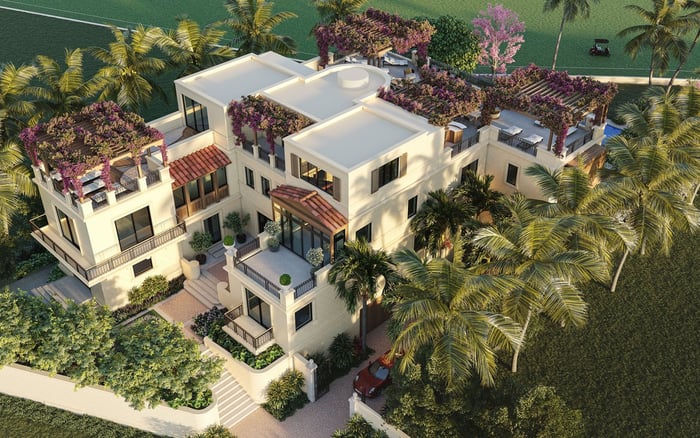
Without recent penthouse sales, a defensible premium begins with comparable residences, consistent interior measurements and explicit adjustments. South Florida examples illustrate why a striking price spread is evidence to examine, not a percentage to borrow.
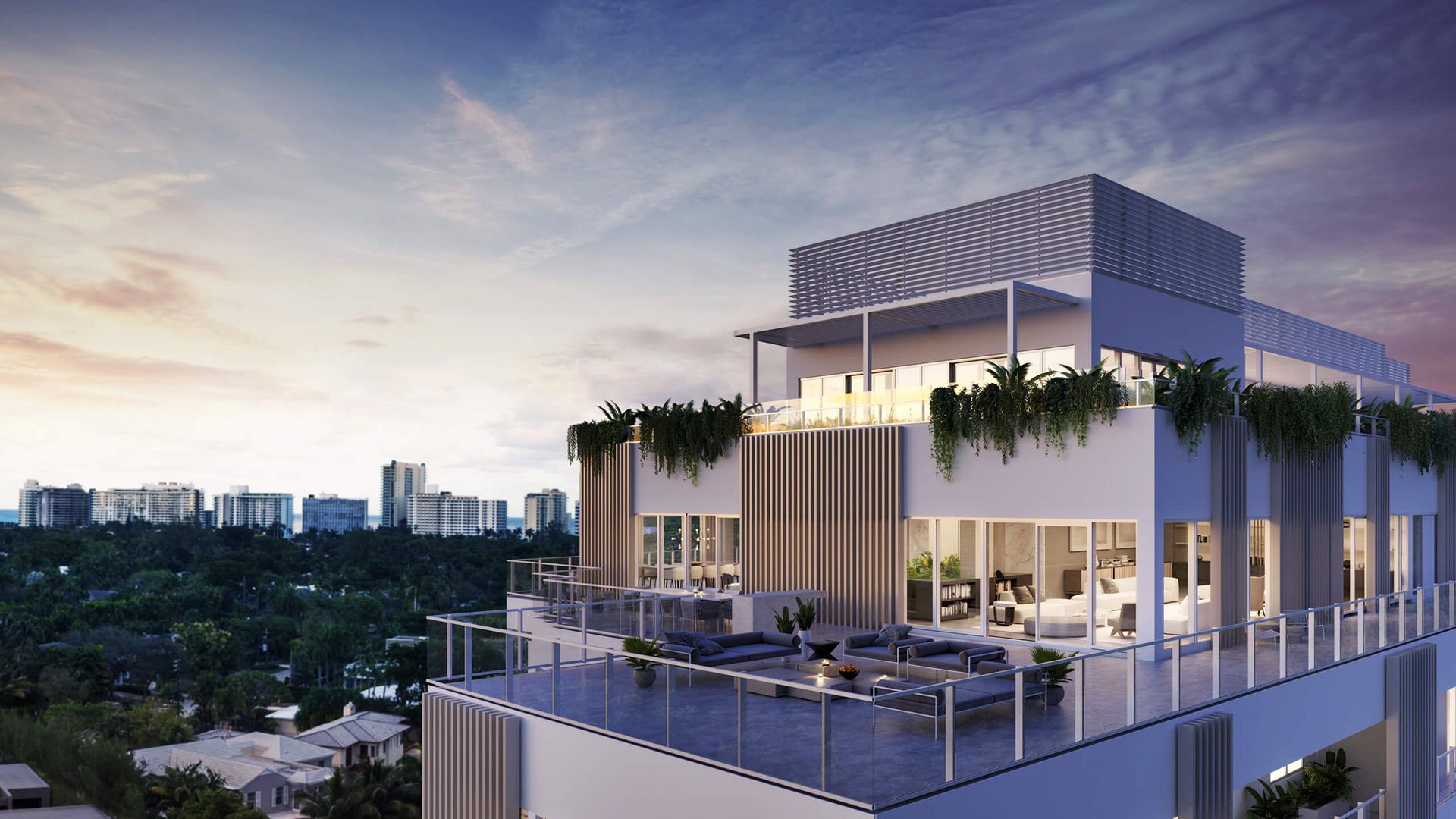
A penthouse can offer a singular way to live above South Florida: greater privacy, an expansive outlook and outdoor space that changes the rhythm of a residence. None of those qualities, however, supplies its own price adjustment. Without recent penthouse sales, the question is not whether the home is exceptional, but how much of that distinction the available evidence supports.
The strongest approach begins with a comparable non-penthouse residence and identifies the differences a buyer would pay for. Location, interior size, construction quality, amenities and view all matter. The objective is a supported range, not a percentage chosen because the word penthouse appears on the floor plan.
Start inside the building. Non-penthouse sales can establish what buyers have paid for its location, services and overall residential offering. Favor residences with similar exposure, condition and scale, then account for the remaining differences. A lower-floor apartment with a different outlook is not a clean baseline simply because it shares the address.
Next, consider nearby top-floor or estate residences with comparable living characteristics. If sufficiently similar local transactions are unavailable, extending the search to nearby neighborhoods may be appropriate. Geographic proximity alone is not enough; the alternative should help explain the subject residence's appeal.
The third layer is competing luxury buildings. A buyer considering Apogee South Beach in Miami Beach should distinguish a plausible alternative from a verified comparable sale. A project belongs in the valuation evidence only when an actual transaction and its relevant characteristics can be established. These three layers organize the search; they do not make every candidate equally persuasive.
Use consistently measured interior square footage when comparing prices. Mixing interior-only measurements with totals that include outdoor areas can create an apparent discount or premium that reflects nothing more than a measurement difference.
Treat terraces and rooftop areas separately. Assess usable dimensions, privacy, access and the relationship to the living spaces. A broad outdoor area with awkward circulation should not automatically receive the same treatment as one that functions naturally with the residence.
Keep a separate record of the interior baseline, outdoor contribution and other adjustments. This makes it easier to see whether a feature has already been recognized elsewhere. A view adjustment and a floor-height adjustment, for example, may overlap if both capture the same improvement in outlook.
July 2025 transaction evidence at The Surf Club Four Seasons Surfside offers a useful illustration. A penthouse sold for $38.2 million, approximately $6,731 per interior square foot. A non-penthouse North Tower residence sold for $17.75 million, approximately $5,267 per square foot.
Dividing $6,731 by $5,267 and subtracting one yields an unadjusted spread of approximately 27.8%. The arithmetic is straightforward. The interpretation requires more care.
The residences differed in tower, size, configuration and other value-relevant characteristics. The spread therefore does not isolate what a buyer paid for penthouse status. It establishes neither a universal premium nor an upper bound. Applied automatically to another Surfside residence, it could import differences that have little to do with the subject property.
Use the example to frame a question: after accounting for the relevant differences, how much of the observed spread remains attributable to the penthouse's distinctive qualities?
Break the proposed premium into identifiable benefits. Consider view, ceiling heights, privacy, elevator arrangements and usable outdoor space. Confirm each feature rather than assuming it follows from the penthouse designation.
For a Sunny Isles Beach search that includes Jade Signature Sunny Isles Beach, the same discipline applies: compare the particular residences, not simply their floor labels. A superior outlook may matter more to one buyer than a larger terrace; another may prioritize privacy or a layout suited to entertaining.
Examine what could offset those advantages as well. Condition, renovation needs, layout, parking, services and association costs belong in the comparison, alongside building-specific financial risks. Unusual concessions and non-arm's-length transactions require scrutiny before their prices become anchors. An adjustment should explain an observable difference, not disguise uncertainty with a precise-looking number.
Closed sales show completed exchanges. Listings, pending contracts, price reductions and days on market help explain positioning and buyer response, but they do not establish the same thing.
A Murano Grande penthouse in South Beach was marketed at $14.9 million, approximately $2,809 per square foot, in December 2025. It led the signed contracts for November 24-30, 2025. Those figures describe the quoted asking price, not a disclosed closing price. Treating that ask as a completed sale would overstate the evidence.
Similarly, a buyer comparing alternatives such as Una Residences Brickell should keep asking-price comparisons separate from closed-sale comparisons. The former can reveal the seller's competitive position. The latter provide a firmer foundation for testing value, subject to timing and property differences.
Broad condominium conditions do not necessarily describe the penthouse buyer pool. Miami-Dade condominium sales fell 25% year over year in May 2025 while luxury condominium sales rose. In July 2025, the county recorded 59 condominium sales at $2 million or more, unchanged from a year earlier.
These are dated observations, not a November 2026 market snapshot. They illustrate why a general condominium trend should not become an automatic adjustment to a singular residence. Timing still matters, but any adjustment needs support relevant to the property and its competitive segment.
Ask for a conclusion that separates observed prices from inferred adjustments. It should show the comparable interior baseline, explain the proposed premium and identify the assumptions that most influence the result.
Then remove the strongest outlier and test the range again. If the conclusion shifts substantially, acknowledge that sensitivity rather than allowing one exceptional transaction to carry the argument. A wider, well-explained range can be more useful than a narrow figure built on fragile comparisons.
The buyer's task is to decide what the residence offers beyond its alternatives and whether the price fairly reflects those differences. Scarcity can frame the conversation; evidence should determine its boundaries.
Explore South Florida's residential possibilities with MILLION.
If branded residences are on your mind — as a home or as an allocation — we would be glad to share what we are seeing, privately.
Begin a quiet conversationYes. Comparable non-penthouse sales can establish a baseline, with supported adjustments for the subject's distinctive characteristics.
Start with similar residences in the same building, then consider nearby top-floor or estate residences and competing luxury buildings. Each transaction still needs to be assessed for relevance.
No. The approximately 27.8% spread is an unadjusted comparison of two transactions with differences in tower, size, configuration and other characteristics.
Interior and outdoor areas should be evaluated separately. Terrace usability, privacy, access and its relationship to the living spaces deserve individual consideration.
No. A quoted asking price does not establish the final closing price, even when a residence has entered contract.
Examine verified differences in views, ceiling heights, privacy, elevator arrangements and usable outdoor space. Avoid assigning overlapping adjustments to the same benefit.
Consider condition, renovation needs, parking, services, association costs and building-specific financial risks. These may offset some of a residence's advantages.
Not by themselves. Miami-Dade's broader condominium sales and luxury condominium sales moved differently in May 2025, illustrating the importance of segment-specific evidence.
Removing the strongest outlier reveals how dependent the conclusion is on one transaction. A substantial change signals greater uncertainty in the supported range.
No. The specific transaction and market examples are dated to 2025 and should not be treated as a November 2026 market snapshot.