Shell Bay and Shore Club pair private residences with Auberge hospitality, but their settings create distinctly different privacy propositions. This buyer-focused comparison examines the documented boundaries around golf, pools, beach facilities, club access and owner amenities, then identifies the circulation plans and governing documents purchasers should review before committing.

In a luxury hotel-residence, privacy is rarely defined by a single locked door. It is shaped by the full sequence of arrival, recognition and access: driveway, valet, lobby, elevator, pool deck, beach path and amenity reservation. The most persuasive ownership experience makes hospitality immediately available without allowing transient activity to dominate daily life.
That distinction is central to Shell Bay by Auberge Hallandale and Shore Club Private Collections Miami Beach. Both combine private residences with an Auberge hotel component, yet they respond to markedly different physical contexts. Shell Bay occupies a private 150-acre development in Hallandale Beach. Shore Club sits directly on the oceanfront at 1901 Collins Avenue, in the active Miami Beach resort corridor.
The decisive luxury is not isolation, but control over where hospitality ends and home begins.
For buyers considering Branded Residences, the useful comparison is not which address offers more amenities, but how clearly each property separates residence-owner routines from hotel-guest circulation.
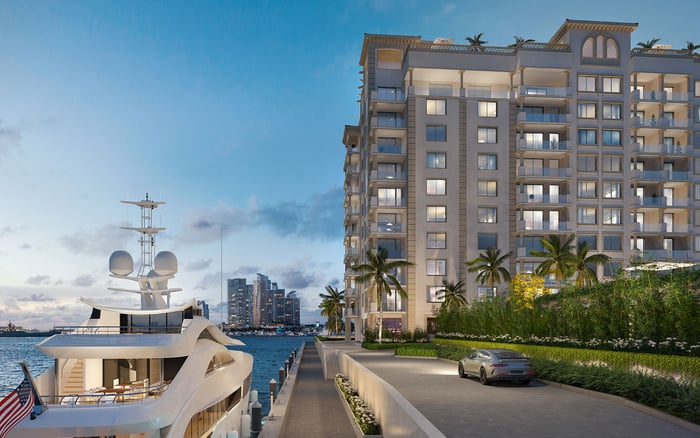
Shell Bay's scale provides its first privacy advantage. Its residential, hotel and private-club program occupies substantial grounds between the Atlantic Ocean and Intracoastal Waterway, creating a physical buffer from surrounding streets. The plan includes a 20-story tower with 108 private residences and views across the Intracoastal, golf course and gardens, as well as a planned 60-room Auberge boutique hotel and spa.
The signature boundary is unusually clear: hotel guests will not receive access to the private 18-hole golf course designed by Greg Norman. The club opened with a $1 million membership fee, further limiting casual access to its centerpiece. Residents receive social-club access, while golf privileges require a separate membership arrangement. Buyers should not conflate residence ownership with automatic golf rights.
Program variety further reinforces privacy. A 48-slip private marina and yacht-club program, racquet facilities, private dining and resident-exclusive tower amenities give owners multiple controlled settings beyond the hotel. These layers matter because they reduce reliance on spaces that may serve a broader hospitality population. The result is less a single resident enclave than a sequence of thresholds: private grounds, members-only facilities, owner amenities and, finally, the residence itself.
Buyers comparing Broward's coastal offerings may also include Auberge Beach Residences & Spa Fort Lauderdale in their touring set. The relevant discipline remains the same: inspect how an owner's ordinary day moves through the property rather than judging privacy from a rendering of an empty amenity deck.
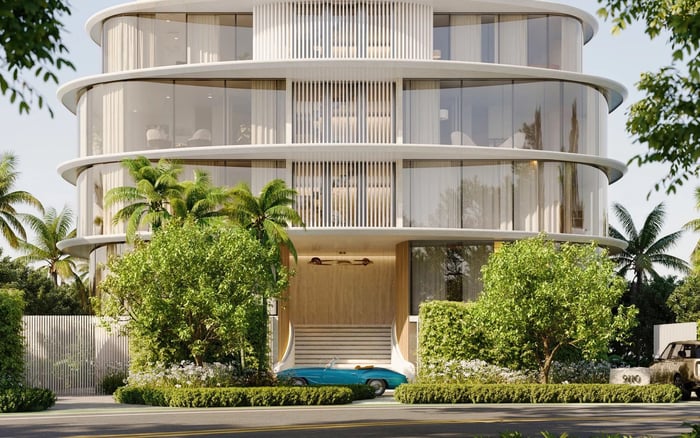
Shore Club presents a more urban, oceanfront privacy proposition. Its residences are planned alongside a 75-room luxury hotel, with owners offered access to Auberge amenities and services. That integration is part of the appeal, but the Collins Avenue setting makes the precise zoning of owner areas especially consequential.
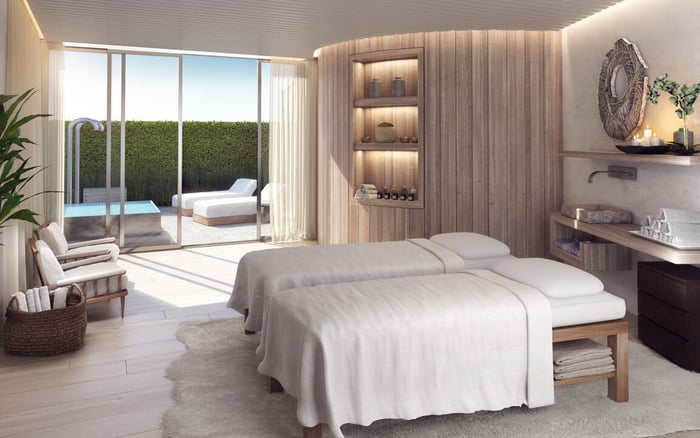
The clearest documented separator is the pool program. Shore Club identifies lap, leisure and explicitly private residential pools within a botanical-garden setting. The phrase “private residential pools” establishes an owner-focused retreat apart from the broader hospitality environment. A Residents' Beach Club with dedicated cabana service extends that resident zone toward the beachfront.
These allocations may carry more weight than a generalized promise of exclusivity. Pools and beach facilities are where hotel and residential schedules most visibly overlap. A designated residential pool can protect quiet and availability, while a resident-focused beach operation can create a more composed arrival at the water. Yet those labels do not, by themselves, explain the routes used to reach them.
The final lobby, elevator, loading, valet and back-of-house circulation plan has not been confirmed. Buyers should request architectural diagrams showing whether residents and hotel guests share an entrance, reception sequence or vertical core, and how service staff and deliveries reach residential floors. For a broader Miami Beach comparison, 57 Ocean Miami Beach can be included in a coastal property tour, with the same operational questions applied consistently.
An intriguing connection between the two properties is that Shore Club owners are slated to receive social membership at Shell Bay Club, including access to its racquet club, yacht club and restaurants. This extends the Shore Club lifestyle beyond Collins Avenue, but it should not obscure the distinction between social access and golf membership.
For buyers, that connection creates two distinct privacy experiences. Shore Club offers a resident retreat within a prominent oceanfront hospitality address. Shell Bay offers access to an expansive private campus where hotel guests are excluded from the golf course and multiple club programs create additional thresholds. Neither structure is inherently superior. The better fit depends on whether the owner values immediate resort energy with protected residential zones or a larger, controlled environment with greater distance between the perimeter and the home.
Marketing language can identify an amenity as private, resident-focused or exclusive, but governing and operating documents determine how that promise functions. Before contract, buyers should request a marked circulation plan covering entrances, valet handoffs, lobbies, elevator banks, pool approaches, beach access, loading areas and service corridors.
The condominium documents and club agreements should then establish who may use each space. Particular attention should be paid to owner guests, family members, tenants and hotel guests, as well as reservation priority, operating hours and the ability to host private events. Buyers should also verify whether memberships transfer upon resale, whether recurring dues apply and which privileges require a separate agreement.
Operational questions deserve equal weight. Ask who controls access credentials, whether hotel and residence management share staff, how deliveries are screened and what happens when a hotel event increases traffic. Confirm, rather than assume, whether restaurants, gardens, spas or principal pools will be shared. Planned room counts and amenity programs may change before completion, making final documents more consequential than early descriptions.
This framework belongs naturally within MILLION's Buyer's Guides: privacy should be evaluated as an operating system, not a decorative feature. The most revealing test is simple. Trace the route from car door to residence, then from the residence to the owner's preferred pool, beach, dining room, marina or club facility. Every shared threshold should be identified, governed and understood.
Shell Bay's strongest documented separator is the exclusion of hotel guests from golf, reinforced by campus scale, club controls and resident-exclusive tower amenities. Shore Club's clearest safeguards are its private residential pools and Residents' Beach Club within a more socially visible oceanfront setting. In both cases, the quality of privacy will depend on whether the built circulation and operating rules preserve those distinctions in daily use.
For discreet guidance on comparing South Florida's most considered residences, connect with MILLION.
If branded residences are on your mind — as a home or as an allocation — we would be glad to share what we are seeing, privately.
Begin a quiet conversationShell Bay uses controlled grounds, members-only facilities and resident-exclusive tower amenities. Its clearest documented boundary is that hotel guests will not receive golf-course access.
No. Residents receive social-club access, while golf privileges require a separate membership arrangement.
The 20-story residential tower is planned with 108 private residences.
Shell Bay's hospitality component is planned as a 60-room Auberge boutique hotel and spa.
Shore Club identifies private residential pools, providing the clearest documented division between owner retreat areas and the broader hospitality setting.
Project descriptions identify a Residents' Beach Club with dedicated cabana service.
Shore Club is planned with a 75-room luxury hotel alongside its residences.
Shore Club owners are slated to receive social membership with access to Shell Bay's racquet club, yacht club and restaurants.
Buyers should request plans for lobbies, elevators, valet, loading and back-of-house routes, as final arrangements have not been confirmed in the available detail.
Buyers should verify transferability at resale, recurring dues, separate golf requirements and access rules for family members, guests and tenants.