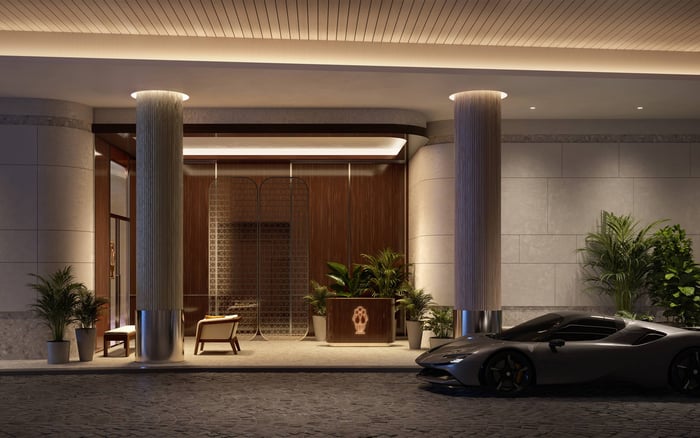
A dedicated arrival entrance and round-the-clock service are meaningful amenities, but chauffeur waiting rights, vehicle staging, parking allocation, and late-night pickup procedures deserve separate confirmation before purchase.
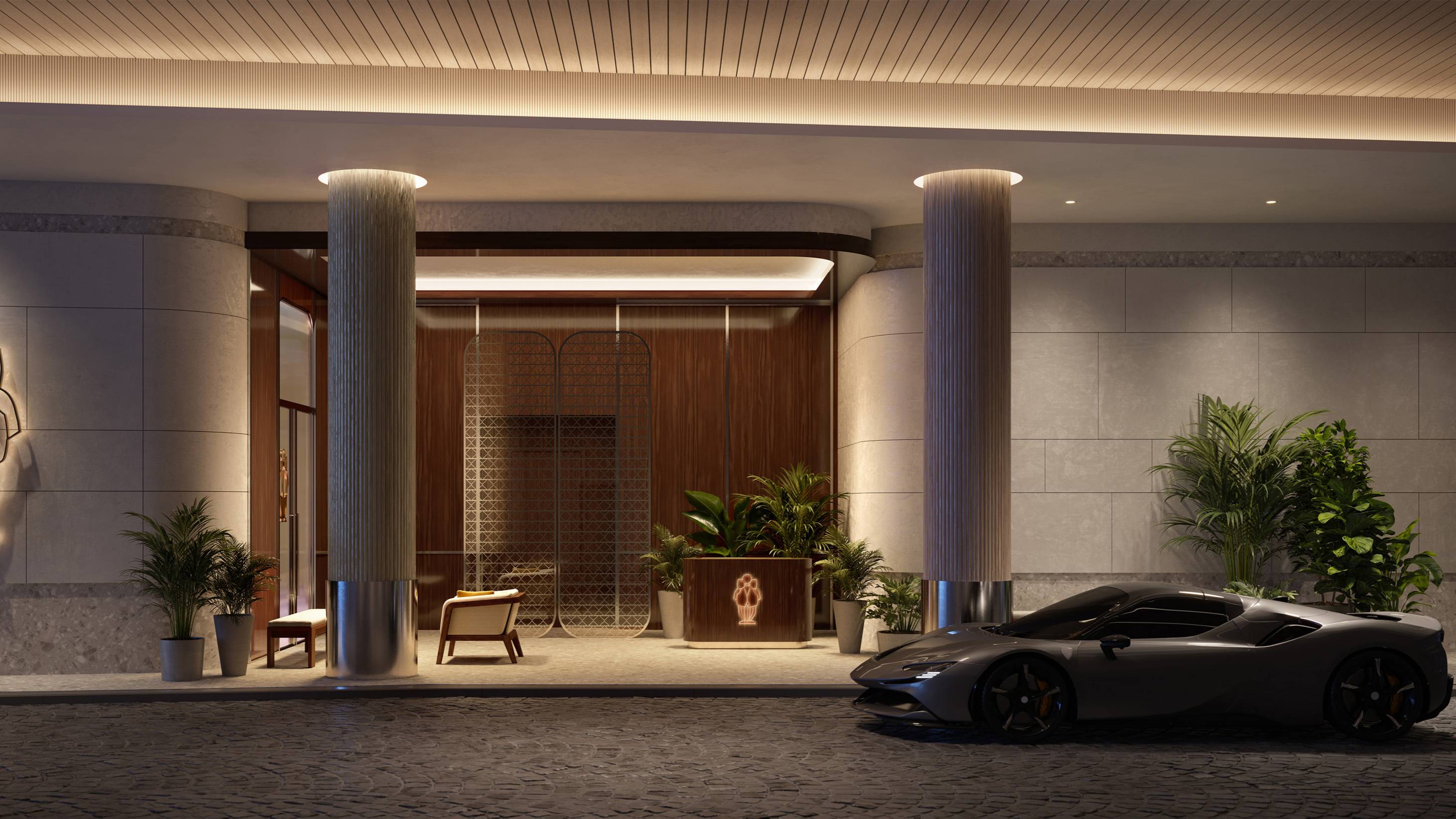
For a buyer who travels with a chauffeur, the arrival experience extends beyond an elegant entrance. It includes where a driver waits, who authorizes entry, and whether the vehicle can be positioned before the resident steps outside. At Mr. C Residences West Palm Beach, these details warrant a purchase review separate from the residence itself.
The advertised offering includes a dedicated porte-cochère, 24-hour valet and security, concierge reception, and front-desk services. An above-ground garage with security surveillance is also advertised. Together, these features outline an arrival and parking framework. They do not establish exclusive access, chauffeur waiting privileges, or guaranteed pickup performance.
The published address is 327 Okeechobee Boulevard, West Palm Beach, FL 33401. Confirm the actual vehicle entrance rather than assuming navigation to the street address will bring a driver to the correct arrival point.
A porte-cochère is an arrival feature, not proof of a driver holding area. Queue capacity, maximum curb dwell time, and permission for chauffeurs to remain in their vehicles while waiting are not specified in the disclosed details. Those permissions matter when departure times shift or a resident needs additional time upstairs.
The advertised amenities do not identify a dedicated chauffeur lounge, driver waiting room, or driver restroom. That does not establish that these facilities are absent. Buyers should request a direct answer about their availability, location, hours, and permitted users.
Ask management to distinguish a brief passenger pickup from a longer wait. A useful written response should identify where the driver goes if the arrival lane must be cleared, how the driver is recalled, and whether access changes after dark. For a household employing a regular driver, these are everyday operating requirements, not occasional conveniences.
Parking descriptions conflict between an entirely valet-operated arrangement without assigned spaces and secured parking with assigned spaces. Neither arrangement should be treated as definitive without confirmation in the governing documents. Separate hotel and residential arrivals, lobbies, and valet facilities are also described, but that separation remains unconfirmed.
Request the condominium declaration, parking and house rules, site and garage circulation plans, and applicable valet agreement or operating policies. Together, they should clarify whether valet is mandatory, whether self-parking is permitted, how spaces are allocated, and whether a chauffeur may retrieve or reposition a resident’s vehicle.
For buyers also considering Alba West Palm Beach, apply the same documentary standard rather than assuming similar addresses imply similar parking rights. Compare confirmed permissions, not arrival imagery.
Electric-car charging ports are advertised at Mr. C, but their number, reservation rules, and suitability for driver waiting are unspecified. Charging access should not be treated as permission to stage a vehicle. Separately, clarify valet insurance, damage-reporting deadlines, and the process for resolving a claim.
A waiting policy is useful only if the permitted location accommodates the household’s vehicle. Vehicle-height limits, turning clearances, and separate staging zones for chauffeurs, rideshares, taxis, and deliveries remain unspecified. Ask for dimensions and a marked circulation plan before assuming a full-size SUV can wait and load luggage comfortably.
The practical review should trace an entire arrival: entry from the street, authorization, passenger unloading, movement to the waiting location, recall, and departure. At each point, ask what happens when another vehicle occupies the intended position. Request confirmation of resident priority and any restrictions on advance staging.
A Palm Beach buyer accustomed to controlling a private driveway should be especially precise about shared-arrival rules. The question is not simply whether the car fits, but whether the permitted movement and waiting sequence suit the household’s routine without relying on an informal exception.
Advertised 24-hour valet and security establish a service offering-not actual staffing levels, guaranteed retrieval times, or a continuously available pickup position. They also do not establish a late-night pickup protocol or advance-notice requirement. Concierge reception and the front desk may serve as coordination contacts, but a dedicated chauffeur-dispatch service is not documented.
Ask for the proposed sequence in writing: whom the resident contacts, how the driver is identified, who authorizes entry, where the vehicle waits, and how staff notify the resident that it is ready. Include a fallback if the designated position is occupied or the driver arrives early.
Vehicle-entry authentication remains an open question. Whether authorization involves a guard, license-plate recognition, an intercom, or another credential is unspecified. Private, high-speed residential elevators are advertised, but residential-floor authentication is likewise unspecified. Review these as distinct access points rather than assuming one security feature governs the entire journey.
Garage surveillance does not establish camera coverage at the porte-cochère, recording retention, continuous monitoring, or incident-response procedures. Request clarification without treating undisclosed details as evidence of a deficiency.
If Forté on Flagler West Palm Beach is also on the shortlist, use the same pickup scenario at each property. This is a comparison framework, not a claim that either property provides a particular chauffeur service. Consistent questions make differences in documented permissions easier to evaluate.
If operations are available, arrange a permitted after-dark pickup test using the vehicle type the household expects to use. Observe lighting, staff presence, pedestrian separation, luggage-loading space, curb conflicts, and elapsed retrieval time. Follow the authorized route and waiting instructions rather than testing access boundaries.
One smooth pickup cannot establish performance on every evening. It can, however, reveal whether the stated procedure is clear and workable. If an operating test is unavailable, keep the proposed policy distinct from an observed service experience.
The principal risk is not a demonstrated failure of the advertised amenities. It is treating unresolved waiting permissions, staging capacity, parking allocation, and late-night procedures as settled.
Before committing, assemble the governing documents, applicable operating policies, and written answers relevant to the household’s actual use. Have counsel assess which parking and access rights those documents establish and which arrangements remain discretionary. Where a chauffeur is essential to daily life, an informal assurance should not substitute for a clear operating rule.
The most persuasive arrival experience is one that remains composed when a departure changes, a driver arrives early, or a pickup occurs late. For this buyer, precision is part of luxury.
For a discreet perspective on your South Florida residential shortlist, connect with MILLION.
If branded residences are on your mind — as a home or as an allocation — we would be glad to share what we are seeing, privately.
Begin a quiet conversationThe published address is 327 Okeechobee Boulevard, West Palm Beach, FL 33401. Confirm the vehicle entrance separately before directing a driver there.
No. A dedicated porte-cochère is advertised, but exclusive use and access-control procedures are not established by that description.
Both are advertised as 24-hour services. Actual staffing levels and vehicle-retrieval times are not established in the disclosed details.
The advertised amenities do not identify those facilities. That nondisclosure does not prove they are absent, so request written confirmation.
The disclosed arrival details do not establish that permission or a maximum dwell time. Confirm both the authorized waiting location and any time restrictions.
Parking descriptions conflict between all-valet parking without assigned spaces and secured parking with assigned spaces. Confirm allocation and self-parking rights in the governing documents.
Charging ports are advertised, but their reservation rules and suitability for driver waiting are unspecified. Do not assume charging access includes staging permission.
The advertised services do not establish a specific late-night protocol, advance-notice requirement, or guaranteed pickup position. Request the authorization and coordination sequence in writing.
No. Porte-cochère coverage, recording retention, continuous monitoring, and incident-response procedures remain unspecified.
Review parking rules and circulation plans, then confirm vehicle clearance, waiting permissions, and loading space. If operations are available, arrange a permitted after-dark pickup test.