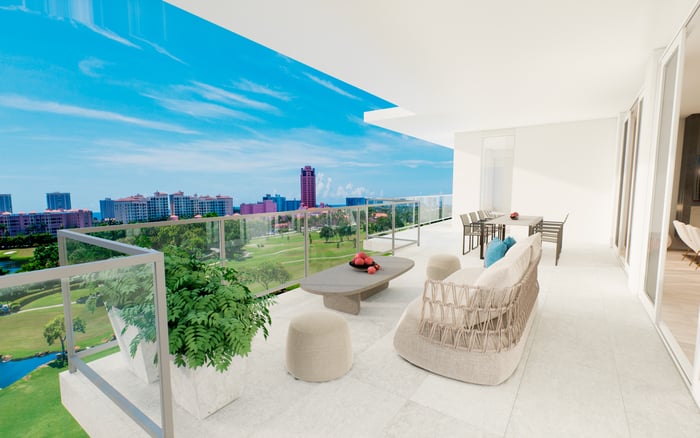
A considered furnishing installation begins well before delivery day. For Boca Raton owners, customs classification, appropriate storage, building access, and written coverage confirmation should form one coordinated residence-management plan.

A beautifully furnished Boca Raton residence requires more than a successful buying trip. Between an overseas showroom and the final placement of a dining table lie several distinct decisions: customs entry, interim storage, building access, and financial protection. For a high-value installation, manage them as one coordinated sequence rather than a series of unrelated vendor appointments.
The governing principle is simple: freight arrival is not an installation appointment. A shipment may still require customs release, while the residence needs its own delivery authorization. For an owner planning interiors at Alina Residences Boca Raton, begin with a written installation brief. Confirm the property's current requirements separately; do not assume those of another address apply.
Assign one representative to maintain that brief. Include the inventory, customs documentation, storage destination, access approvals, and the person authorized to accept delivery. Every handoff should be deliberate.
Used household effects may qualify for duty-free entry when owned and used abroad for at least one year and not intended for sale. Potentially eligible items include furniture, carpets, paintings, tableware, stereos, linens, and similar furnishings. Assess eligibility against the goods' actual history, not merely their destination.
A newly purchased suite of furniture does not qualify for this exemption simply because it is destined for a private home. Separate established household possessions from new acquisitions in the inventory, then have the proposed entry treatment reviewed before dispatch. Evidence supporting a claim of previous use abroad may be requested during customs review.
For household effects arriving without their owner, the entry process requires Form 3299, Declaration for Free Entry of Unaccompanied Articles. Treat it as one element of the entry file, not a substitute for resolving each item's status.
Commercial furniture imports generally require a commercial invoice, packing list, bill of lading, tariff classification, and a customs bond when applicable. Duty treatment depends on classification and origin. Ask the customs adviser to resolve those questions before shipment and identify any additional commodity-specific government requirements. Do not build the installation calendar around a universal duty rate or a guaranteed clearance period.
Customs-bonded warehousing and ordinary residential storage serve different purposes. Bonded warehousing can defer duty payment while imported goods remain under customs control. It is not interchangeable with a holding facility selected to stage a home's furnishings.
First, establish whether the proposed storage arrangement serves a customs purpose, an installation purpose, or both. Then confirm arrangements for inspection, release, onward transport, and access to individual pieces. Do not assume goods can be unpacked or collected whenever the designer is ready.
For furnishings awaiting installation, request written details on environmental conditions, handling procedures, security, condition documentation, and retrieval arrangements. These are criteria for evaluating a facility, not assurances that any particular warehouse standard is sufficient for every material or object.
An owner preparing a residence at Glass House Boca Raton can follow the same approach: select storage around the collection's needs and the destination's confirmed access arrangements, without assuming project-specific services or policies. Request the costs of extending storage before committing to a tightly timed delivery.
Building access deserves its own approval process. Request the current delivery rules, loading entrance, vehicle restrictions, elevator reservation procedure, protection requirements, and documentation deadline. Have the installation team check the proposed route and packaged dimensions before the goods leave storage.
Boca Towers illustrates how precise property-specific conditions can be. Furniture deliveries and moves must be scheduled with the front desk at least 24 hours in advance. They are permitted Monday through Friday, excluding holidays, starting at 8 a.m. and finishing by 4 p.m. Furniture loading uses garage access, and movers must register.
At that property, the owner, lessee, or a representative must be present to accept deliveries. Delivery cartons and containers must be removed, and owners are responsible for damage to common areas. These are not citywide rules and should not be assumed to apply to another condominium.
For any destination, confirm whether a Certificate of Insurance is required before loading or elevator access is granted. Secure the delivery window independently of the freight schedule. Allow time within the approved appointment for unloading, placement, inspection, and packaging removal. The building's finish time governs the full operation, not merely the truck's arrival.
Keep access paperwork separate from the owner's coverage review. Ask the insurance adviser to identify which policy, if any, responds during international transit, customs holding, warehousing, local transport, unloading, and installation. Obtain written answers rather than assuming protection follows the furnishings through every stage.
The review should address declared values, limits, deductibles, exclusions, storage duration, and any packing or handling conditions. Ask how to document damage discovered during unpacking and when notice must be given. These questions require policy-specific answers; they are not assurances of cargo or homeowners coverage.
Prepare an item-level record with purchase documentation and condition photographs where available. Ask each custodian to acknowledge receipt and record visible exceptions. Establish who will notify the insurer, preserve packaging if requested, and coordinate an inspection. A clear chain of responsibility is more useful than several parties assuming someone else will act.
Turn the design brief into an installation sequence. Ask the designer to identify which pieces need assembly, which rooms should be completed first, and which items require specialist handling. Confirm these arrangements with the installation team rather than assuming they are included.
For a buyer considering The Residences at Mandarin Oriental Boca Raton, this is a planning discipline, not a statement about the project's delivery services. Establish the destination's actual procedures and appoint the appropriate receiving representative before dispatch.
Set a final release checkpoint: customs status confirmed, storage release arranged, access approved, receiving representative available, and coverage questions answered. If any element remains unresolved, revisit the delivery date rather than asking the rest of the team to absorb the uncertainty.
For an owner arriving after installation, define completion in writing. Request a room-by-room placement record, photographs, an exceptions list, and confirmation that packaging has been removed. Distinguish between delivered, installed, inspected, and accepted so unresolved issues remain visible.
The objective is not simply to move valuable objects indoors. It is to make the residence ready for use through documented decisions, measured scheduling, and clear responsibility at every transition.
Explore Boca Raton residences with MILLION and bring the same considered approach to your next home.
If branded residences are on your mind — as a home or as an allocation — we would be glad to share what we are seeing, privately.
Begin a quiet conversationThey may qualify when owned and used abroad for at least one year and not intended for sale. Eligibility depends on the actual circumstances of the goods.
No. New purchases should be assessed separately rather than treated as eligible used household effects solely because they are destined for a home.
The household-effects entry process requires Form 3299, Declaration for Free Entry of Unaccompanied Articles. Supporting entry documentation and eligibility still need to be addressed.
They generally require a commercial invoice, packing list, bill of lading, tariff classification, and a customs bond when applicable. Additional commodity-specific requirements may apply.
Duty treatment depends on tariff classification and origin. Resolve the shipment's classification before relying on a duty estimate.
Customs-bonded warehousing can defer duty payment while imported goods remain under customs control. Ordinary storage selected for installation staging serves a different purpose.
Furniture deliveries and moves require at least 24 hours' advance scheduling and take place Monday through Friday, excluding holidays, from 8 a.m. to 4 p.m. These requirements should not be assumed to apply to other buildings.
The owner, lessee, or a representative must be present. Movers must also register, and delivery cartons and containers must be removed.
Treat access documentation and the insurance review separately. Ask the insurance adviser to confirm applicable protection during transit, storage, unloading, and installation in writing.
Confirm customs status, storage release, building access, receiving arrangements, and answers to coverage questions. The delivery appointment should accommodate placement, inspection, and packaging removal within the approved window.