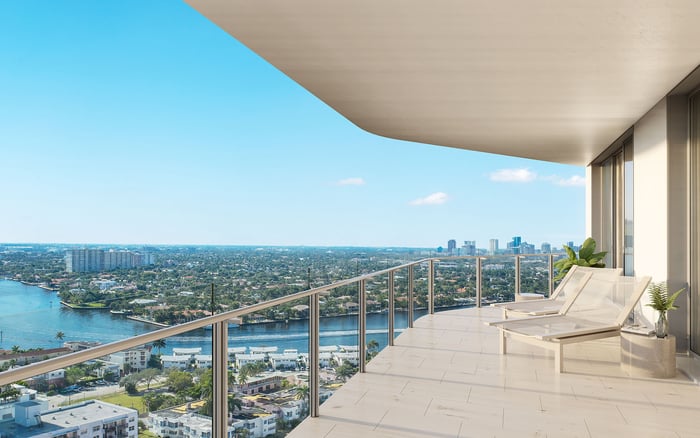
Four Seasons Fort Lauderdale’s February 2022 temporary-occupancy milestone illustrates why buyers should distinguish permission to occupy from contractual completion, insurance readiness, and the availability of residential services.

At Four Seasons Hotel & Private Residences Fort Lauderdale, permission to occupy and a fully settled residential experience are distinct milestones. For a buyer arranging furnishings, insurance, and a first arrival, they should not be treated as interchangeable.
By February 11, 2022, Fort Partners and minority partner Merrimac Ventures had secured a temporary certificate of occupancy, or TCO, for the development. The approval enabled residential closings to begin, while the hotel was expected to open during the first quarter of that year. This was a historical milestone-not a statement that the property currently operates under temporary approval.
At that time, the development comprised a 22-story building at 525 North Fort Lauderdale Beach Boulevard, with 83 condominiums and 138 hotel rooms. Approximately 93% of residences had sold. The development is now described as sold out, but neither figure establishes present resale availability or the occupancy documentation applicable to a particular purchase.
The essential distinction for buyers is simple: permission to occupy, the obligation to close, and readiness for daily living answer different questions.
A TCO permits occupancy before final completion when the building, or its approved portion, is safe for its intended use. Noncritical work may remain. Temporary approval should therefore be read as neither a blanket safety warning nor a promise that every space and service is complete.
In Broward, temporary and final occupancy certificates are distinct, and temporary-occupancy requests can identify a particular portion of a project. Scope matters as much as the certificate’s title. Buyers should ask which residence, access routes, and shared areas fall within the applicable approval rather than assume the entire development has identical status.
Request the applicable certificate, its conditions, any expiration or extension documents, and the final certificate if issued. The February 2022 milestone does not establish today’s certificate status. Nor should another Florida city’s renewal periods or penalties be treated as Fort Lauderdale requirements. The relevant authority’s actual approval is the starting point.
New-construction purchase agreements may use either a TCO or a final certificate of occupancy as the completion trigger. The consequence is significant: a buyer’s obligation to close may arise before every anticipated element of the residential experience is available. Whether that applies to a particular transaction depends on the executed agreement.
Have counsel identify the completion language, applicable notice provisions, and treatment of remaining work. Ask counsel to distinguish contractual requirements from preferences, especially when planning a seasonal arrival. A promised delivery date, an occupancy approval, and a furniture installation appointment should not be treated as one assumed deadline.
For buyers also considering Auberge Beach Residences & Spa Fort Lauderdale, the useful comparison is document by document, not brand by brand. This is a diligence framework, not an assertion that the properties share occupancy conditions. Each purchase deserves its own review of the agreement and applicable certificates.
Staged move-ins, elevator scheduling, and delivery restrictions are possible features of temporary occupancy. These are possibilities to investigate, not established Four Seasons Fort Lauderdale rules. A lawful right to occupy does not, by itself, reserve a service elevator or confirm the timing of a household installation.
Before committing to movers, request written instructions covering reservation procedures, delivery windows, access arrangements, and any areas unavailable during installation. If an interior team will arrive ahead of the owner, ask management to confirm the permitted schedule and requirements directly.
For a Fort Lauderdale Beach residence intended as a seasonal retreat, the most useful planning document is a coordinated calendar: closing, insurance inception, delivery access, and first overnight stay. Keep those dates provisional until the parties responsible for each step have confirmed them. This protects the arrival experience without assuming that temporary occupancy necessarily creates disruption.
A TCO calls for precise insurance questions, not automatic conclusions. It does not, by itself, establish higher premiums, altered deductibles, exclusions, or a provisional building master policy. The historical approval supports no such property-specific conclusion.
Ask the association or its representative for the relevant master-policy documents, then have the unit insurer or broker review the occupancy status and intended use. Request written confirmation of when unit coverage takes effect and whether any conditions apply to the circumstances disclosed.
The objective is alignment: the insurer should understand the applicable approval, and the buyer should understand the relationship between building coverage and the unit policy. Review deductibles, exclusions, and coverage responsibilities in the actual documents rather than infer them from the word temporary. Coordinate the effective date with counsel and the insurance adviser before closing or bringing possessions into the residence, as appropriate to the transaction.
An occupancy certificate addresses authorized use; it is not a complete service schedule. Unfinished areas can remain unavailable during temporary occupancy. That possibility does not establish any pool, spa, restaurant, or concierge restriction at Four Seasons Fort Lauderdale, either historically or today.
Ask management for written confirmation of the services and amenity access applicable to the residence on the intended arrival date. Separate what is available now from what is scheduled, and distinguish an operating schedule from a contractual commitment. In a development combining residences and hotel rooms, do not assume that residential closings and hotel operations necessarily begin together.
A buyer considering Four Seasons Residences Coconut Grove should apply the same discipline without transferring Fort Lauderdale’s history to that property. Brand familiarity can inform expectations, but the applicable agreements and written operating arrangements should guide the purchase decision.
Before setting a firm arrival date, bring five items into one review: applicable occupancy certificates and conditions; the purchase agreement’s completion clause; master-policy documents; written unit-policy confirmation; and management’s move-in and service schedules.
Ask counsel, the insurance adviser, and management to resolve inconsistencies within their respective responsibilities. If the certificate authorizes only part of a project, clarify access. If a service date is tentative, plan accordingly. If the contract permits closing on temporary approval, understand that obligation before treating unfinished details as grounds for delay.
The luxury is not simply an elegant address. It is arriving with the legal, financial, and practical arrangements already reconciled.
For a considered approach to South Florida residential ownership, explore MILLION.
If branded residences are on your mind — as a home or as an allocation — we would be glad to share what we are seeing, privately.
Begin a quiet conversationBy February 11, 2022, the developers had secured a temporary certificate of occupancy. That approval enabled residential closings to begin.
No. Buyers should request the applicable current certificates, including the final certificate if issued, rather than infer present status from the historical milestone.
A TCO permits occupancy of a building or approved portion that is safe for its intended use before final completion. Noncritical work may remain unfinished.
Yes. Temporary approval can be area-specific, so buyers should confirm the approved scope and any conditions affecting access or shared areas.
A new-construction agreement may make a TCO the completion trigger. Counsel should review the actual purchase agreement to determine the buyer’s obligations.
No automatic premium increase, deductible change, or exclusion follows from the historical TCO alone. Buyers should have their insurance adviser review the applicable policies and occupancy status.
No property-specific move-in restrictions are established here. Staged arrivals and elevator restrictions are general possibilities to confirm with management, not assumed property rules.
No. Occupancy approval is not a service schedule, and buyers should obtain written confirmation of amenity access and service availability for their intended arrival.
The development’s sold-out designation does not establish current resale availability. The historical 93% sales figure likewise should not be used as a present inventory measure.
Request applicable occupancy certificates and conditions, the purchase agreement’s completion clause, master-policy documents, unit-policy confirmation, and written move-in and service schedules.