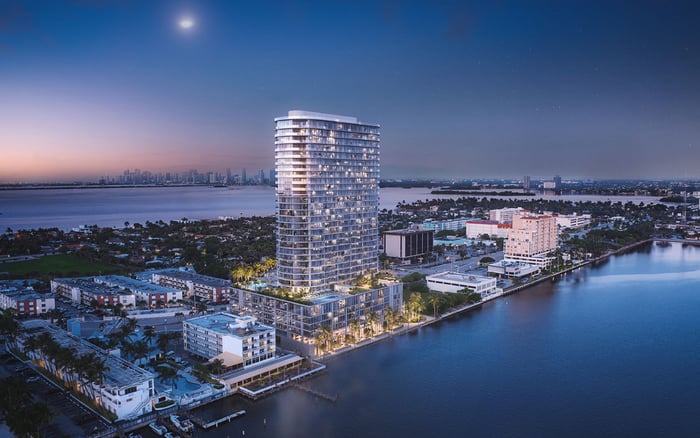
In North Bay Village, a stated parking count is only the beginning of buyer diligence. The purchase review should establish each space’s documented status, examine EV and valet access, and confirm that the buyer’s vehicles fit the building’s physical and operational systems before key contract deadlines.

In North Bay Village, parking can influence daily convenience as much as a residence’s interior layout. A statement that a home includes one or more spaces does not, by itself, explain where they are, how they may be used, or whether they are suitable for a buyer’s vehicles.
That distinction deserves attention when evaluating Continuum Club & Residences North Bay Village, Shoma Bay North Bay Village, or another North Bay Village condominium. Buyers should reconcile the contract, governing documents, parking exhibits, sales materials, and physical conditions rather than relying on a parking count alone.
The first task is to determine the documented character of every space associated with the residence. A space may be described as deeded, assigned, licensed, shared, tandem, compact, valet-controlled, or subject to another arrangement. Those distinctions can affect control, transferability, access, and ongoing cost.
The review should identify the precise space, its location, any separate agreement, and the rules governing reassignment or use. If marketing language and transaction documents differ, the discrepancy should be resolved in writing before the applicable contract deadline.
Buyers should also distinguish resident parking from guest, loading, and temporary-access areas. None should be treated as interchangeable without supporting documentation.
The presence of EV equipment does not necessarily establish that a particular owner will have dependable access. Buyers should ask whether charging is tied to a specific stall or shared, how access is managed, what charges may apply, and whether installation at an assigned space is permitted.
Useful follow-up topics include approval procedures, electrical capacity, equipment ownership, maintenance, insurance, cable placement, and plans for future demand. The goal is to understand how charging would work for the specific residence and vehicle, not merely whether chargers appear on an amenity list.
The same residence-specific analysis applies when comparing Tula Residences North Bay Village with nearby Onda Bay Harbor. Buyers should focus on the rights, procedures, and physical conditions documented for the home under consideration.
A valet component can affect access, guest handling, retrieval, and day-to-day predictability. The operating agreement and related rules should be reviewed for service procedures, hours, charges, insurance responsibilities, interruption planning, and what happens if the operator changes.
Mechanical parking requires additional scrutiny. Buyers should obtain the applicable dimensions and operating limits, then compare them with the exact height, width, length, wheelbase, and weight of each vehicle they expect to use. Maintenance responsibility, downtime procedures, redundancy, and access during an outage also deserve written clarification.
Even a conventional garage should be inspected carefully. Stall dimensions, columns, turning space, ramp angles, gates, overhead clearance, and tandem layouts can determine whether a nominally available space is practical.
Owners of tall vans, wide performance cars, long-wheelbase SUVs, heavy EVs, branded vehicles, or contractor trucks should avoid assumptions about access and storage. Building rules, physical constraints, valet procedures, and vehicle classifications may affect whether a particular vehicle can be accommodated.
Loading areas should be evaluated separately from resident parking. Buyers who expect frequent deliveries, moving activity, staffed transportation, or service vehicles should understand the building’s procedures and confirm that those procedures fit their routine.
A focused parking file may include the declaration, parking exhibit, site or garage plan, association rules, EV policy, valet agreement, and any separate license or assignment document connected with the residence. Buyers should compare those materials with the purchase agreement and inspect the actual route from the entrance to the relevant stall or service area.
Questions should be specific: Which space is included? Who controls it? Can it be transferred with the residence? Is it subject to valet or mechanical operation? Are there separate costs? Can the buyer’s vehicle clear every ramp, gate, turn, and lift? Written answers make it easier to identify inconsistencies while the buyer still has an opportunity to address them.
Does a stated parking count establish the buyer’s rights? No. The transaction and governing documents should identify the status, location, control, and conditions attached to each space.
Which parking documents deserve early review? Review the declaration, parking exhibit, applicable plans, association rules, and any assignment, license, valet, or EV documents connected with the residence.
Why should the exact stall be inspected? Columns, turning space, gates, ramps, tandem arrangements, and overhead clearance can make one stall materially different from another.
Does the presence of chargers guarantee dependable EV access? No. Buyers should confirm who may use the equipment, how access is managed, and which costs and procedures apply.
What should an owner ask about installing a charger? Ask about approval requirements, electrical capacity, equipment ownership, maintenance, insurance, cable placement, and associated charges.
What should be reviewed in a valet arrangement? Examine service procedures, operating hours, fees, insurance responsibilities, interruption plans, guest handling, and operator-change provisions.
Why does mechanical parking require added diligence? Vehicle limits and equipment downtime can directly affect access. Compare the system’s documented specifications with the buyer’s actual vehicle.
Which vehicle measurements matter most? Confirm height, width, length, wheelbase, and weight, then test them against stalls, ramps, gates, clearances, and any mechanical equipment.
Can a loading area be treated as resident parking? Buyers should treat loading and resident parking as separate unless the governing documents expressly establish otherwise.
When should parking questions be resolved? Resolve material discrepancies in writing before the relevant contract deadlines, with advice from the buyer’s legal and technical professionals when appropriate.
For a confidential assessment and a building-by-building shortlist, connect with MILLION.
If branded residences are on your mind — as a home or as an allocation — we would be glad to share what we are seeing, privately.
Begin a quiet conversation