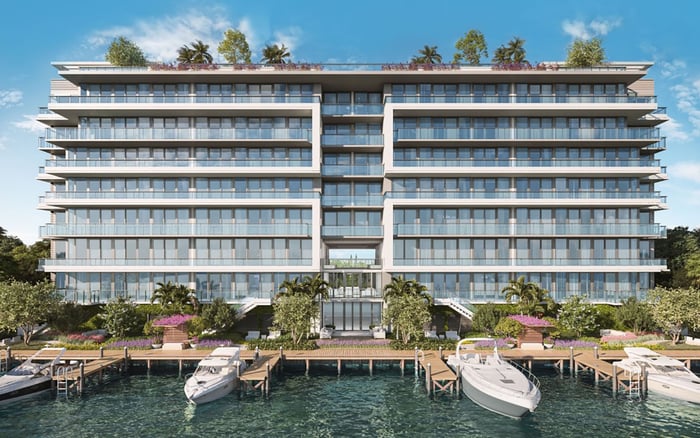
A due-diligence guide to evaluating elevator access, arrival privacy, daily circulation, and resale language when considering La Baia North in Bay Harbor Islands.

At La Baia North Bay Harbor Islands, buyers interested in private-elevator living should evaluate the complete journey from arrival to residence. The key question is not simply whether marketing materials use the word “private,” but how access works for the particular home under consideration.
A useful review follows every transition: vehicle arrival, building entry, lobby access, elevator authorization, corridor or vestibule use, and the final approach to the front door. Each shared or controlled space affects how discreet the experience feels in daily life.
Residence-specific plans and purchase documents should establish whether an elevator opens directly into a home, into a vestibule shared with another residence, or into a common corridor. Without that confirmation, buyers should avoid assuming that the same elevator arrangement applies throughout the building.
Arrival privacy is most valuable when it works consistently during ordinary routines. Buyers should test how residents, guests, deliveries, household staff, and service providers move through the property rather than focusing only on a staged arrival.
Access control also deserves close review. Relevant questions include how visitors are authorized, whether elevator permissions are limited by floor, how temporary access is issued, and what happens when a credential or system is unavailable. The answers should come from current project documents and the appropriate representatives.
The elevator itself is only one part of the experience. Waiting areas, shared vestibules, corridors, loading routes, and service procedures can all shape privacy. Buyers comparing Bay Harbor Islands options may also consider Onda Bay Harbor and Alana Bay Harbor Islands, using the same residence-by-residence review.
“Private elevator” can describe different configurations, so precise definitions matter. Direct-to-residence service, a dedicated vestibule, a limited-access floor, and a conventional shared corridor do not provide identical experiences.
A semi-private arrangement may still suit a buyer who values controlled access but does not require direct entry into the residence. Conversely, a household seeking maximum separation should confirm every shared point along the route and determine whether the practical operation matches its expectations.
Privacy should also be considered during busy periods and operational events. A tour can help reveal sightlines and walking distances, while written materials should clarify procedures for moves, large deliveries, contractors, and emergencies. Buyers should rely on the applicable documents rather than informal descriptions.
A fair comparison uses the same checklist at every property. Buyers can record where the elevator opens, how many transitions occur before reaching the home, which areas are shared, and how guest access is managed.
For a broader local comparison, The Well Bay Harbor Islands and La Maré Bay Harbor Islands may be reviewed alongside La Baia North. These links provide project navigation, but buyers should obtain current, residence-specific information directly through their due-diligence process.
The objective is not to identify one universal best configuration. It is to determine which circulation pattern fits the household’s routines, privacy preferences, hosting style, and tolerance for shared space.
Privacy-related features may help distinguish a residence at resale, but descriptions should match the documented configuration. A listing should not promise direct elevator entry, exclusive access, or a private vestibule unless those details are confirmed for that home.
Clear wording can distinguish among controlled elevator access, limited-access circulation, a shared elevator lobby, a semi-private vestibule, and direct-to-residence service. This precision helps prospective buyers understand what they are evaluating and reduces the risk of an overstated claim.
Future sellers should retain relevant floor plans, access descriptions, and governing materials. Conditions and procedures can change, so resale marketing should be checked against the documents and building operations current at the time of listing.
Before contracting, request the floor plan and documents applicable to the selected residence. Walk the arrival route in person when possible and ask for a clear explanation of every controlled or shared access point.
Review how occupants authorize guests and how deliveries, staff, contractors, and move-ins are handled. Confirm whether the passenger and service routes differ, and determine what backup procedures apply if normal access systems are interrupted.
Finally, ensure that any privacy description in sales materials is consistent with the contract documents. Legal, title, association, and building-operation questions should be directed to qualified professionals and the appropriate project representatives.
Does every residence at La Baia North have direct-to-residence elevator service? The provided fact table does not confirm that configuration. Buyers should verify the selected residence’s floor plan and purchase documents.
What does “private elevator living” mean? The phrase can refer to several access arrangements, from direct entry to a limited-access shared area. The exact configuration should be defined in writing.
What is a semi-private elevator vestibule? It generally describes an elevator arrival area shared by a limited number of residences rather than the entire floor. Buyers should confirm how the term applies to a specific home.
Why should buyers trace the entire arrival route? Privacy depends on every transition between arrival and the front door, not only on the elevator. Shared lobbies, corridors, and service paths can affect the experience.
How should guest access be evaluated? Ask how visitors are authorized, where they wait, and whether residents must provide time-limited or floor-specific access. Confirm the current procedure in the applicable materials.
Do deliveries and household staff affect privacy? They can, because service routines may use shared entrances, elevators, or corridors. Buyers should review the designated routes and authorization process.
What should be checked during a property tour? Observe access points, waiting areas, sightlines, elevator openings, corridors, and the distance to the residence. Compare those observations with the written plans.
How should La Baia North be compared with nearby projects? Apply the same checklist to each residence and compare actual circulation patterns rather than relying on marketing labels alone.
Can elevator privacy influence resale positioning? It can help distinguish a home when the configuration is desirable and accurately documented. Resale claims should reflect conditions at the time of listing.
What language is safest for resale marketing? Use specific, verifiable terms such as controlled access, shared lobby, semi-private vestibule, or direct-to-residence service only when supported by current documentation.
To compare the best-fit options with clarity, connect with MILLION.
If branded residences are on your mind — as a home or as an allocation — we would be glad to share what we are seeing, privately.
Begin a quiet conversation