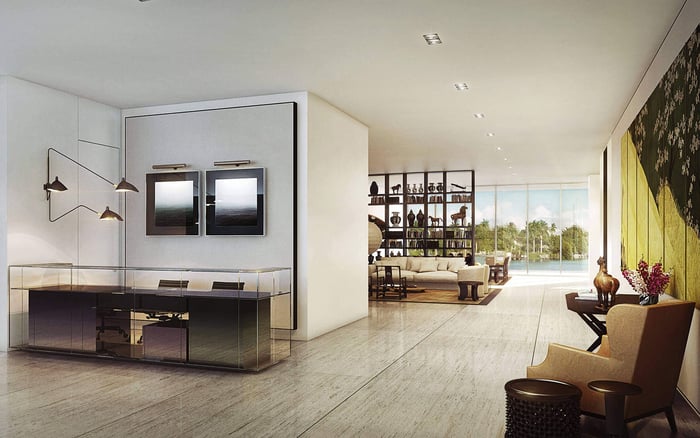
A private dining room is valuable only when its access, pricing and operating rules suit the way an owner intends to entertain. Here is how buyers should read reservation priority, service charges, catering restrictions and event liabilities before treating the amenity as an extension of the residence.

A private dining room can be one of the most persuasive spaces in a luxury residence. It offers the intimacy of entertaining at home without requiring guests, staff and service equipment to circulate through the apartment. Yet the room itself is only half the amenity. Its real value lies in the operating system behind it: who may reserve it, how far in advance they can book, what an event costs and what kind of hospitality is actually permitted.
That distinction matters across South Florida, where entertaining can range from a chef-led dinner to a multigenerational celebration. Buyers considering Cipriani Residences Brickell or other Brickell options should approach private dining with the same diligence applied to parking, storage or marina access. The current reservation agreement, house rules and fee schedule carry more practical weight than a rendering or a broad promise of priority access.
The room is only half the amenity; the rules determine its real value.
“Priority” is incomplete unless management defines the advantage. It may mean an earlier booking window, additional annual reservations or preferential access to peak dates-materially different benefits. A resident who entertains around holidays needs clarity on blackout dates and the allocation of prime evenings, while a buyer anticipating frequent business dinners should focus on reservation caps and repeat-use restrictions.
Ask when the calendar opens, whether bookings are first-come, first-served and whether certain residence categories receive earlier access. Confirm who qualifies as the host. Rules may limit use to residents’ friends and family or restrict reservation frequency. Either condition could prevent an owner from having an assistant, event planner or corporate entity make the reservation.
The event period also demands precision. A reservation charge may cover a fixed block of time, with additional time billed separately. Buyers should therefore ask whether setup and breakdown count against reserved hours, how overtime is calculated and whether management can schedule another event immediately before or after theirs.
Private-event pricing may begin with either a flat venue fee or a food-and-beverage minimum. Under a minimum-spend structure, room rent may be waived if the threshold is met. If spending falls short, the difference may be charged as rental. This approach rewards a sufficiently large menu order, but it does not make the quoted minimum an all-in price.
A complete estimate may include service charges, tax, staffing, cleaning, equipment, security and overtime. Costs can also vary by room and date. The point is to recognize how significantly format, capacity and timing can affect the final bill.
Deposits add another layer. A deposit may be non-refundable, and a late cancellation may cause the resident to forfeit it. Before signing, request a sample invoice for an event comparable in guest count, duration and service level to the occasions you expect to host. It should separate the deposit from the final balance and identify every potentially variable charge.
For owners comparing service-driven branded residences, including The Residences at Mandarin Oriental, Miami, this exercise helps distinguish a beautifully programmed hospitality concept from a predictable, usable residential benefit. Terms should always be confirmed for the specific property and booking date.
A line labeled “service charge” should never be assumed to be an optional tip or a payment distributed entirely to event staff. It may cover administration, coordination or other operating costs. The resident should ask what the charge funds, whether gratuity is included and whether additional tipping is expected or permitted.
The ideal response is written and itemized. Ask whether the charge applies only to food and beverages or also to room fees, rentals and labor. Confirm whether staffing carries minimum hours and whether bartenders, captains, security personnel or culinary support appear as separate line items. These details can turn a seemingly reasonable minimum into a surprisingly expensive evening.
Cleaning requires similar scrutiny. A cleaning or laundering charge may be financially and legally distinct from room rental. Management may also recover repair or replacement costs from the resident responsible for damage. A host should know whether the standard cleaning fee covers ordinary use, what triggers enhanced cleaning and how damage is documented.
A private dining room does not automatically allow a private chef to prepare a complete menu on-site. Outside catering may be prohibited, particularly when the venue operates through an exclusive culinary provider. Even when an outside chef is permitted, vendor access, loading procedures, approved equipment and insurance requirements may constrain the format.
The phrase “limited kitchen facilities” deserves particular attention. It should not be interpreted as a commercial kitchen. Buyers need written confirmation of approved appliances, ventilation and preparation limits, including whether a chef may cook from raw ingredients or is restricted to reheating, plating and service.
This distinction matters when comparing the lifestyle proposition of a waterfront home with that of a hospitality-oriented residence. At Four Seasons Residences Coconut Grove, as with any Coconut Grove project under consideration, purchasers should request current operational documents rather than infer culinary permissions from branding. The same principle applies to coastal entertaining in Miami Beach, including evaluations of The Perigon Miami Beach.
Alcohol can introduce further controls. Rules may require licensed service personnel, proof of liability insurance or additional security, particularly when outside vendors and guests increase the property’s exposure. Confirm who must obtain insurance, the required form of coverage and the submission deadline. Also ask whether vendors must be preapproved and whether elevators, service entrances or loading areas have fixed access periods.
The most useful diligence package is concise but specific. Request the declaration, current house rules, reservation form, fee schedule and vendor-access policy. Then obtain written answers covering booking windows, eligible users, annual caps, blackout dates, deposits, cancellation, insurance, staffing, alcohol service and outside catering.
The central test is straightforward: model the event you are actually likely to hold. Give management a realistic guest count, preferred date, service style and chef arrangement. Ask for an itemized estimate and a step-by-step booking timeline. If an answer depends on future management discretion, identify that uncertainty before assigning the amenity meaningful value in a purchase decision.
Private dining is most luxurious when it feels effortless, but that ease is produced by clear rules, transparent pricing and capable operations. A handsome room may inspire the purchase conversation. A workable agreement allows the owner to use it with confidence.
For discreet guidance on evaluating South Florida residences and the amenities behind them, connect with MILLION.
If branded residences are on your mind — as a home or as an allocation — we would be glad to share what we are seeing, privately.
Begin a quiet conversationIt may mean an earlier booking window, more annual reservations or better access to peak dates. Buyers should ask management to define the benefit in writing.
Not necessarily. Staffing, cleaning, equipment, security, overtime and damage costs may be charged separately.
It is a required spending threshold that may replace room rent. If spending falls short, the difference can be charged as rental.
It should not be assumed to include gratuity. Ask what portion covers staff, administration or event coordination and whether tipping is additional.
Not always. Some event policies prohibit outside catering or require use of an exclusive culinary provider.
Only if the kitchen and building rules permit it. Limited facilities may support reheating and plating rather than full commercial cooking.
They may. The agreement should state whether both activities fall within the event period and how overtime is charged.
Yes. A deposit may be non-refundable, and late cancellation can result in forfeiture, so deadlines should be reviewed before booking.
It may be required, particularly when outside vendors, alcohol or larger guest groups increase the property's exposure.
Request the current declaration, house rules, reservation form, fee schedule and vendor-access policy, plus written answers on access, costs and restrictions.