A seasonal owner's guide to the marketed parking and charging provisions at The Ritz-Carlton Residences® Pompano Beach, with essential checks for long-term vehicle care, key custody, and storm readiness.

For a seasonal owner, the most valuable arrival amenity is certainty: a residence ready to occupy and a vehicle ready to use. At The Ritz-Carlton Residences® Pompano Beach, that means distinguishing the marketed parking offering from the arrangements required for months away.
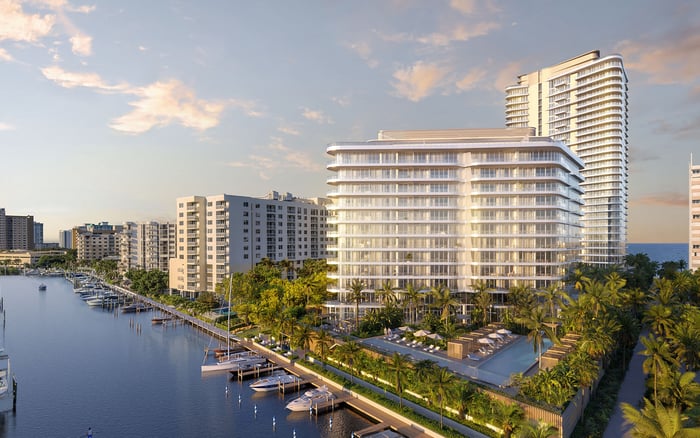
At 1380 S Ocean Boulevard, Pompano Beach, Florida 33062, the project is marketed as an owners-only residential resort rather than a conventional hotel. Advertised amenities include a porte cochère with valet service, a 24/7 attended lobby, and concierge. Planned valet service is described as 24-hour, but these provisions do not establish a seasonal vehicle-care program.
That distinction matters before departure. Construction is described as underway, with delivery subject to a certificate of occupancy; neither an opening date nor current service availability is established. Treat amenities as marketed until final operating documents confirm what is available and who is responsible.
Each residence is marketed with two garage parking spaces and a choice of self-parking or valet service. The offering separately identifies 23 private parking garages available for purchase. Do not assume a private garage accompanies a particular residence or that the marketed count reflects current inventory.
Request the unit-specific parking assignment and, where relevant, private-garage purchase terms. Confirm whether a vehicle may remain in the same location throughout an extended absence, whether staff can move it, and what notice or authorization is required. For a valuable automobile, parking entitlement and storage permission warrant separate confirmation.
Ask about vehicle dimensions, covers, detailing, electrical equipment, and access by an outside specialist. If Armani Casa Residences Pompano Beach is also on your shortlist, ask the same questions there rather than assuming equivalent arrangements. Compare written permissions, not amenity terminology.
A private enclosure may appeal to an owner who values discretion, but the advertised parking description does not establish temperature or humidity control, flood-protection specifications, or independent electrical outlets. Each requires a separate, specific answer.
Before committing to seasonal storage, request the relevant garage specifications and confirm what equipment owners may install or operate. Have your vehicle specialist identify storage requirements, then ask management whether the proposed arrangement is permitted. An electrical outlet, if available, is not in itself authorization to leave equipment connected indefinitely.
Individual secured storage for each residence is also part of the marketed offering. Keep that entitlement separate from garage use. Confirm permitted contents rather than assuming the space can accommodate automotive supplies, charging equipment, or other vehicle-related belongings.
The marketed EV infrastructure specifies Level 2 charging with 220-volt service and capacity for up to two charging stations per residence. This describes infrastructure, not a confirmed installation at every standard parking space. It also leaves separate electricity metering and charger assignment or sharing unresolved.
For an EV left during an extended absence, obtain written answers about plug-in permission, billing, charge-limit settings, fault monitoring, and power-restoration procedures. Ask who, if anyone, would receive an alert and act on it. Do not assume valet or concierge staff monitor charging simply because those services are advertised.
A dedicated 12-volt battery-maintainer service is not documented. Treat battery tending as a separate request covering approved equipment, connection permissions, inspection responsibility, and charges. Ask the vehicle manufacturer or your qualified specialist for model-specific storage instructions, then reconcile them with building rules. A generic charging routine is no substitute for an agreed care plan.
An attended lobby and valet service do not, by themselves, establish a formal seasonal-owner key-custody policy. Approved-driver procedures and identity checks before vehicle release are also unspecified. For an absent owner, these details are central to control.
Request separate rules for residence keys, vehicle keys, valet keys, and access fobs. Ask whether long-term custody is accepted, where items are held, who can retrieve them, and whether handoffs are recorded. Any proposed arrangement should define emergency authority without leaving routine access open-ended.
Provide a narrowly defined approved-driver list if management accepts one. Clarify how identity and owner authorization would be checked before release to a family member, driver, service technician, or transporter. Contractor access to the residence should remain distinct from permission to access the vehicle. Document how authorizations can be changed or revoked while you are away.
The Marina Tower's marketed amenities include a private marina with 13 boat slips offered for sale exclusively to owners. A slip purchase should not be interpreted as permission to store a boat trailer, towing vehicle, or marine equipment in the garage.
For residence #401, the stated restrictions are “No RV/Boats” and “No Trucks/Trailers.” These unit-level details do not independently establish building-wide rules. Request the governing restrictions for the residence and parking arrangement under consideration rather than applying those restrictions more broadly.
For a Broward seasonal home serving both road and water, keep the documentation distinct: residence parking, private-garage rights, secured storage, and marina rights. Each should address its own access and storage questions.
Request the garage hurricane and flood-response plan before leaving a vehicle for the season. Ask whether relocation may be required, who can authorize and perform it, where the vehicle would be taken, and what happens if the owner cannot be reached. Flood-protection specifications are not established by the parking description.
Address prolonged power loss separately, including charging interruptions and any approved battery-maintainer arrangement. Seek written clarity on liability and confirm the proposed storage and relocation arrangements with your insurer. If external transport or storage may be needed, identify that option in advance rather than assuming it is part of concierge service.
Before leaving, assemble a concise vehicle instruction file: parking location, authorized contacts, custody permissions, approved electrical arrangements, emergency decisions, and the intended return date. Request written acceptance of any tasks delegated to management or a third party.
Confirm whether retrieval, detailing, tire checks, charging, or fueling can be arranged, along with lead times, fees, and liability. None should be treated as an included service here. Buyers also considering Waldorf Astoria Residences Pompano Beach can apply the same standard: assess a seasonal residence through explicit responsibilities as well as its arrival experience.
Explore South Florida residences with a more considered ownership perspective at MILLION.
If branded residences are on your mind — as a home or as an allocation — we would be glad to share what we are seeing, privately.
Begin a quiet conversationEach residence is marketed with two garage parking spaces and a choice of self-parking or valet service. Confirm the specific assignment and extended-storage rules for the unit.
The marketed offering identifies 23 private parking garages available for purchase, not automatic inclusion with every residence. Confirm unit-specific purchase terms and current availability.
Twenty-four-hour valet is described as a planned amenity. Current operating status is not established, so confirm availability through final operating documents.
Marketing describes Level 2 EV charging with 220-volt service and capacity for up to two charging stations per residence. It does not establish charging at every standard space, metering arrangements, or assigned versus shared chargers.
A dedicated 12-volt battery-maintainer service is not documented. Ask separately about equipment permissions, monitoring, responsibility, and fees.
Extended plug-in permission is not established. Confirm charging duration, charge-limit settings, monitoring, billing, and outage procedures before departure.
Temperature and humidity control are not established by the parking description. Independent electrical outlets and flood-protection specifications also require confirmation.
Formal seasonal key-custody and vehicle-release procedures are not disclosed. Obtain written rules covering accepted keys, authorized drivers, identity checks, and emergency access.
The marketed marina includes 13 slips offered for sale exclusively to owners, but slip ownership does not establish trailer-storage rights. Confirm garage and vehicle restrictions separately.
Request the garage hurricane and flood-response plan, including relocation authority, destination, and responsibility during prolonged outages. Clarify liability and insurance arrangements before leaving the vehicle.