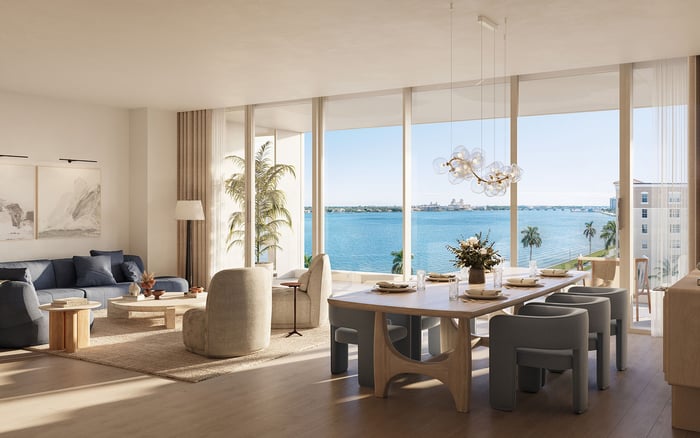
A foreign buyer's currency exposure at Mandarin Oriental Residences, West Palm Beach is divided across four 10% pre-closing payments and a much larger 60% closing balance. A disciplined plan should align conversion decisions with contractual notices, construction milestones, transfer logistics, financing and a practical liquidity buffer.

For an international purchaser, a defining financial feature of Mandarin Oriental Residences, West Palm Beach is the sequence in which the purchase price must be funded in US dollars.
The payment schedule calls for 10% at reservation, 10% at contract, 10% at groundbreaking, 10% when construction reaches the 15th floor and 60% at closing. This divides the acquisition into five funding events: 40% is committed before closing, while the majority remains outstanding until the residence is ready to close.
For international buyers, this is where pre-construction mechanics intersect with branded-residence ownership and cross-border planning. Residence selection may be emotional; the funding calendar should be managed as a treasury exercise.
The final 60% balance deserves its own currency strategy, not merely an extension of the deposit plan.
Staging creates flexibility because a buyer holding euros, sterling, Canadian dollars or another currency need not convert the entire purchase price at once. The trade-off is that every unpaid dollar installment remains exposed to exchange-rate movements.
If the buyer's home currency weakens against the dollar before a payment milestone, more of that currency will be required to acquire the same number of dollars. If it strengthens, the home-currency cost declines. The contractual purchase price may remain fixed in dollars even as the buyer's effective cost continues to move.
The first two funding events occur close to the purchase decision. Reservation and contract together represent 20% of the price, making early currency decisions material before construction milestones begin. Only the executed agreement and formal notices should govern actual timing.
Groundbreaking and construction reaching the 15th floor each trigger another 10% payment under the schedule. These are operational milestones, but for a foreign buyer, they are also currency deadlines.
The schedule assigns no exact calendar dates to those milestones. A plan based solely on an estimated construction timeline could leave too little time to convert funds, clear compliance checks and complete an international wire. Buyers should obtain the contract's notice procedures, payment windows and permitted transfer methods, then monitor formal construction communications.
The same issue applies across the local luxury landscape. A purchaser comparing Forté on Flagler West Palm Beach, The Ritz-Carlton Residences® West Palm Beach or other new-development opportunities should examine each project's contract independently. Similar market positioning does not imply identical deposit triggers, protections or deadlines.
A disciplined FX plan establishes decisions before market movements create pressure. Depending on eligibility and advice from regulated professionals, a buyer may consider immediate conversion, staged conversion, forward contracts or currency options. Pricing, collateral requirements, cancellation provisions, counterparty exposure and availability vary, so no instrument should be assumed suitable for every purchaser.
Immediate conversion can remove rate uncertainty from a known dollar obligation, but it may require holding substantial dollars well before payment. Staged conversion can mirror the deposit schedule and preserve flexibility, although future installments remain exposed. A forward contract may establish a rate for a future transfer, while an option may offer a form of protection with different costs and terms.
Rather than trying to identify the perfect market level, buyers can establish a policy for each installment. It might specify the amount to protect, the latest decision date, who can authorize a transfer and what happens if a milestone arrives earlier than expected. The objective is reliable completion, not speculative currency trading.
The final payment is six times the size of any individual 10% installment and 1.5 times the entire 40% paid before closing. This concentration makes the closing balance the dominant FX exposure.
An all-cash buyer retains direct currency exposure to the full closing amount until the dollars are acquired. A buyer using a US dollar mortgage may fund part of the balance with loan proceeds, subject to approval and the contract, but this can shift a portion of the exposure into future dollar-denominated debt service. Mortgage and currency planning therefore need to be considered together.
The closing plan should also include a liquidity reserve for exchange-rate movements, international transfer delays, intermediary-bank charges and other transaction costs. The appropriate buffer is personal and should reflect the buyer's currency, banking arrangements and contractual payment window. Funds should not be scheduled to arrive at the last possible moment.
Market convention may provide context, but it is not a substitute for the signed agreement. Florida counsel should review escrow treatment, refundability, default provisions, notice delivery, assignment restrictions, payment methods and the consequences of a delayed wire.
A buyer exploring branded ownership beyond this project, including The Residences at Mandarin Oriental Boca Raton, should apply the same discipline without assuming that brand affiliation produces matching contract terms.
The strongest preparation unites the buyer, Florida counsel, tax advisers, mortgage professionals, the receiving escrow party and a regulated FX provider around one schedule. It should record every known dollar obligation, distinguish fixed dates from milestone estimates and assign responsibility for notices and transfer approvals.
Before reserving, the buyer should know how the initial dollars will be sourced. Before contracting, the next 10% should be operationally ready. During construction, milestone alerts should be linked to conversion and wire procedures. Well before closing, the buyer should resolve the largest funding decision and test the banking path that will deliver the balance.
For discreet guidance on South Florida's finest residential opportunities, connect with MILLION.
If branded residences are on your mind — as a home or as an allocation — we would be glad to share what we are seeing, privately.
Begin a quiet conversationIt is 10% at reservation, 10% at contract, 10% at groundbreaking, 10% at the 15th floor and 60% at closing.
The four pre-closing payments total 40% of the purchase price, leaving 60% due at closing.
The dollar price can remain fixed while the amount required in the buyer's home currency changes with exchange rates.
The 60% closing balance is the largest single exposure, at six times any individual 10% installment.
No exact calendar dates are stated, so the contract, formal notices and construction updates should guide planning.
No. Buyers should rely on the executed contract and formal notices for their specific obligations.
Potential approaches include immediate conversion, staged conversions, forward contracts and currency options, subject to eligibility and professional advice.
Mortgage proceeds may fund part of the closing balance, but they can shift some exposure into future dollar-denominated debt service.
It can account for adverse rate movement, transfer delays, intermediary-bank fees and milestones arriving earlier than estimated.
The executed purchase agreement and formal deposit notices should control rather than a marketing schedule or general market convention.