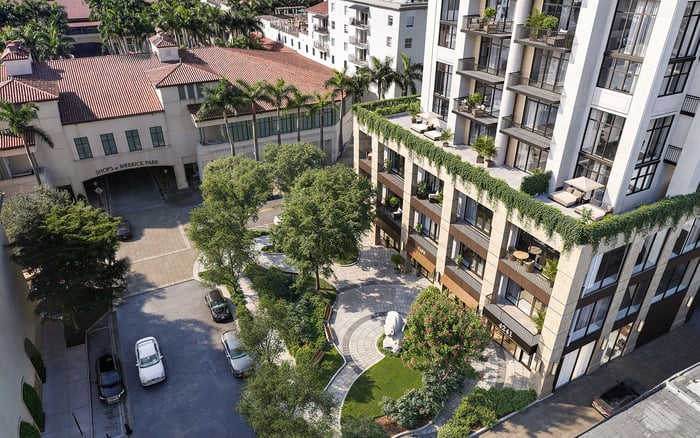
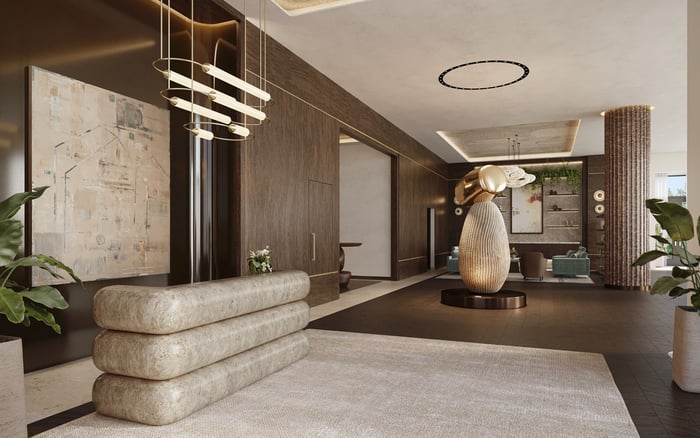
For a Cora Merrick Park purchase, insurance diligence is an exercise in matching documents. The association’s master policy, the buyer’s HO-6 form, its endorsements, and the condominium documents must be reviewed together to reveal who insures luxury interiors, how wind deductibles may reach owners, and which special assessments could remain uncovered.

A residence at Cora Merrick Park sits within the two-layer insurance structure common to Florida condominiums. The association maintains a commercial master policy, while the owner obtains an HO-6 unit policy. Neither should be evaluated in isolation. The essential question is whether their definitions, limits, deductibles, exclusions, and endorsements align cleanly-or leave a costly gap between them.
That distinction carries particular weight in a luxury residence. The master policy typically addresses the structure, common areas, building systems, association liability, and certain condominium property as originally installed or replaced with like kind and quality. An HO-6 policy generally addresses qualifying interior finishes, personal property, owner improvements, personal liability, loss of use, and eligible loss assessments. Precise responsibility depends on the governing documents and policy language.
The most consequential insurance gap is often found between documents, not within one page.
For a Coral Gables buyer, this is more than a closing requirement. It is an investment decision about preserving an interior, managing a potential association obligation, and understanding the cash exposure that may follow a major insured event.
Begin by requesting the complete master-policy declarations and endorsements-not simply a certificate or summary. Examine the declarations for total insured value, covered perils, the wind or named-storm deductible, liability limits, other deductibles, exclusions, and applicable sublimits. Endorsements can materially alter the protection that appears on the declarations page.
The policy’s coverage basis is equally important. Bare-walls, single-entity, and all-in structures draw different boundaries around insured condominium property. That boundary determines whether flooring, wall coverings, cabinets, appliances, built-ins, and original finishes belong to the association layer or the owner layer after a covered loss. A buyer should not infer the answer from a residence’s appearance or a general description of the building.
The same document-matching discipline applies when comparing nearby ownership opportunities such as Ponce Park Coral Gables and The Village at Coral Gables. The relevant coverage boundary is specific to each association’s documents and policies. Similar location, positioning, or new-construction status does not establish identical insurance treatment.
HO-6 Coverage A should reflect the current cost to reconstruct insured interior improvements-not the residence’s purchase price or market value. For a refined home, that estimate may need to account for flooring, cabinetry, wall finishes, appliances, custom millwork, integrated built-ins, and other upgraded materials that could sit outside the association policy.
A generic allowance may be inadequate when the design and architecture program relies on bespoke fabrication or premium finishes. The prudent process is to inventory insured components, obtain a credible reconstruction estimate, and confirm how the carrier values a covered loss. The proposed policy should also be reviewed for personal property, personal liability, loss of use, deductibles, exclusions, and any restrictions relevant to the owner’s intended occupancy.
Revisit coverage after a renovation. New stone, millwork, fitted storage, wall treatments, or upgraded appliances can materially change reconstruction cost, even if the residence’s market value moves for unrelated reasons. Buyers considering other design-led condominiums, including Four Seasons Residences Coconut Grove, should apply the same principle: insure the covered interior that would need to be rebuilt, subject to the actual policy terms.
Florida unit-owner policies issued or renewed on or after July 1, 2010, must include at least $2,000 of property loss-assessment coverage for assessments arising from the same direct loss. The deductible for that required coverage is limited to $250. If the same direct loss causes covered damage to the unit and the deductible for that claim applies, an additional deductible cannot be imposed on the associated loss-assessment claim.
Those statutory terms are a floor, not a complete strategy. Standard forms may carry only $1,000 to $2,000 of loss-assessment protection, while endorsements may raise the overall limit to $25,000, $50,000, or more. Yet the headline amount does not tell the full story. Some Florida forms apply a separate, much smaller sublimit when an assessment is solely attributable to the association master policy’s deductible.
Obtain written confirmation from the proposed HO-6 carrier addressing that precise scenario. Ask whether an assessment generated solely by the master wind or named-storm deductible is covered, what sublimit applies, which deductible applies, and whether any exclusions or conditions narrow recovery. A large overall loss-assessment limit can still leave meaningful exposure if the master-deductible provision is restrictive.
A practical first-pass test begins with the master policy’s total insured value and applicable percentage wind deductible. Multiplying those figures produces a rough building-level deductible exposure. That amount is not automatically the buyer’s share, but it establishes the scale of the association obligation that could arise after a covered storm loss.
Next, review the declaration and governing documents to determine how that obligation could be allocated among units. Do not assume an equal division. Compare the resulting potential unit share with the HO-6 loss-assessment limit and, separately, with any sublimit for an assessment based on the master-policy deductible. A percentage deductible on a high-value South Florida building can create a multimillion-dollar association obligation, placing an owner’s potential share well above the statutory minimum.
This calculation is a scenario test, not a prediction. Its purpose is to clarify the relationship among building value, deductible structure, allocation formula, and personal coverage before the purchase becomes unconditional.
Loss-assessment coverage generally responds only when the association assessment stems from a peril or liability event covered by the HO-6 policy. The words “special assessment” do not make an expense insurable. Reserve shortages, routine maintenance, milestone inspections, planned structural work, code upgrades, and budgeting decisions generally fall outside coverage merely because they are assessed to owners.
Request recent claims information, deductible assessments, pending assessment notices, reserve information, and meeting minutes discussing uninsured losses. Condominium associations can levy assessments to maintain, repair, and replace common elements, potentially shifting uninsured losses and master-policy obligations to unit owners. Insurance review therefore complements-rather than replaces-legal and financial condominium diligence.
Before closing, have an experienced insurance adviser and Florida condominium attorney review the master declarations, endorsements, governing documents, proposed HO-6 form, and HO-6 endorsements together. Seek a written comparison of Coverage A, loss-assessment coverage, all applicable deductibles, exclusions, valuation provisions, and the master-deductible sublimit.
The strongest file answers four questions without ambiguity: what the association insures, what the owner must insure, how a major building deductible may be allocated, and which assessments the HO-6 policy would actually recognize. That clarity allows a Cora Merrick Park purchase to be evaluated with the same care given to title, financing, and the residence itself.
For discreet guidance on South Florida luxury real estate, connect with MILLION.
If branded residences are on your mind — as a home or as an allocation — we would be glad to share what we are seeing, privately.
Begin a quiet conversationThey insure different layers of condominium ownership. Reading them together reveals where association coverage ends and owner responsibility begins.
It typically covers the structure, building systems, common areas, association liability, and certain condominium property as originally installed or replaced with like kind and quality.
It generally covers eligible interior finishes, personal property, improvements, personal liability, loss of use, and qualifying loss assessments, subject to its terms.
Coverage A should reflect the current cost to reconstruct insured flooring, cabinetry, built-ins, wall finishes, and other interior improvements, rather than market value.
Qualifying unit-owner policies issued or renewed on or after July 1, 2010 must include at least $2,000 for assessments arising from the same direct loss.
Florida law limits the deductible for the required property loss-assessment coverage to $250, subject to the statutory conditions.
No. It generally requires an assessment arising from a peril or liability event covered under the HO-6 policy.
Generally not merely because they are called special assessments. Routine maintenance, reserve shortages, milestone inspections, code upgrades, and planned work are typically ownership costs.
Some HO-6 forms impose a smaller sublimit when an assessment is based solely on the association master policy deductible, despite a higher overall loss-assessment limit.
Request the complete master declarations and endorsements, governing documents, proposed HO-6 form and endorsements, recent claims, assessment notices, reserve information, and relevant meeting minutes.