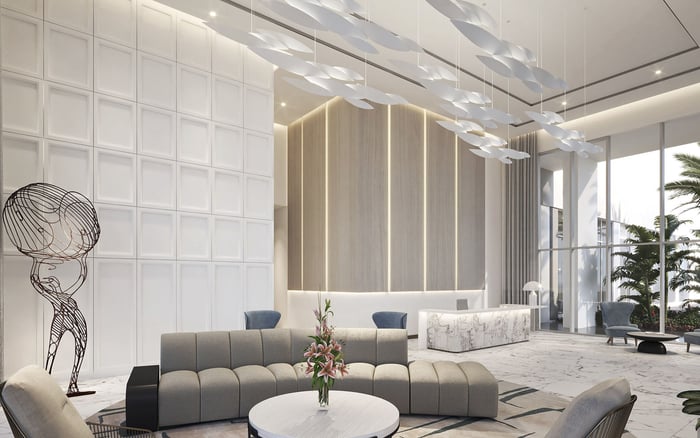
At Auberge Beach, the oceanfront setting and hospitality identity are distinct purchase considerations. Buyers should examine the operative agreements, service funding and governance provisions that determine how the residential experience continues over time.

At Auberge Beach Residences & Spa Fort Lauderdale, a purchase encompasses both a physical residence and the expectation of a carefully serviced lifestyle. The two-tower condominium development at 2200 N. Ocean Boulevard occupies an Atlantic beachfront setting, with approximately 171 residences and 450 linear feet of beach frontage.
Those physical attributes are a starting point. For a service-oriented buyer, the more consequential questions are who delivers the experience, which obligations are documented and what happens when an agreement expires or an operator changes. An elegant amenity space and the service that sustains it are distinct purchase considerations.
For buyers considering a primary residence or seasonal retreat in Broward, the objective is not to discount the hospitality identity. It is to understand precisely what supports it throughout the intended ownership period.
The development team comprised The Related Group, Fortune International Group and The Fairwinds Group, distinct from the Auberge hospitality brand. Nichols Brosch Wurst Wolfe & Associates designed the architecture, with interiors by Meyer Davis. These roles should not be conflated with ongoing operational responsibility.
Auberge’s appointment to manage the residential development was announced on October 30, 2014. The intended remit extended beyond name recognition to oversight of every aspect of the lifestyle. The historical service concept included management of the residences and amenities, including the spa.
That history does not establish the current contracting parties, the present operator or the legal form of the relationship. Nor does it establish a franchise arrangement or a separate trademark license.
For purchase analysis, distinguish permission to use the brand from responsibility for delivering services. Ask counsel whether those matters are addressed together or separately. Identify the operative documents rather than assuming the building’s name answers either question.
Request the operative management agreement, any branding license and the amendments or renewals relevant to each. Counsel should identify the parties, covered property and service obligations, then establish the remaining term and renewal conditions. Do not assume that a publicly announced appointment continues on its original terms.
The review should establish whether renewal is automatic, discretionary or conditional, and who can exercise the relevant rights. Termination provisions warrant equal scrutiny: which events permit termination, what notice is required and whether there is an opportunity to remedy a default. These are questions for documentary review, not established features of Auberge Beach’s arrangements.
Ask how the documents connect. If management ends, does permission to use the name also end? If branding changes, can the existing operator remain? Are transition obligations specified? The answers distinguish continuity of identity from continuity of service.
A buyer also considering Four Seasons Hotel & Private Residences Fort Lauderdale should apply the same questions independently. A hospitality name is no substitute for property-specific contract analysis.
The original amenity offering included a fitness center, spa, restaurant, wine cellar, golf simulator, club room and children’s playroom, alongside valet and concierge services. The spa concept emphasized land-and-sea elements within the wellness experience.
For a purchaser, the next step is to distinguish the existence of those spaces from the terms under which they operate. Request confirmation of current availability, resident access, operating hours, staffing and any separate charges. Ask which services are contractual obligations and which may be adjusted through budgets or operating decisions.
Ownership and control of amenity spaces also require verification. The historical amenity offering does not establish who owns each space or what rights an individual residence carries. Counsel should trace access rights to the applicable documents, including any separate arrangements governing the spa or restaurant.
The phrase “five-star resort-style” is promotional language, not an independent rating or a permanent service guarantee. Buyers should translate it into specific, reviewable expectations.
Service continuity is also a financial question. Request current budgets, financial statements and relevant meeting minutes, then connect the service offering to the expenses that support it. Ask how management costs, amenity operations and any applicable branding charges are allocated.
The review should distinguish association-funded costs from resident user charges or other arrangements. If an amenity receives a subsidy, ask who provides it, how long the commitment lasts and what happens when it ends. Do not assume a subsidy exists; establish whether one is part of the operating structure.
For a buyer comparing Auberge Beach with Shell Bay by Auberge Hallandale, shared branding should not imply shared funding arrangements, fees or contractual protections. Each purchase requires its own examination of obligations and cost allocation.
The useful comparison goes beyond the quoted ownership expense: what it supports, what remains separately payable and which commitments extend beyond the current budget period.
Governance determines who can act when an operational relationship needs to change. Ask counsel to identify who can appoint or replace the operator and whether owner approval is required. Do not assume that purchasing a condominium conveys a direct vote over every management or branding decision.
Review relevant meeting minutes for discussions affecting services, funding or contractual relationships. Request clarification of any proposed changes and reconcile informal assurances with the operative documents.
Examine the practical implications of a hypothetical transition. Ask whether the agreements address staffing handover, continuity of resident-facing services and responsibility for transition expenses. This is contingency planning, not a suggestion that a change is pending at Auberge Beach.
The central question is whether the documents provide a workable path to maintaining the residential experience, even if the parties delivering it change.
Before proceeding, assemble a concise service-continuity brief with counsel: the current operator, applicable agreements, renewal horizon, termination rights, amenity access, funding responsibilities and decision-making authority. Identify unresolved questions before treating a preferred service as a dependable component of ownership.
Evaluate the residence’s physical qualities separately from the hospitality experience. Neither should obscure uncertainty in the other. There is no established basis here to quantify an Auberge resale premium or predict the price effect of hypothetical rebranding.
The strongest purchase rationale combines an appealing home with a clear understanding of the arrangements that sustain its lifestyle.
For a discreet perspective on South Florida residential opportunities, connect with MILLION.
If branded residences are on your mind — as a home or as an allocation — we would be glad to share what we are seeing, privately.
Begin a quiet conversationThe two-tower oceanfront condominium development is at 2200 N. Ocean Boulevard in Fort Lauderdale.
Development materials described approximately 171 residences and 450 linear feet of Atlantic beachfront.
Auberge’s management appointment was announced in October 2014 with an intended role overseeing the residential lifestyle. That historical appointment does not confirm current contractual terms or the present operator.
A separate brand license is not established here. Buyers should request any applicable branding agreement and have counsel determine how brand rights relate to management obligations.
Review service scope, remaining term, renewal conditions, termination rights and transition obligations. Counsel should also identify the contracting parties and how any management and branding documents interact.
The offering included a fitness center, spa, restaurant, wine cellar, golf simulator, club room and children’s playroom, plus valet and concierge services. Current availability, access terms and charges require confirmation.
No. It is promotional language, not evidence of an independent rating or a permanent service guarantee.
Request current budgets, financial statements and relevant meeting minutes. Review how service costs are allocated and whether any amenity subsidies or separate user charges apply.
That authority must be established from the applicable agreements and governance documents. Buyers should not assume that owner approval is required or that individual owners have direct replacement rights.
No quantified brand premium is established here, nor is a price effect for hypothetical rebranding. Evaluate physical qualities and documented service arrangements separately.