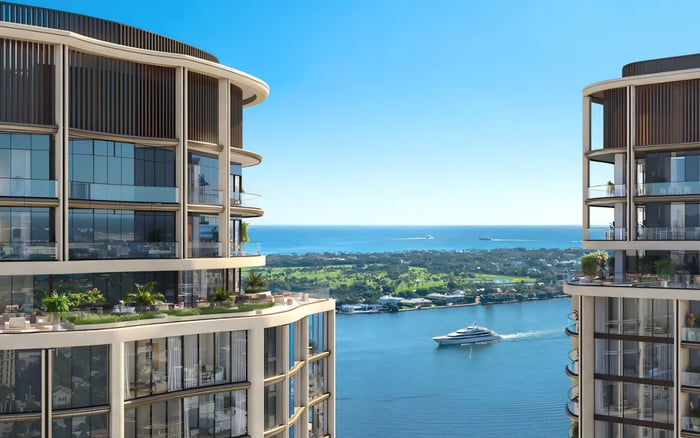
A disciplined penthouse review separates exclusivity from ownership, maps roof and terrace obligations, tests mechanical adjacency, and documents rights that may influence appraisal.

For a buyer whose calendar is shaped by private aviation, a Palm Beach Gardens residence may be expected to function with unusual precision. The home must be ready upon arrival, secure during absences, and manageable without prolonged intervention. At the penthouse level, however, the most visually compelling spaces can also raise the most consequential questions: Who controls the roof? Who pays for terrace waterproofing? Can building personnel cross an exclusive outdoor area to service equipment? What exactly will an appraiser recognize as part of the condominium parcel?
A brochure’s use of “private rooftop” or “exclusive terrace” does not resolve these issues. The recorded declaration, amendments, surveys, plans, title materials, association records, and purchase contract must tell a consistent story. Under Florida condominium law, responsibility for maintaining common elements generally rests with the association, but a declaration can assign duties for a limited common element to the owner who benefits from it.
Penthouse value is strongest when exclusivity, responsibility, access, and condition align.
A useful starting point is The Ritz-Carlton Residences® Palm Beach Gardens-not as proof of any particular roof condition or allocation, but as a prompt to apply the same document-led discipline to every luxury residence under review.
Ask condominium counsel to classify each roof, roof deck, terrace, balcony, overhang, stair, equipment pad, and adjoining service zone as unit property, a common element, or a limited common element. The distinction governs far more than vocabulary.
A limited common element remains a common element, even when reserved for one unit’s exclusive use. Exclusivity should not automatically be treated as ownership. A condominium roof is ordinarily a common element maintained by the association unless the governing documents allocate responsibility differently. Project-specific language can also make an owner responsible for the maintenance, care, preservation, repair, or replacement of a rooftop area serving that residence.
Counsel should read the declaration together with every amendment and exhibit. Confirm that the legal description, recorded plans, unit boundaries, and appurtenance provisions identify the same spaces. Then compare those documents with the purchase agreement and title commitment. If a terrace is presented as a central feature of the residence, its legal status and cost allocation should be unmistakable before the inspection period expires.
The same discipline applies when comparing Palm Beach Residences or Forté on Flagler West Palm Beach. A project link can introduce a property, but only its governing documents establish the rights attached to a specific unit.
A penthouse buyer should not treat “the roof” as a single component. The structural deck, waterproofing membrane, insulation, drainage, parapets, finishes, planters, railings, outdoor kitchens, pools, and owner-installed improvements may fall under different responsibility clauses. The party responsible for a decorative surface may not be responsible for the membrane beneath it.
Request a component-by-component responsibility matrix prepared with counsel and tested by an engineer. It should identify ownership or legal classification, maintenance duty, repair duty, replacement duty, insurance treatment, approval requirements, and access rights. It should also address damage that begins in one component but appears in another, such as water entering through an outdoor assembly and surfacing inside the residence.
An engineering assessment can examine roofing, waterproofing, framing, foundations, and corrosion risks that a standard visual walkthrough may not reveal. Legal review establishes who bears a duty; engineering establishes the existing condition. Neither substitutes for the other.
Mechanical adjacency warrants its own plan review. Obtain drawings showing rooftop and nearby equipment, service corridors, shafts, exhaust points, drains, screens, and access routes. Then have the appropriate professionals evaluate potential noise, vibration, odor, heat discharge, visual exposure, and maintenance traffic. Reconcile the available documents with what is physically installed.
Visit the residence under more than one operating condition when practicable. Ask how technicians reach equipment and whether the association retains access across an exclusive-use area. Review rules governing notice, emergency entry, work hours, protective coverings, and restoration after service. For an owner who travels frequently, the practical question is not merely whether access exists, but whether it can be managed discreetly while the home is unoccupied.
When considering another Palm Beach option such as The Berkeley Palm Beach, repeat the inquiry from the beginning. Mechanical placement and access conditions are project-specific and should never be inferred from price point, branding, or architectural presentation.
The document package should extend beyond the declaration. Review the bylaws, articles, rules, current budget, recent financial statements, reserve study, reserve balances, dues history, and resale certificate or estoppel. Examine meeting materials and available project records for planned or discussed roof, façade, waterproofing, structural, and equipment work.
Reserve balances and expense history can help reveal future assessment risk, but the analysis should remain tied to actual components and assigned duties. If the association maintains the structural roof while the penthouse owner maintains an exclusive deck above it, counsel and the engineer should examine how investigation, removal, storage, and reinstatement costs are treated. The clearest answer is one grounded in the governing documents, not custom or informal assurances.
This is where a sophisticated buyer’s-guide mindset becomes valuable: organize every issue by right, responsibility, condition, access, cost, and remedy. Unresolved contradictions should become written closing conditions, negotiated protections, or reasons to reconsider the transaction.
For appraisal purposes in Florida, a condominium parcel includes its fractional or proportionate share of appurtenant common elements. Documentation of claimed rooftop and terrace rights is therefore especially important. An appraiser should not be left to translate promotional language into a legal conclusion.
Provide the recorded declaration and amendments, relevant plan sheets, legal descriptions, title materials, and clear evidence of any appurtenant or exclusive-use rights. Disclose the corresponding owner obligations as well. A right carrying significant repair or replacement exposure is not identical to fee ownership of outdoor area, and the appraisal file should preserve that distinction.
For penthouses, physical features, legal rights, and recurring liabilities must be presented separately. If recorded plans conflict with marketing floor plans, or if an exclusive area cannot be tied clearly to the unit, resolve the discrepancy before valuation and lending deadlines. The goal is not to direct the appraiser, but to ensure the analysis begins with accurate evidence.
Before closing, ask Florida condominium counsel and an engineer to reconcile the declaration, amendments, recorded plans, title materials, physical inspection, association finances, and contract. Convert their findings into a concise schedule of spaces and systems, with responsibility and access assigned to each.
For an aviation-oriented owner, the post-closing file should also be operational. Keep governing provisions, equipment locations, service contacts, access procedures, warranties, inspection photographs, and approval requirements in one secure record. That preparation protects the quality that matters most in a lock-and-leave residence: confidence that an arrival will not reveal a preventable surprise.
For discreet guidance on South Florida’s finest residences, connect with MILLION.
If branded residences are on your mind — as a home or as an allocation — we would be glad to share what we are seeing, privately.
Begin a quiet conversationNo. It may be a limited common element reserved for one unit while remaining part of the condominium’s common elements.
The recorded declaration and its amendments establish legal status. Marketing descriptions do not replace that review.
The association ordinarily maintains common elements such as the roof, unless the governing documents establish a different allocation.
Yes. A declaration may assign maintenance, repair, or replacement duties to the owner who benefits from that area.
The structural deck, membrane, finishes, drainage, and owner improvements may have different responsibility and cost allocations.
The review may include roofing, waterproofing, framing, foundations, corrosion risks, and relevant mechanical conditions.
Plans and physical conditions should be checked for equipment locations, access routes, noise, vibration, exhaust, heat, and maintenance traffic.
Review the governing documents, budget, financial statements, reserve study, reserve balances, dues history, and resale certificate or estoppel.
An appraiser needs reliable evidence of appurtenant or exclusive-use rights and any related owner obligations, rather than promotional terminology.
Counsel analyzes legal rights and responsibility, while the engineer evaluates physical condition. Both findings should be reconciled before closing.