For an art collector buying in South Florida with a securities-backed line, ownership decisions, post-sale property taxes and collateral liquidity belong in one coordinated plan. Separate closing costs from future tax reserves, confirm homestead eligibility and prepare for financing pressure beyond the purchase date.

For an art collector, a South Florida residence can be both a private setting for a collection and a substantial commitment of capital. A securities-backed line of credit, or SBLOC, allows borrowing against eligible investment assets without immediately selling the pledged securities. That flexibility calls for a cash-flow plan as considered as the acquisition itself.
The central discipline is to separate closing obligations from what follows. A qualifying ownership change generally resets Florida assessed value on the following January 1, while the credit line remains exposed to collateral movements and variable interest expense. The seller’s tax bill is not the buyer’s forecast.
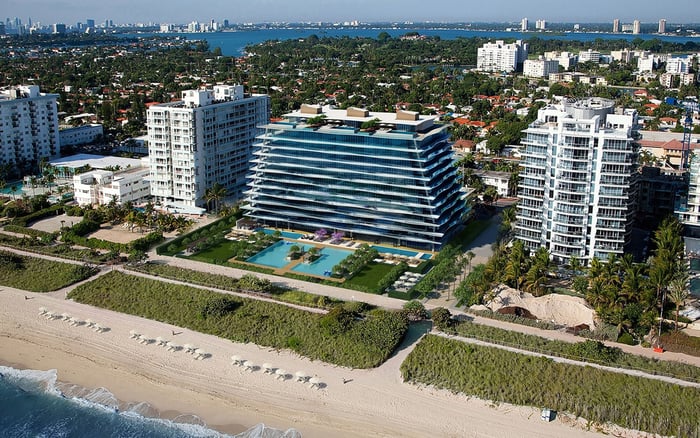
For a collector considering Faena House Miami Beach, the search should include three parallel reviews: how title will be held, how future property taxes will be estimated, and how much liquidity will remain outside the purchase.
Ownership structuring begins with intended use. Will the residence become an eligible primary residence or serve another purpose? An eligible primary-residence owner can apply for Florida homestead exemption, which reduces taxable value. The benefit is not automatic upon purchase.
Before selecting individual, trust or entity ownership, ask legal and tax advisers to confirm how the proposed title arrangement interacts with the intended homestead claim. Do not assume that an LLC, trust or art-holding arrangement delivers a particular property-tax result. Nor should the residence and collection automatically share an ownership structure simply because they will occupy the same space.
Keep the review specific: who will own the property, who will occupy it, who will borrow, and which assets will support the borrowing? These are planning questions, not a recommendation for a particular vehicle. Any budget that assumes an exemption or portability benefit should make that assumption explicit and confirm eligibility before relying on it.
Florida property-tax determinations generally depend on ownership, value and exemption status on January 1 of the tax year. A qualifying purchase completed in 2026 would generally trigger reassessment at just value on January 1, 2027-not immediately at closing. Statutory exceptions can apply.
That change generally removes the seller’s Save Our Homes assessment limitation and exemptions. A long-held property’s capped assessed value can sit substantially below current market value, making the existing bill an unreliable starting point for the buyer’s ongoing budget.
In Brickell, a purchaser evaluating Una Residences Brickell should distinguish the purchase-year tax treatment from the following year’s assessment. A comparatively modest 2026 bill does not establish the cost of ownership in 2027.
Use a preliminary estimate that reflects the post-sale assessment and the buyer’s applicable exemptions. An official county property-tax estimator can support that exercise, but its output is neither a final assessment nor a tax bill. Extend the planning horizon through the reassessment year, even if it falls beyond the first twelve months after closing.
Homestead exemption itself does not transfer from one residence to another. Eligible owners may instead transfer some or all of their Save Our Homes assessment difference through portability. That distinction matters when a buyer expects a prior Florida residence to reduce the new property’s taxable value.
Portability requires a new homestead application and a Transfer of Homestead Assessment Difference application, generally Forms DR-501 and DR-501T. Portability applications are generally due March 1 of the year for which the benefit is requested.
The eligibility window is tied to January 1 and tax years-not simply three years after a sale. The new homestead must be established within three years of January 1 of the year the previous homestead was abandoned. Confirm the relevant dates before including portability savings in the reserve calculation.
The acquisition budget should distinguish three cash flows: deed taxes at closing, contractual property-tax prorations, and a reserve for future annual property taxes. Combining them into one tax allowance can obscure both timing and responsibility.
Miami-Dade’s base deed documentary stamp tax is $0.60 for each $100 of consideration, or fraction thereof, approximately 0.60%. An additional $0.45 for each $100 applies to applicable transfers, with transfers involving only a qualifying single-family dwelling excluded from that surtax. Where both apply, the combined rate is $1.05 for each $100, approximately 1.05%.
On an illustrative $10 million of taxable consideration, those rates produce $60,000 at the base rate or $105,000 with the surtax. These are deed-tax illustrations only. They neither establish who pays under the purchase contract nor include other closing costs.
For a prospective acquisition at Arte Surfside, have the closing agent confirm the applicable classification rather than automatically assigning the combined rate to a condominium or townhouse. These deed-tax rates are specific to Miami-Dade, not all of South Florida.
An escrow estimate also needs a clear label. Ask whether it represents a contractual closing adjustment, a lender-required deposit or the buyer’s own reserve. Do not assume a universal SBLOC escrow requirement. For internal planning, divide the estimated post-sale annual property tax by twelve to establish a monthly reserve target, then adjust funding for the payment calendar. That is a budgeting convention, not a lender requirement.
An SBLOC allows investments to be retained at purchase, but it does not eliminate liquidation risk. Declining collateral values can trigger a maintenance call requiring additional cash or securities, or repayment of part of the outstanding balance.
If the call is not satisfied, the lender may sell pledged securities, potentially during a market decline. Liquidating appreciated securities can create capital-gains tax consequences even when the sale is forced. Variable interest rates add another fluctuating expense, while demand-loan provisions and changing collateral requirements can accelerate repayment pressure.
Do not model the line as guaranteed permanent financing. Test whether the plan remains workable when higher property-tax reserves, increased interest expense and a collateral call coincide. Avoid counting the same available dollar as both a tax reserve and collateral-call liquidity.
Create a single acquisition schedule covering closing funds, title, legal and lender charges, insurance, HOA assessments, maintenance, art transport and installation, SBLOC interest and collateral-call liquidity. Keep contractual prorations distinct from the following year’s tax reserve.
Assign each item an expected payment period, funding source and review point. Label estimates clearly rather than treating them as settled obligations. The objective is not merely to complete the purchase, but to preserve flexibility after the collection is installed and the reassessment takes effect.
Explore South Florida residences with MILLION while keeping ownership, financing and first-year liquidity central to the acquisition plan.
If branded residences are on your mind — as a home or as an allocation — we would be glad to share what we are seeing, privately.
Begin a quiet conversationA qualifying ownership change generally triggers reassessment at just value on January 1, 2027, rather than immediately at closing. Statutory exceptions can apply.
The seller’s capped assessed value may be substantially below current market value. A qualifying ownership change generally removes the seller’s assessment limitation and exemptions.
The appropriate structure requires an individualized legal and tax review. Do not assume that a proposed LLC, trust or art-holding arrangement will qualify for homestead benefits.
No, homestead exemption itself does not transfer. Eligible owners may transfer some or all of their Save Our Homes assessment difference through portability.
Portability generally requires Forms DR-501 and DR-501T, with the portability application generally due March 1 of the requested benefit year. The new homestead must be established within three years of January 1 of the year the previous homestead was abandoned.
Use a preliminary estimate reflecting the post-sale assessment and the buyer’s applicable exemptions, not simply the seller’s bill. A county estimator provides a planning figure rather than a final assessment or tax bill.
Taxable consideration of $10 million produces $60,000 at the base rate or $105,000 when the additional surtax applies. These figures cover deed taxes only and do not determine contractual payment responsibility.
Do not assume that it does. The closing agent should confirm the applicable classification and whether the qualifying single-family-dwelling exception applies.
No, a buyer’s internal reserve, contractual closing prorations and lender-required deposits are distinct. Confirm any escrow requirement in the financing terms rather than assuming a universal SBLOC rule.
Falling collateral values can prompt demands for additional assets or repayment, and an unmet call can lead to forced securities sales with possible capital-gains consequences. Variable rates and demand-loan provisions also make the line unsuitable to model as guaranteed permanent financing.