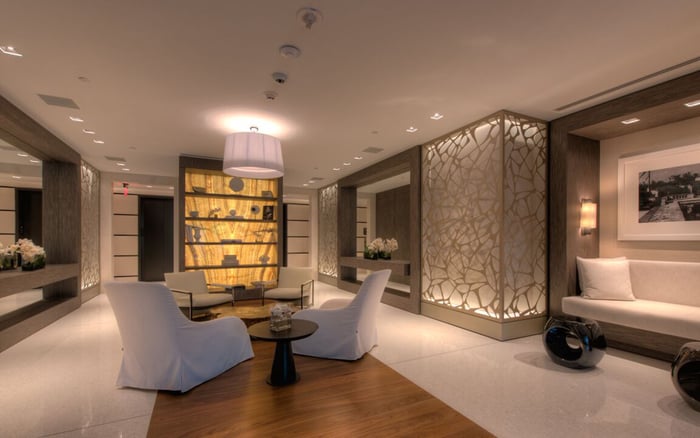
A buyer’s framework for evaluating privacy behind the service offering at Palazzo del Sol, from resident and staff circulation to recurring-worker credentials, contractor approvals, and access when owners are away.

At Palazzo del Sol, the operational question is not simply whether service is available. It is whether a household can receive that service while preserving the privacy, predictability, and discretion its owners expect. On Fisher Island, off the southern tip of Miami Beach, the condominium sits within a ferry-access, controlled-access environment. That setting makes the journey from island arrival to residence door an essential part of purchase due diligence.
For an owner employing a housekeeper, chef, personal assistant, or visiting specialist, the distinction matters. An elegant resident entrance and an attentive concierge do not establish where workers enter, which elevators they use, or who authorizes access when the owner is absent. Those questions deserve the same attention as the residence’s layout and outlook.
Palazzo del Sol’s advertised offering includes 24-hour front-desk reception/security, concierge, and valet service. The concierge is marketed as multilingual and full-service, with the description “six-star.” Treat that phrase as marketing language, not an independently established service classification or a definition of staff-entry procedures.
Private elevator entry is described for residences, and elevator security appears among the advertised security features. Neither detail establishes a dedicated household-staff elevator, a continuous service corridor, or a separate entrance to the residence under consideration. The decisive distinction is between access control and circulation separation: one concerns permission to enter; the other concerns the route taken once permission is granted.
Ask management to explain both in writing. A useful answer identifies who grants permission, where credentials are checked, which spaces are shared, and how the arrangement applies to the specific unit. General assurances of privacy should translate into a clear sequence of movements and approvals.
Request an authorized walkthrough that follows four journeys: the resident, a recurring household employee, a one-time contractor, and a delivery team. Begin with island arrival, not the building lobby. Ask where island access authorization ends and building authorization begins, and whether separate residence-level approval is required.
Within the building, request plans or a demonstration covering any service entrance, back-of-house corridor, loading area, package room, and freight or service-elevator arrangements. These are items to verify, not features to assume. Identify every shared lobby or elevator segment and clarify whether separation is physical, scheduled, or unavailable for that journey.
The last few feet matter as much as the arrival. Establish whether a worker reaches the residence through the same entry guests use, and whether an alternative route is available and permitted. Have management demonstrate the authorized route without requesting sensitive security configurations.
For buyers also considering Palazzo della Luna, use the same route-by-route questions. Compare each property’s current procedures and the selected residence; do not assume neighboring addresses operate identically.
A recurring employee presents a different operational question from a single delivery. Request the current staff-entry procedures and recurring-worker credential rules. Ask what registration requires, who may approve it, whether authorization expires, and how a household changes or withdraws that authorization.
Clarify whether permissions attach to an individual, a company, a residence, or a defined visit. Ask how substitutions are handled when a regular cleaner sends a colleague or a household’s usual driver changes. Do not presume that approval for a business covers every person it dispatches.
Then establish responsibility. Who in the household can authorize entry: the owner, a designated representative, or another approved contact? What happens when that person cannot be reached? Ask how arrivals and departures are recorded, what confirmation is available to the owner, and how concerns are escalated. These are questions for management, not claims about existing systems.
Request vendor approval requirements, contractor insurance requirements, and permitted work hours before relying on a preferred service provider. Distinguish routine housekeeping from maintenance, installation, and larger deliveries. Ask management which category governs each proposed activity and whether additional documentation or reservations are required.
Use realistic examples: a florist making a short visit, an appliance technician carrying tools, or a furniture team needing extended unloading time. For each, establish the approval lead time, arrival point, permitted route, parking arrangement, and person responsible for receiving the visitor. Ask whether an escort is required and, if so, who provides it.
Assigned, covered, garage, and valet parking options are advertised, but they do not establish vendor parking privileges or loading permissions. Confirm those separately. Ask how delayed arrivals, missed appointments, and after-hours repair requests are handled. A workable protocol should explain exceptions without suggesting they are guaranteed.
Café Sol is described as a butler-staffed aperitivo bar and lounge. The advertised amenities also include two treatment and massage suites, a salon, a business center, a private theater, and a children’s playroom. These features describe the resident experience; they do not establish access rights for privately retained professionals.
Discuss a household’s own therapist, stylist, or trainer separately with management. Ask where an outside provider may work, what approvals apply, and whether an amenity reservation is necessary. A staffed amenity is not proof that outside vendors are screened, escorted, or admitted on a particular schedule.
Before purchase, describe an ordinary day when the residence is unoccupied: the housekeeper arrives, a technician needs entry, and a delivery is delayed. Ask management to walk through each approval and handoff, including what happens if the household’s designated contact is unavailable.
For a shortlist that includes The Residences at Six Fisher Island, carry the same scenario into the comparison. The aim is not to presume equivalent operations, but to identify which documented arrangements fit the household’s actual needs.
The most useful buyer’s guides distinguish an attractive service proposition from an operating arrangement a household can rely on. Assemble the current written rules, management’s unit-specific clarifications, and observations from the authorized walkthrough into one decision record. Flag unresolved questions for follow-up rather than treating verbal reassurance as confirmation.
The objective is not separation at any cost. It is a clear understanding of where routes overlap, who controls entry, and what the owner must coordinate. For Palazzo del Sol, that is the practical foundation for evaluating whether the advertised service offering supports the desired private life.
For a discreet perspective on South Florida residential decisions, connect with MILLION.
If branded residences are on your mind — as a home or as an allocation — we would be glad to share what we are seeing, privately.
Begin a quiet conversationPalazzo del Sol is a luxury condominium on Fisher Island, off the southern tip of Miami Beach, within a ferry-access, controlled-access environment.
No. Private elevator entry does not establish a separate staff elevator, service corridor, or alternative residence entrance.
The advertised offering includes 24-hour front-desk reception/security, concierge, and valet service. These services do not by themselves establish household-vendor access procedures.
It is marketing language rather than an independently established service classification. Buyers should verify the specific responsibilities and access procedures relevant to their household.
Request authorized demonstrations of resident, recurring-staff, contractor, and delivery routes from island arrival to the unit door, identifying shared spaces.
Request current staff-entry procedures and recurring-worker credential rules. Clarify registration, substitutions, authorization expiry, and withdrawal of access.
Confirm vendor approval requirements, contractor insurance requirements, permitted work hours, and any applicable loading or elevator arrangements with management.
No. Their presence does not establish whether privately retained professionals may enter, use amenities, or require screening or escorts.
No. Assigned, covered, garage, and valet parking options are advertised, but vendor parking and loading permissions require separate confirmation.
Ask management to explain a realistic sequence involving staff, a technician, and a delayed delivery. Confirm who authorizes each visit and what happens when the designated contact is unavailable.