A buyer-oriented look at upper-floor ownership at One Park Tower, focusing on documented emergency communications, refuge planning, mobility assistance, and the maintenance obligations behind long-term confidence.

The appeal of One Park Tower by Turnberry North Miami is clear: a 33-story residential tower at 2411 Laguna Circle, within the 184-acre SoLé Mia community. Advertised features include views of a seven-acre Crystal Lagoon, private beach access, floor-to-ceiling windows, and oversized wrap-around balconies. For a long-term owner, however, the most consequential questions extend beyond the view.
An upper-floor residence warrants evaluation against the household’s needs over time, including temporary injury, reduced mobility, and visits from older relatives. The essential distinction is between everyday convenience and documented emergency arrangements. High-speed elevators and professional security are meaningful features, but neither establishes how a resident who cannot use stairs will receive instructions or assistance.
This is not a finding of deficiency. It is a framework for understanding what ownership requires before selecting a floor, signing a contract, or planning a permanent move.
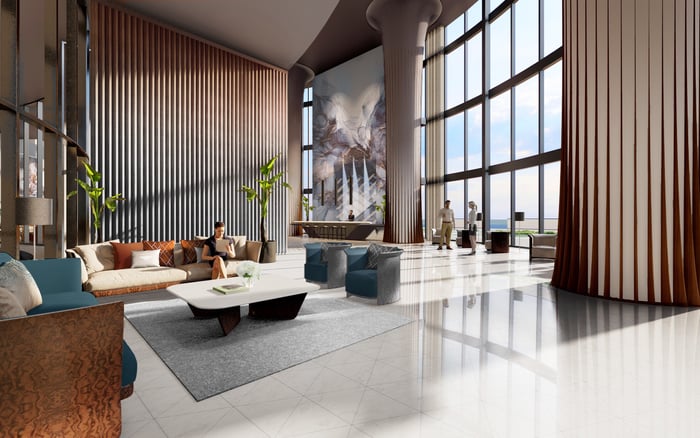
Advertised arrival features include gated entry, secured garage parking, electric-vehicle charging stations, and a private residential porte cochère and lobby. Residences are advertised with high-speed elevator access, with direct access promoted for corner residences. These details describe the daily arrival experience, not elevator availability during an emergency.
Ask for a clear distinction among ordinary service, a routine outage, and emergency operation. Which written instructions govern each situation? What support is planned for a resident who cannot reach the lobby independently? If backup power is provided, which systems does it support, and what operating limitations apply?
Likewise, advertised 24-hour professional security and video surveillance should not be read as a promise of trained evacuation assistance. Request the actual division of responsibilities among management, security personnel, service contractors, and emergency responders. A useful answer identifies duties and limitations rather than offering a general assurance that someone will help.
Life-safety communications deserve a separate review. Request documented alarm and notification procedures, including how instructions reach residents inside their homes and in shared spaces. Ask what accessible alerts are provided for people with hearing or vision-related needs, and how residents learn to recognize and act on them.
The review should also cover communication during a power interruption. Ask which communication functions have backup power, how their operation is tested, and what residents should do if their usual contact channel is unavailable. Do not assume that a telephone call, mobile application, or message to the front desk constitutes the building’s emergency procedure.
For a household with mobility needs, the critical question is more specific: how does someone unable to use stairs communicate their location and receive the applicable instructions? Request a written explanation tied to the approved emergency plan. Personalized reassurance is welcome, but it is no substitute for a defined procedure.
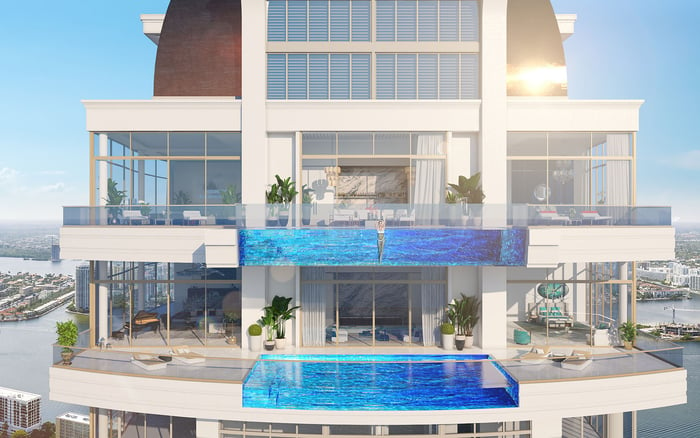
A sixth-floor social deck with a pool and spa is planned, placing a major shared amenity above ground level. The tower’s balconies, garage, and surrounding lagoon setting also raise practical questions about movement and waiting areas. None should be treated as an approved refuge location or emergency assembly point without explicit documentation.
Request the approved emergency plan and confirmation of any designated refuge locations. Ask how those locations, if provided, are identified, reached, and connected to the building’s assistance and communications procedures. Clarify which instructions apply to residents who cannot independently complete the prescribed route.
Do not substitute an intuitive location for the approved arrangement. An open-air deck, a spacious balcony, or a familiar parking level may feel reassuring without serving the emergency role a buyer imagines. During an incident, follow the building’s applicable emergency instructions and responder directions, not a route improvised from an amenity tour. This article is a due-diligence framework, not an evacuation plan.
A household’s mobility needs can change without a major incident. Ask how management would handle a prolonged elevator interruption, what assistance falls within its responsibilities, and what the household would need to arrange independently. Distinguish support for daily living from assisted evacuation: these are separate questions requiring separate answers.
Walk through everyday routes during the buying process, including arrival, garage access, the lobby, the residence, and shared amenities. Consider a wheelchair, walking aid, caregiver, or visiting family member when discussing these routes. The aim is not to certify accessibility through a walkthrough, but to identify questions for qualified review.
For buyers also considering Turnberry Ocean Club Sunny Isles in Sunny Isles Beach, the same written questionnaire can structure a comparison. Compare documented arrangements rather than infer equivalent staffing, emergency systems, or mobility support from branding or presentation.
For an owner who is not always present, ask how guests, caregivers, and other authorized occupants receive emergency instructions. Clarify how household contact information is updated and whether a process exists for communicating assistance needs, including how sensitive information is handled. These are questions to resolve with management, not services to presume.
Before committing, confirm current completion and occupancy status, and distinguish planned procedures from those already implemented. Ask which documents will be available before occupancy and which operating arrangements remain subject to confirmation.
A buyer weighing The Residences at 1428 Brickell alongside a North Miami residence can apply the same distinction. Compare what is documented for each property at the relevant stage, without assuming that a proposed operating model is an established service.
Long-term confidence depends on more than the initial equipment specification. Request applicable inspection and testing records, maintenance responsibilities, staff-training procedures, and funding plans for safety-critical equipment. Where operations have not begun, ask for the planned schedule, responsible parties, and records owners should expect to receive later.
The review should also establish how issues are tracked and resolved. Who receives notice of a failed test or service interruption? Who authorizes corrective work? How are residents informed of temporary limitations? Ask how recurring maintenance and eventual replacement costs are reflected in the ownership budget, without assuming that a particular reserve balance or funding mechanism exists.
The purchase decision need not rest on technical fluency alone. Have appropriate legal and technical advisers review documents that exceed your expertise. The goal is a clear understanding of responsibilities, limitations, and follow-through-especially where a household’s ability to live independently depends on reliable vertical access.
For a discreet perspective on South Florida residences and the questions that shape lasting ownership, explore MILLION.
If branded residences are on your mind — as a home or as an allocation — we would be glad to share what we are seeing, privately.
Begin a quiet conversationThe 33-story residential tower is at 2411 Laguna Circle in North Miami, within the 184-acre SoLé Mia community.
No. Buyers should request the documented emergency operating procedures and clarify any backup-power provisions and limitations.
Yes, corner residences are marketed with direct high-speed elevator access. That feature does not establish emergency elevator availability.
Advertised 24-hour professional security does not establish evacuation-assistance staffing. Request written responsibilities, training procedures, and service limitations.
The planned deck includes a pool and spa, but its designation as an approved refuge area is not established. Confirm any refuge locations through the approved emergency plan.
No. Balconies should not be treated as approved refuge locations without explicit documentation and applicable emergency instructions.
Request written instructions for communicating their location, receiving accessible alerts, and obtaining any assistance specified in the approved emergency plan.
Ask what support management provides, what the household must arrange independently, and how service limitations are communicated. Routine outage support should be distinguished from assisted evacuation.
Request applicable inspection and testing records, maintenance responsibilities, staff-training procedures, and funding plans for safety-critical equipment.
No. Current completion and occupancy status should be confirmed separately, along with which operating procedures are implemented rather than planned.