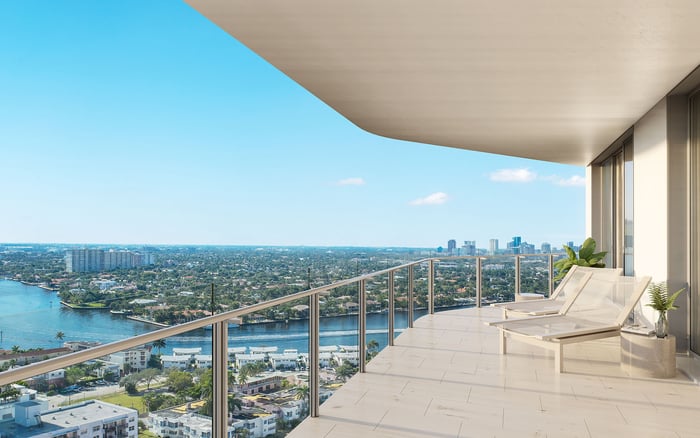
For buyers considering The Ritz-Carlton Residences® Fort Lauderdale, window responsibility is a document-level question. Understanding the distinction between maintenance, insurance, statutory warranties and manufacturer coverage is essential to assessing future claims.

At The Ritz-Carlton Residences® Fort Lauderdale, a buyer’s review of window warranties should begin with something less photogenic than the view: the documents governing the glass itself. For an acquisition of this caliber, knowing who maintains, insures and potentially replaces an exterior component is part of understanding ownership.
Florida’s Chapter 718 provides the general condominium framework of individually owned units and shared common elements. It does not, by itself, establish this property’s recorded ownership arrangements, window classifications or allocation of costs. Those conclusions require review of the applicable declaration and amendments.
The essential distinction is straightforward: maintenance responsibility, insurance coverage, statutory warranties and manufacturer warranties are separate questions. A favorable answer to one does not resolve the others, and none alone establishes whether a future claim will succeed.
Section 718.113 generally places maintenance of common elements with the association. The declaration can, however, assign maintenance of limited common elements to individual owners. For windows and sliding glass doors, the condominium documents are therefore central to determining responsibility.
The question is not simply whether a window serves one residence, but how the documents classify it and allocate maintenance, repair and replacement duties. Ask counsel to identify each obligation separately rather than accepting a blanket statement that windows are an owner or association matter.
In Broward, buyers comparing Four Seasons Hotel & Private Residences Fort Lauderdale should apply the same document-first discipline. Compare the clarity of each property’s obligations; do not assume that residences sharing a hospitality pedigree also share a legal structure.
Request a written responsibility summary tied to the relevant declaration provisions for the closing file. It provides a more precise starting point than an informal explanation of building practice.
An owner’s duty to maintain a window does not automatically determine who must insure it. Florida condominium insurance obligations treat windows and sliding glass doors separately from everyday upkeep. The association’s statutory responsibility to insure these components cannot simply be reassigned through condominium documents because maintenance falls to owners.
That distinction is not a promise that every damaged window will result in an insurance payment. A future claim requires its own review of the applicable coverage and circumstances. Neither an insurance obligation nor a maintenance clause substitutes for that analysis.
Obtain the relevant insurance materials alongside the declaration and have both reviewed without conflating their functions. Ask who performs the work, who initially bears the expense and what potential recovery may exist. These financial questions are related, but a single assumption should not answer them all.
Section 718.113 expressly addresses hurricane protection, including impact glass and code-compliant windows and doors. Its provisions connect maintenance, repair and replacement responsibilities to the declaration and allow board-adopted specifications, including appearance requirements. An individual replacement decision therefore requires more than choosing a product or finish.
The statutory details also make timing important. The 2023 statute includes an exception to the owner-vote requirement for hurricane-protection installation when the declaration already assigns maintenance, repair and replacement to the association. Under the 2024 version, owners generally do not pay to remove and reinstall hurricane protection when necessary for association work on other condominium property, unless the declaration provides otherwise.
These provisions are neither a project-specific authorization nor a current cost guarantee. Counsel should determine which statutory version applies to the relevant work or dispute and read it alongside the governing documents. Request the association’s hurricane-protection specifications before budgeting any window or door changes.
The phrase impact glass should prompt a documentation request, not an assumption about the installed system. Ask for the manufacturer and model, applicable product approvals, any relevant Miami-Dade Notice of Acceptance, test documentation, installation records and inspection sign-offs.
Have a qualified professional compare the approval documentation with the system actually installed. Ask that professional to explain what the records establish, which installation details require attention and whether further inspection is appropriate. A product approval is not a substitute for the warranty agreement or a promise that a future claim will be paid.
For buyers considering The Ritz-Carlton Residences® Pompano Beach alongside Fort Lauderdale options, the same questions belong in each property’s review. A shared brand is not evidence of identical glazing, approvals or warranty terms. Each purchase deserves its own technical file.
Section 718.203 establishes developer warranties for condominium construction and improvements, distinct from a manufacturer’s product warranty. It also establishes warranty obligations involving contractors, subcontractors and suppliers. The developer is therefore not the only potential party for counsel to consider when evaluating a statutory warranty issue.
These warranties have specified durations and commencement rules. The statute’s existence does not establish that a particular residence retains coverage. Routine maintenance also matters: the statutory warranties are conditioned on its performance, except when maintenance is the obligation of the developer or a developer-controlled association.
A manufacturer warranty requires a separate reading. Request the actual agreement and have its coverage, exclusions, notice requirements and any transfer provisions reviewed. Do not infer a particular term, transferability or remaining coverage from a sales description.
The legal provisions relevant to these questions span different years. Counsel should establish the applicable rules and claim deadlines for the installation, loss or dispute rather than rely on a generalized warranty timeline.
Before closing, organize the review into a compact ownership file:
The declaration and amendments, with window classifications and responsibilities identified.
Hurricane-protection specifications and applicable approval procedures.
Actual warranty agreements, installation records and relevant dates.
Product approvals, inspection sign-offs, maintenance records and engineering assessments.
Relevant association financial and insurance materials for professional review.
This is a diligence framework, not a suggestion of existing defects, litigation, inadequate reserves or pending assessments at the property. Its purpose is to distinguish established obligations from expectations before an issue arises.
The strongest purchasing position rests not on an assumption that a future window claim will succeed, but on a clear understanding of the responsible parties, the applicable protections and the records needed to evaluate a claim. For a luxury buyer, that clarity is part of the asset’s appeal.
For a considered approach to South Florida residential ownership, explore MILLION.
If branded residences are on your mind — as a home or as an allocation — we would be glad to share what we are seeing, privately.
Begin a quiet conversationNo. It supplies Florida’s general condominium framework; the applicable declaration and amendments are needed to establish project-specific arrangements.
Responsibility depends primarily on the condominium documents. Section 718.113 generally assigns common-element maintenance to the association, while the declaration can assign limited-common-element maintenance to owners.
Not automatically. The association’s statutory responsibility to insure windows and sliding glass doors cannot simply be reassigned because owners maintain them.
Board-adopted hurricane-protection specifications, including appearance requirements, can constrain replacements. Review those specifications and the governing documents before proceeding.
Under the 2024 version of Section 718.113, owners generally do not pay for removal and reinstallation needed for association work on other condominium property, unless the declaration provides otherwise. Counsel should confirm the applicable rules.
Request manufacturer and model information, applicable product approvals, any relevant Notice of Acceptance, installation records and inspection sign-offs. Have a qualified professional compare those records with the installed system.
No. Approval documentation, warranty terms, maintenance obligations and the circumstances of a claim require separate evaluation.
No. Section 718.203 establishes statutory warranties involving developers, contractors, subcontractors and suppliers, separate from a manufacturer’s product agreement.
No. Statutory durations and commencement rules must be checked, while manufacturer coverage requires review of the actual agreement and any transfer provisions.
Section 718.203 conditions its warranties on routine maintenance being performed, except when maintenance is the obligation of the developer or a developer-controlled association. Records help counsel evaluate that requirement.