The Links Estates pairs detached-home autonomy with a layered island governance model. For buyers who entertain, the decisive details extend beyond architecture to club membership, association rules, catering privileges, security clearance, and ferry or watercraft logistics.

The appeal of The Links Estates at Fisher Island begins with an unusual distinction. The enclave comprises 12 custom single-family estates along the island’s golf course, with a plat approved for 12 single-family residential parcels. On an island where residential inventory is predominantly condominium based, that legal structure meaningfully alters the setting for private life.
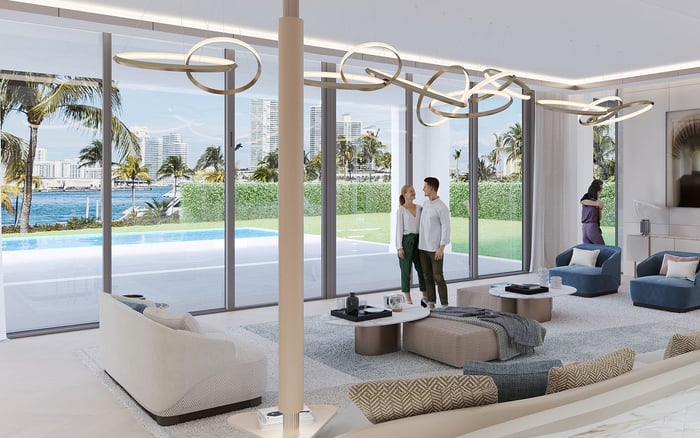
A Links Estates residence is a single-family dwelling, not a condominium unit. Owners therefore have more direct control over the design of dining rooms, kitchens, terraces, service areas, and guest circulation than they typically would in a conventional apartment. That latitude supports a more tailored approach to entertaining, from an intimate chef’s dinner to a larger gathering organized across indoor and outdoor spaces.
Yet detached ownership does not place the residence outside Fisher Island’s broader operating environment. The home belongs to one of the island’s two estate-style homeowners associations, with Valencia Estates as the other. It also remains part of a community where access, hospitality, recreation, and security are closely coordinated.
The privilege of entertaining here depends as much on governance and access as it does on architecture.
The ownership model is best understood through three related but legally separate layers: title to the residence; participation in the Fisher Island Community Association, commonly known as FICA; and equity membership in Fisher Island Club. Acquiring a Links Estates home does not merge those components into a single set of rights.
Fisher Island Club is a private membership club and a legal entity separate from FICA and the individual homeowner or condominium associations. Equity membership is available to Fisher Island property owners, but it remains legally distinct from ownership of the home itself. The club platform provides access to dining, beach facilities, golf, tennis, spa and fitness facilities, marinas, and the Island Market.
For a buyer focused on lifestyle, this separation warrants close attention. The house may provide the physical setting for private hospitality, while the club can supply much of the island’s broader social and service infrastructure. A sophisticated purchase review should examine each layer on its own terms rather than treating island ownership as a universal membership package.
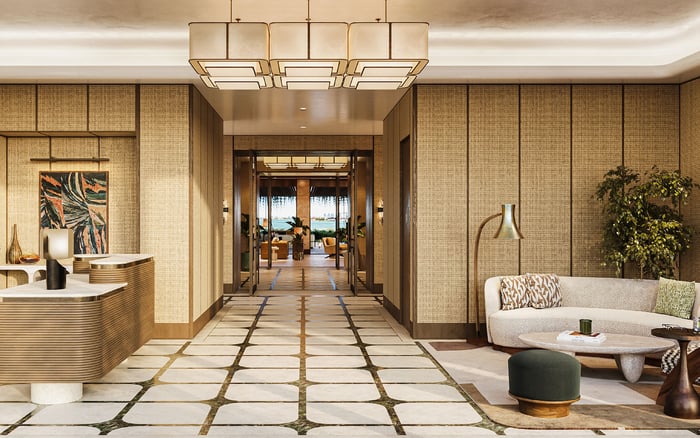
Single-family ownership gives an estate buyer greater latitude to shape an entertaining program around the residence. The relevant questions are practical: Can guests move from arrival to reception without crossing family areas? Is there an appropriate service route between the kitchen and table? Can a private chef or catering team stage discreetly? Do interior and exterior dining zones work together without compromising privacy?
These are design matters, but they also carry operational consequences. A beautifully proportioned dining room is only part of the equation. Back-of-house circulation, delivery timing, waste handling, security coordination, acoustics, and the transition between formal and informal spaces can determine whether an event feels effortless.
Golf frontage provides a distinctive visual context, but it does not supersede association controls or community standards. Owners considering landscape lighting, music, temporary equipment, or outdoor service should confirm what is permissible before designing an event around those elements. Within the Estates & Single-Family category, architectural independence is substantial, but it is not synonymous with unrestricted use.
Private catering for weddings, birthday celebrations, and dinners is a Fisher Island Club membership privilege. Members seeking details or wishing to submit a request must log in to the club website and use the Catered Events area within Restaurants & Dining.
That process has an important implication for prospective owners. Anyone expecting to rely on club-managed catering or private club venues should treat active club membership as central to the entertaining plan, not as an incidental amenity. Homeownership alone should not be assumed to confer access to those services.
Complete event fees, venue capacities, booking lead times, cancellation provisions, and food-and-beverage requirements are not publicly set out. Buyers should obtain the current membership plan and house rules before assuming that a preferred date, venue, guest count, menu arrangement, or outside vendor will be accepted.
This distinction is particularly useful when comparing estate ownership with condominium options such as Palazzo del Sol, Palazzo della Luna, or The Residences at Six Fisher Island. Each may figure in a Fisher Island search, but buyers should assess the governing documents and club relationship specific to the property rather than projecting one ownership model onto another.
At-home entertaining can engage several rulebooks. The Links Estates homeowners association may govern residential matters, while FICA oversees a separate community layer. Club rules apply when club services, venues, or privileges are involved. Each set of documents should be reviewed independently.
Before planning a recurring calendar of dinners or celebrations, counsel should confirm current provisions concerning noise, parking, deliveries, security clearance, vendor access, guest procedures, and any limits on event activity. Club materials should also be reviewed for guest limits, dress standards, outside-vendor permissions, venue availability, minimum spending requirements, and reservation procedures.
This is more than a compliance exercise. Clear parameters allow an owner, household team, event planner, and caterer to create a more polished guest experience. Gated-community protocols work best when arrival information, vendor credentials, delivery windows, and host approvals are resolved well before the first guest leaves the mainland.
Fisher Island is reached by ferry or private watercraft. That controlled arrival is central to its privacy, but it also makes transportation planning integral to every event. Guest timing, staff movement, equipment delivery, and vendor departure cannot be approached as ordinary mainland logistics.
A host should map the full sequence from clearance through arrival at the residence. Service providers may require advance coordination, while guests need precise instructions that preserve both punctuality and discretion. When several vendors are involved, staggered access can reduce friction at the property and help keep service areas composed.
The same planning applies after dinner. Return transportation, late departures, and the movement of hired staff should be addressed before invitations are issued. The result may feel seamless, but that seamlessness is planned.
The most useful pre-contract review brings together legal, membership, design, and operational questions. Request the current Links Estates association documents, applicable FICA materials, the Fisher Island Club membership plan, and current club house rules. Confirm which obligations attach to ownership and which privileges require a separate active membership.
Then test the home against the intended style of hospitality. Review kitchen capacity, service circulation, guest parking arrangements, outdoor acoustics, security interfaces, and vendor staging. If renovations are contemplated, determine which approvals may be required before assuming that a dining terrace, catering kitchen, or revised arrival court can be created.
The Links Estates contact address is 1 Fisher Island Drive, Fisher Island, Florida 33109, but transaction-specific questions should still be resolved through the relevant current documents and qualified advisers. For buyers drawn to golf, privacy, and highly controlled access, the essential insight is straightforward: the estate provides uncommon residential autonomy, while the island’s club-centered ecosystem supplies a separate framework of privileges and protocols.
The Links Estates offers a rare combination on Fisher Island: detached single-family living within a hospitality-rich private island setting. Its entertaining potential is strongest when the owner treats the residence, association structure, FICA participation, club membership, and transportation plan as coordinated but distinct elements.
For discreet guidance on evaluating Fisher Island ownership and entertaining priorities, connect with MILLION.
If branded residences are on your mind — as a home or as an allocation — we would be glad to share what we are seeing, privately.
Begin a quiet conversationNo. It is legally a single-family dwelling within a 12-parcel residential plat.
The enclave comprises 12 custom single-family estates positioned along Fisher Island’s golf course.
No. Property ownership and equity membership in Fisher Island Club are legally distinct components.
No. Fisher Island Club is a separate legal entity from FICA and the island’s individual residential associations.
Private catering for weddings, birthdays, and private dinners is identified as a privilege of club membership.
Members log in to the club website and use the Catered Events area under Restaurants & Dining.
Complete fees, capacity limits, lead times, and cancellation terms are not publicly detailed in the available information.
Review the Links Estates HOA and FICA documents separately, plus club rules whenever club services or venues are involved.
Fisher Island is reached by ferry or private watercraft, so guest, vendor, and service-team arrivals require advance coordination.
It offers more direct control over private dining layouts, service circulation, and in-home entertaining than a conventional condominium residence.